Spectrum Analyzer With 555 Fits In A Tin

[VK2ZAY] has a thing for 555 chips. Before the ready availability of microcontrollers, the 555 was the hardware hacker’s swiss army knife. After all, even though the chip is supposed to be a timer, it is really a bunch of simple pieces you can use to make a timer: a pair of comparators, a few transistors, and a flip-flop. You can use those parts in many different ways, and a timer is just one of them.

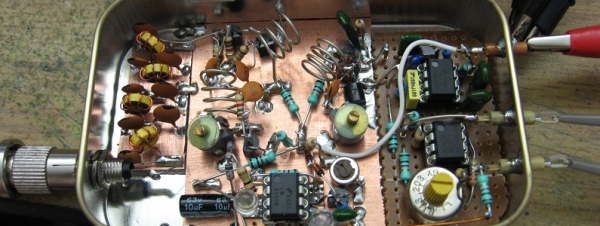
[VK2ZAY] used one as a key component in a simple spectrum analyzer. The 555 generates a ramp voltage which alters the frequency of an oscillator. The oscillator mixes with the input signal and a fixed-frequency superregenerative detector creates an output voltage proportional to the input signal strength. You can see a video of the whole setup, below.
Continue reading “Spectrum Analyzer With 555 Fits In A Tin” →

High Impedance Headphones? They’re In The Can!

[George Trimble] likes to build crystal radios. The original crystal radio builders used high impedance headphones. In modern builds, you are as likely to include a powered amplifier to drive a speaker or normal headphones (which are usually around 4 to 16 ohms).

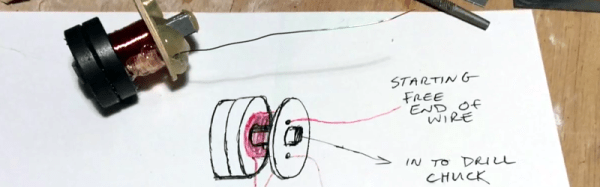
[George] builds his own speakers using chile cans, some wire, a few magnets, part of a Pepsi can (we are pretty sure someone will leave a comment that Coke cans sound better), and the iron core out of an audio transformer. You can see a very detailed video of the process, below.

There is a little woodworking and hot gluing involved. The result is decidedly homemade looking, but if you want to say you built it yourself (or, if you are a prepper trying to get ready to  rebuild after the apocalypse and you can’t find a cache of headphones) this might be just the ticket.

Most of the headphone hacks we see start with a pair of headphones. That’s a bit tautological, but the goal is usually to add features, not make the whole thing. It does give you some hacker cred, though, to be able to look at the other guy’s radio and say, “Oh. I see you used commercial headphones.”

Continue reading “High Impedance Headphones? They’re In The Can!” →

Wilderness Radio Build

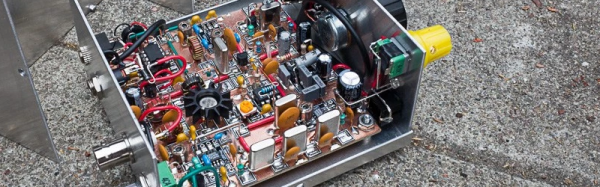
[AA7EE] is no stranger to building radios. His latest is a from-scratch build of a 20 meter QRP transceiver based on the popular SST design. Although the SST has been available as a kit, [AA7EE] incorporated some design changes from others and some of his own, too. He even added an onboard keyer to simplify operation. You can see videos of the radio below.

The build uses Manhattan-style PCB pads. Although the construction is very attractive, the real value of the post is the detailed explanation of not only how, but why everything is the way it is. This isn’t a simple project, and being able to see it completed step-by-step is very educational. About the only decision not adequately explained was the change of red and yellow knobs to black! You can see both versions in the videos below.

The Manhattan construction is tidy, but the radio also has an attractive case. The size is just big enough to stack a pair of paddles on top.

There may be some more enhancements for the little radio coming. We’ve covered [AA7EE’s] RF exploits before, including a physically attractive radios and details about the same construction method used in this radio.

Continue reading “Wilderness Radio Build” →

High Performance Crystal Radio

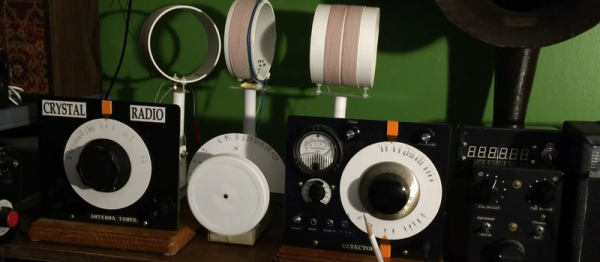
When you think of a crystal radio, you probably think of something simple maybe built out of household scraps. Not if you are [Chris Wendling]. He recently posted a video (see below) of his high-performance crystal set. He doesn’t take any shortcuts: he has several hundred feet of antenna wire, and uses a cold-water pipe ground system. With no amplifier, a strong signal input is crucial.

The radio has four subsystems: an antenna tuner, a bandpass filter, a detector, and a powered audio output system. He also has a truly enormous system of speakers on the ceiling–this isn’t the crystal radio you made in the boy scouts.

Continue reading “High Performance Crystal Radio” →

Yet Another Inductance Measuring Scheme

How do you measure the value of an unknown inductor? If you have an LCR bridge or meter, you are probably going to use that. If not, there are many different techniques you can use. All of them rely on the same thing my Algebra teacher Mr. Harder used to say back in the 1970’s: you have to use what you know to get what you don’t know.

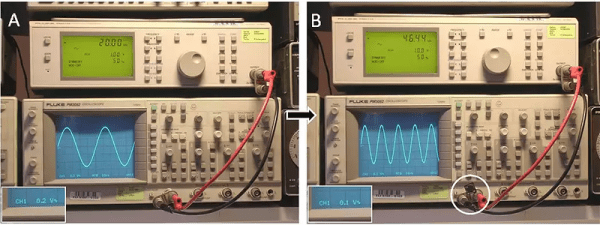
[Ronald Dekker] must think the same way. He took a 50-ohm signal generator and a scope. He puts the signal output to about 20kHz and adjusts for 1V peak-to-peak on the scope. Then he puts the unknown inductor across the signal and adjusts the frequency (and only the frequency) for an output of 1/2 volt peak-to-peak.

Continue reading “Yet Another Inductance Measuring Scheme” →

Custom Gaming Keypad Developed With PSoC And Fusion 360

There was a time when building something yourself probably meant it didn’t look very much like a commercial product. That’s not always a bad thing. We’ve seen many custom builds that are nearly works of art. We’ve also seen plenty of builds that are–ahem–let’s say were “hacker chic”.

[AlexanderBrevig] decided to take on a project using a PSoC development board he picked up. In particular, he wanted to build a custom game keypad. He prototyped a number of switches with the board and got the firmware working so that the device looks like a USB HID keyboard.

Continue reading “Custom Gaming Keypad Developed With PSoC And Fusion 360” →

Robotic Arm From Cardboard

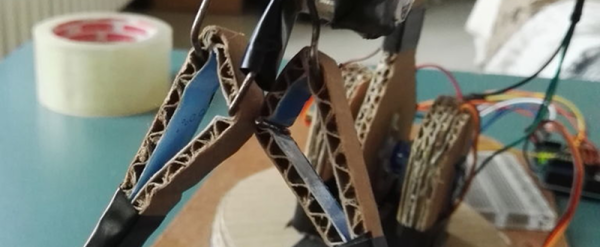
Google showed the world that you could make a virtual reality headset from cardboard. We figure that might have been [Uladz] inspiration for creating a robotic arm also made out of cardboard. He says you can reproduce his design in about two hours.

You’ll need an Arduino and four hobby servo motors. The cardboard doesn’t weigh much, so you could probably use fairly small motors. In addition to the cardboard, there’s a piece of hardboard for the base and a few metal clips. You can control it all from the Arduino program or add an IR receiver if you want to run it by remote control. There’s a video of the arm–called CARDBIRD–in action, below.

Continue reading “Robotic Arm From Cardboard” →