Cheap Electric Scooter Gets A Big Brake Upgrade; Unlocks Proper Drift Mode

The last few years have seen a huge rise in the prominence of electric scooters. Brushless motors, lithium batteries, and scooter sharing companies have brought them to the mainstream. However, electric scooters of a variety of designs have been around for a long time, spawning a dedicated subculture of hackers intent on getting the best out of them.

One such hacker is yours truly, having started by modifying basic kick scooters with a variety of propulsion systems way back in 2009. After growing frustrated with the limitations of creating high-speed rotating assemblies without machine tools, I turned my eye to what was commercially available. With my first engineering paycheck under my belt, I bought myself a Razor E300, and was promptly disappointed by the performance. Naturally, hacking ensued as the lead-acid batteries were jettisoned for lithium replacements.

Over the years, batteries, controllers and even the big old heavy brushed motor were replaced. The basic mechanical layout was sound, making it easy to make changes with simple hand tools. As acceleration became violent and top speeds inched closer to 40 km/h, I began to grow increasingly frustrated with the scooter’s one glaring major flaw. It was time to fix the brakes.

Continue reading “Cheap Electric Scooter Gets A Big Brake Upgrade; Unlocks Proper Drift Mode” →
Mix And Match Parts To Build A Better Mountain Bike Derailleur

Mountain bikers take their sport seriously, and put their bikes through all manner of punishment in the course of a ride. This has given rise to a wide range of specialist equipment, such as suspension, disc brakes and even clutch derailleurs, which help reduce chain slap when riding over rough terrain. However, these specialist derailleurs aren’t available for all applications, so sometimes you’ve gotta hack together your own.

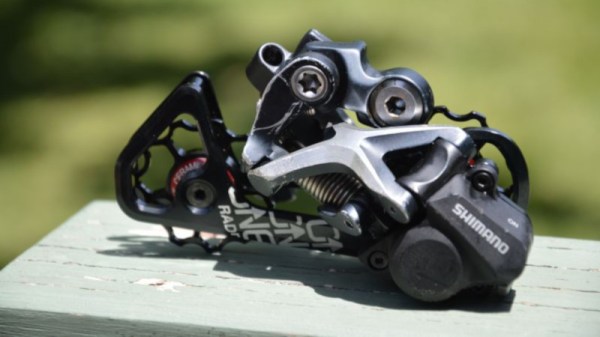
Shimano clutch derailleurs are only really available for 10-speed rear cassettes and up, due to a change in derailleur ratio compared to the earlier 6 to 9 speed cassettes. Using a derailleur designed for 10-speed operation on a rear cassette with fewer gears won’t shift properly.

[SzurkeEg] was inspired by earlier work, and realised that by combining parts from several generations of Shimano hardware, it was possible to build a working clutch derailleur for 6 to 9 speed rear cassettes. The main parallelogram is what handles the positioning of the derailleur, and is sourced from a 9-speed part to get the gear indexes correct.The rest of the parts are sourced from later models with the clutch feature built in.

It’s a smart mechanical hack, and one that isn’t necessarily the most intuitive. But by having a go, and seeing what’s possible, now a whole generation of mountain bikes can tear up the trail like never before. We’ve seen Shimano gear hacked before, too. Video below the break. Continue reading “Mix And Match Parts To Build A Better Mountain Bike Derailleur” →

EL Wire Makes For A Great Faux-Neon Sign

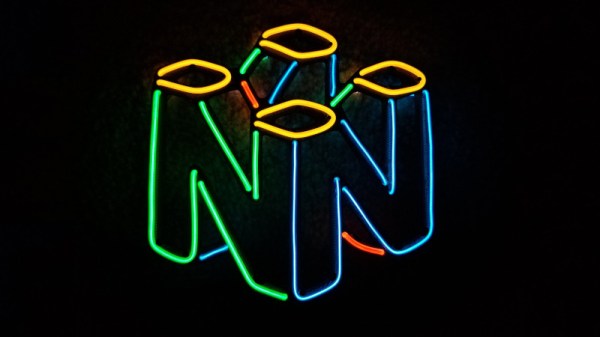
Neon signs are attractive, but require specialised tools and skills for their manufacture. If you don’t have time to learn glass blowing and source the right gasses, you’re pretty much out of luck. However, EL wire can give a similar aesthetic, and with an off-the-shelf power supply it is easy to hook up and get working. [sjm4306] combined this with 3D printing for a quick and easy build.

The project starts by selecting a Nintendo 64 neon sign as a basis for the design. An image of the sign was traced in Inkscape, and an outline imported into CAD software. From there, a frame was designed with posts for the EL wire to wrap around, and holes for it to pass through to the back of the sign. The frame was then 3D printed, and laced with EL wires in the requisite colors.

The final result is impressive, with the EL wire serving as a great small-scale simulacrum of neon tubes. It’s a construction method that should scale as large as your 3D printed assemblies can go, too. If you need to get to grips with how it works, there’s a tutorial available for working with EL wire. Video after the break.

Continue reading “EL Wire Makes For A Great Faux-Neon Sign” →

Eric Weinhoffer Covers Enclosure Design And Manufacturing Tech During Hackaday Prize Mentor Session

Eric Weinhoffer has had plenty of experience in the product design arena, and this hard-earned knowledge is readily apparent in his mentor session for The Hackaday Prize. These serve to link up Prize entrants with industry experts in order to help them take their projects into production. You still have time to get in on the 2019 Hackaday Prize which is accepting entries until August 25th.

Eric’s work as a Prototype Engineer at Bolt stands him in good stead to deliver valuable advice on manufacturing techniques and prototyping. With projects as diverse as CNC milling machiness and ISS payloads under his belt, Eric was able to help out these entrants with a series of tricky problems that will be familiar to anyone who has tried to take a project out of the lab and into the market.

Let’s take a look at the projects and the advice that were shared during this session.

Continue reading “Eric Weinhoffer Covers Enclosure Design And Manufacturing Tech During Hackaday Prize Mentor Session” →

Putting Carbs On A Miata, Because It’s Awesome

Carburettors versus electronic fuel injection (EFI); automotive fans above a certain age will be well versed in the differences. While early EFI systems had their failings, the technology brought with it a new standard of reliability and control. By the early 1990s, the vast majority of vehicles were sold with EFI, and carburettors became a thing of the past.

The Mazda Miata was no exception. Shipping in 1989, it featured not only multiport fuel injection, but also a distributorless ignition system. Consisting of two coilpacks in a wasted spark configuration, with computer-controlled timing, the system was quite advanced for its time, especially for a budget sports car.

Despite the Miata’s technological credentials, those in the modified car scene tend to go their own way. A man by the name of Evan happened to be one such individual and decided to do just this — scrapping the EFI system and going with a retro carburetor setup. It was around this point that this I got involved, and mechanical tinkering ensued.

Continue reading “Putting Carbs On A Miata, Because It’s Awesome” →

Disappearing Writing With UV Laser Reveals Whitening Agents In Myriad Products

Many a budding maker has experimented with invisible inks, with a wide variety of solutions having a viable set of properties for this purpose. However, [Ben Krasnow] stumbled upon a different method entirely when tinkering with a UV laser.

The effect is subtle, but remains visible for several minutes.

The laser in question was a MNL100 UV laser, configured to produce nanosecond-scale 20 kW pulses at up to 24 Hz, operating at wavelength of 337 nm, deep in the ultraviolet. After piping the laser light through an optical fiber and aiming it at some regular white paper, dark marks were observed, which disappear without a trace over the course of a few minutes.

Upon investigation, the dark marks seemed to be the result of fluorescent whitening agents in the paper. It appears they are overloaded or otherwise changed chemically by the laser, and slowly return back to normal over time. Further experiments showed that hydrogen peroxide was able to remove the marks instantly, and an argon atmosphere slowed the rate at which the marks faded.

It’s an interesting look at an odd chemical effect, with the benefit of a well-equipped optics lab to analyse what’s going on. Following the phenomenon down the rabbit hole leads to some tips on how to extract fluorescent additives from common laundry detergent. Be it paper, plastic, or textile, if it looks really bright white to your eye it probably contains stilbene organic compounds as optical brighteners, a hidden trait you never actually thought about before. Video after the break.

Continue reading “Disappearing Writing With UV Laser Reveals Whitening Agents In Myriad Products” →

A Trillion Trees – How Hard Can It Be?

Data from 2016 pegs it as the hottest year since recording began way back in 1880. Carbon dioxide levels continue to sit at historical highs, and last year the UN Intergovernmental Panel on Climate Change warned that humanity has just 12 years to limit warming to 1.5 C.

Reducing emissions is the gold standard, but it’s not the only way to go about solving the problem. There has been much research into the field of carbon sequestration — the practice of capturing atmospheric carbon and locking it away. Often times, this consists of grand plans of pumping old oil wells and aquifers full of captured CO2, but there’s another method of carbon capture that’s as old as nature itself.

As is taught in most primary school science courses, the trees around us are responsible for capturing carbon dioxide, in the process releasing breathable oxygen. The carbon becomes part of the biomass of the tree, no longer out in the atmosphere trapping heat on our precious Earth. It follows that planting more trees could help manage carbon levels and stave off global temperature rises. But just how many trees are we talking? The figure recently floated was 1,000,000,000,000 trees, which boggles the mind and has us wondering what it would take to succeed in such an ambitious program.

Continue reading “A Trillion Trees – How Hard Can It Be?” →