With only two space stations in orbit around Earth today in the form of the International Space Station and the Chinese Tiangong (‘Sky Palace’) station, it’s easy to forget how many space stations were launched in the previous century. And the Soviet Union launched by far the most, as part of the Salyut (Russian for ‘salute’ or ‘fireworks’) program. Although the program entailed both military (Orbital Piloted Station, or OPS) and civilian (Durable Orbital Station, or DOS) stations, it was the civilian stations that saw the most success, as well as the most daring rescue attempt with the recovering of the Salyut 7 space station.
Salyut 7 (DOS-6) was set to repeat Salyut 6’s success after its launch on April 19th 1982, until disaster struck in February 1985. Due to a series of electrical and other faults ground communication with the space station was cut off, and the at the time unmanned space station began to gradually tumble towards the Earth’s atmosphere. This left those in charge with two options: leave the station to burn up in the atmosphere, or stage a rescue mission.
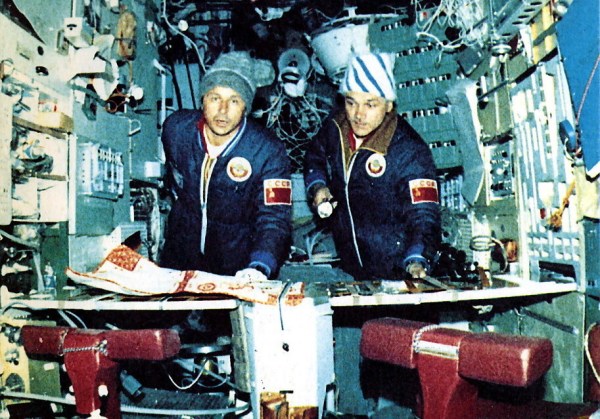
Ultimately, on June 6th, 1985, Soyuz T-13 launched to rendezvous with Salyut 7. On board were cosmonauts Vladimir Dzhanibekov – who had previously manually docked with Salyut 7 – and Viktor Savinykh. Both men had done all they could to perform a manual docking and attempt to revive the stricken space station. Ultimately they managed to revive the station using what little charge was left in its batteries and the Soyuz’s thrusters, all the while braving freezing temperatures in the dead station’s interior.
Salyut 7 would continue to perform its duties until February 1991, with Mir (DOS-7, launched 1986) as the first modular space station taking over. The final DOS module (DOS-8) that directly traces its lineage to this era is still in orbit today as the ISS’ Zvezda module, keeping the Salyut legacy and the bravery of Dzhanibekov and Savinykh alive.