Building An Analog Meter Watch

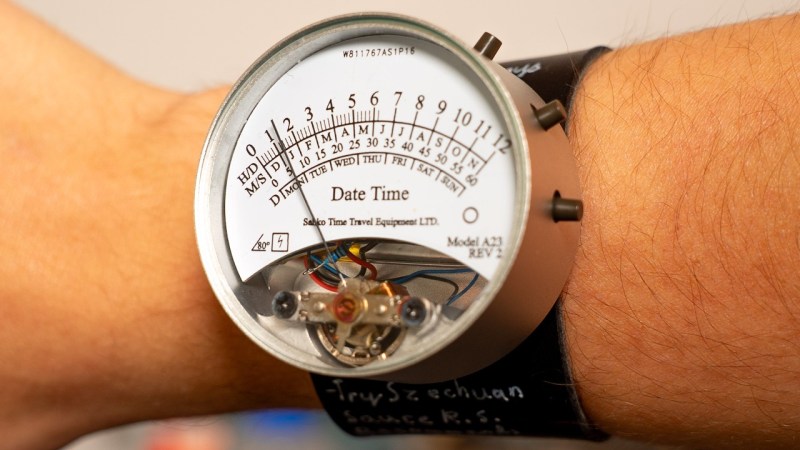
Most conventional analog watches have two or three hands, covering hours, minutes, and seconds (where present). [Sahko] has built a different kind of analog watch that creatively displays the time with just one. 

The build is based around a simple analog coil meter, which, at its heart, just sweeps its needle across a scale based on the voltage input to the device. A Raspberry Pi Pico is employed to drive the meter through a digital-to-analog converter. Pressing the buttons on the outside of the device tells the watch to display hours, minutes/seconds, or the current month or day of the week. With a single needle, only one parameter can be displayed at a time, but that’s just a compromise you accept for having a cool unique analog dial watch.

Another cool touch in the design is that the dial backer isn’t just a printed piece of paper—it’s a custom PCB, which has a much nicer, hardier finish. The case of the watch is also CNC milled out of aluminum and bead blasted for a quality surface finish, adding a nice industrial touch to the build.

This is a great example of a custom watch with quality fit and finish. The attention to detail really pays off in terms of feel. We’ve seen other watch projects use similar construction techniques before, too.


Continue reading “Building An Analog Meter Watch”

Amazing Stories

The 2026 installment of Hackaday Europe was last weekend, and I’m still basking in the warm glow of hanging out with such an inspiring group of hackers. It’s hard to emphasize how important it is, maybe especially for those of us on the inside of Hackaday, to get to nerd out together like that. While we do our best to present your stories on our pages, there is just no substitute for getting to talk about projects, hacks, and dreams in real life.

While we can’t bring you all of the side-conversations that took place, we did manage to get the talks recorded, and we’ll be writing them up shortly. We have some bad news on that front, though: due to a technical limitation with the setup that the university had in place, we only got the audio and slide feeds, and not the camera that should have been filming the presenters. Still, we have a record of most everything that went down on the main stage, so stay tuned.

We know that not everyone can make it out to either Supercon or Hackaday Europe, but we heartily recommend keeping your eyes out for local hacker events near you. This weekend, there’s Open Hardware Summit in Berlin, for instance. If you’re near NYC, there’s HOPE coming up in August. If your tastes run more toward retrocomupting, there might be a Vintage Computer Festival chapter near you. Heck, consider looking into some of the more mainstream events as well, if that’s what is in your neighborhood.

It’s definitely more of an effort to get out to an event in the physical world, but the connections you make with fellow hackers are absolutely worth it. Any events that we should know about?

Water-cooling A 3D Printed Rocket Isn’t Quite Practical

Consumer-grade 3D printers are useful for lots of things, but they kind of fall down when it comes to making stuff that survives high temperatures. [Mr. More Gooder] wasn’t deterred from a rocket build using FDM printed parts though, instead relying on water cooling to try and beat this practical limit.

The concept is simple enough—[Mr. More Gooder] printed a propane-burning combustion chamber and nozzle out of plastic that you’d totally expect to melt when the flames started. Thus, the nozzle was given fittings to allow water to be continually pumped through to try and drag away enough heat to let the rocket survive more than a few seconds. Unfortunately, during testing the uncooled combustion chamber quickly melted. A redesign with water cooling throughout performed a little better, until the water jacket began to leak into the main chamber and extinguished the flames. Melted plastic could be seen dripping out of the nozzle shortly after ignition, too.

Even if the nozzle did hold up for a longer period of time, it’s worth noting this is probably not a viable route towards a flight-ready engine. Mostly because you would need a huge supply of water to keep the components cool which would add a great deal of weight to any such build. There’s a reason NASA doesn’t recycle old drink bottles to make rocket engines, after all.

In any case, we love to see all sorts of rocket experiments, even the unsuccessful ones.

Continue reading “Water-cooling A 3D Printed Rocket Isn’t Quite Practical”

Unitree GO-M8018-6 Motor Reverse Engineering

People seem to be rather into the Unitree Go2 quadruped robot, if only for the low price tag. But perhaps more interesting are the motors that propel it — they appear to be similar to the Go1’s GO-M8010-6 motors that Unitree also sells, with [Thomas Flayols] currently working on reverse-engineering its proprietary driver using the publicly available documentation for that motor and some reverse-engineering.

These motors are an assembly that includes a reducer, magnetic encoder, 3-phase inverter, current sensing, an RS-485 bus and a Cortex-M0-based CMS32M57xx MCU, all in a very capable package intended for robotics applications where a compact actuator is needed.

The first step of reverse-engineering involved the physical PCB, made all the more difficult as Unitree was so kind as to remove all markings on the ICs. Fortunately using an X-ray machine and some sleuthing it was possible to deduce the MCU and other components. Following this SWD/OpenOCD access to the MCU could be established and the firmware key extracted from the bootloader SRAM.

Although the firmware was encrypted, a locally recovered key was found to decrypt it. This allowed for an initial custom firmware to be developed, which [Thomas] hopes to develop into a fully featured open source firmware. Doing so would obviously open these motors to a larger audience outside of Unitree’s ecosystem, as they are pretty good value for what they offer mechanically.

It might give the associated Go2 robot a new life too considering the serious malware accusations and security issues pertaining to its firmware.

The Team Behind The Flipper One Needs Your Help

You’ve probably heard of the Flipper Zero, a pocket-sized device that packs in lots of great hacking potential. The team behind it has now turned their efforts towards developing the Flipper One, and they’re calling out for help from the broader community. 

The Flipper One is not intended to be a replacement or sequel for the Flipper Zero. Instead, it’s designed to exist as a entirely new device in its own segment. The team is hoping to build “the most open and best-documented ARM computer in the world,” as they attempt to create a Linux cyberdeck of grand capability. Where the Flipper Zero has found great use for interrogating and investigating low level communications, like IR and NFC, the Flipper One is intended to go to a higher level, working with protocols like Wi-Fi, 5G, and Ethernet in the networked world.

The new device will be based around a co-processor architecture, where a microcontroller is paired with a capable CPU for great flexibility. It will also feature all the high-speed interfaces you’d expect, like PCI Express, USB 3.0, SATA, and Gigabit Ethernet. It’s a proper, capital-C Computer in that regard. The intention of the team is also to redefine some of the typical Linux experience, by creating GUI wrappers around certain traditional CLI utilities. It should go a long way to giving the software the same cyberdeck feel that the current prototypes embody in their hardware design.

If you want to learn more and get involved, head over to the Flipper One Development Portal and dive in. Alternatively, you might like to get up to speed with some of our prior reporting on the Flipper Zero. Happy hacking!

[Thanks to Andrew for the tip!]

The Maths Behind A Chord Recognition Engine

A key part of any tertiary musical education is learning about all the wonderful (and less wonderful) types of chords out there. Typically this involves a great deal of exercises involving the identification of a given chord from its component notes. But how would you do this programmatically? Well, thankfully, the developers behind the WhatChord tool are happy to explain just how it’s done.

The problem with classifying chords is that the way musicians use them and construct them can be quite varied. Names can also be applied somewhat differently depending on the musical context of a given set of notes. To suit the musical reality of real players and composers, WhatChord uses a specially-developed scoring algorithm to try and nut out what a chord is actually supposed to be.

As an example, a major chord must require a root note and a major third interval. It can optionally include a perfect fifth. However, if there is a minor third, minor seventh, or major seventh present, then you’re almost certainly not looking at a simple major chord. WhatChord takes these things into account by weighting the different tones present and seeing which chord gets the highest score. The required notes add weight, while notes that shouldn’t be there add a penalty to the score. Then there are extra penalties for ambiguous “unexplained” tones, extensions, and a few other parameters to disambiguate edge cases.

If you’d like to see how it works in practice, you can check out the WhatChord app and see how good it is for yourself. Alternatively, explore some of the other chord-focused projects we’ve featured over the years, or send your best musical projects into the tipsline.

[Thanks to baschwar for the tip!]

Low Head Turbine Generates Plenty Of Power

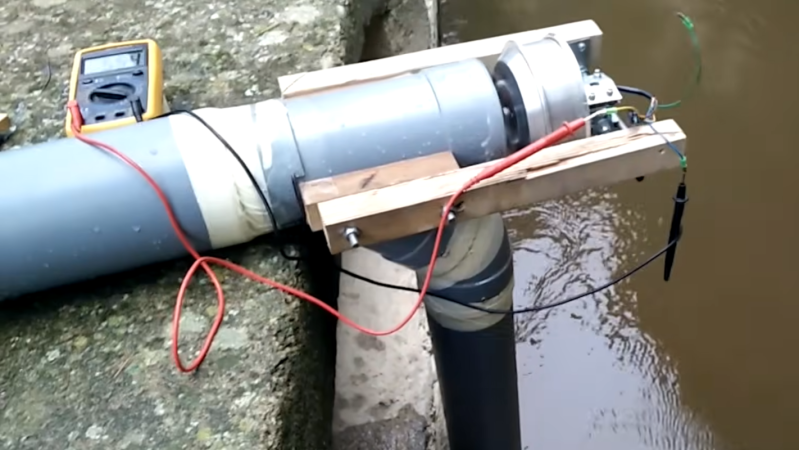
Engineering design makes all kinds of tradeoffs. Power trades off with torque, strength trades off with weight, and cost can trade off with quality. For designing a hydroelectric turbine, one of the main tradeoffs is hydraulic head with flow rate. Many large dams meant for bulk power generation will go with high head (or medium) designs, and for small dams with low head it’s usually not cost effective to build any generation. But if you’re really determined, you’ll want to build a low head water turbine like this one.

The build aims to use easy-to-find materials and simple tools. It uses 110mm and 160mm PVC pipe to not only siphon water up and over a dam, but to house the turbine as well. The turbine is built from a computer fan and sits inside the pipe with a shaft running through a Y-type fitting to the generator. The generator is built from a scavenged hoverboard wheel, and outputs a reported 3.3A DC at 60V for around 200 watts of power with only around 3m of head. The design allows the turbine to be placed at the point in the pipe that best suits the environment.

[OpenSourceLowTech], the creators of this project, make a compelling case that this build is cheaper than a 150W solar panel and it might even be able to produce more energy as well over certain timeframes, provided there’s a reliable source of water available and the owners of the dam don’t mind someone siphoning water over it continuously. The build video is worth a watch as well if for nothing else than the animation, which documents the build in excellent detail. Generating usable energy from hydropower doesn’t even need this big of a dam; if all you need is to charge your phone this tiny waterwheel will get the job done.

Thanks to [Keith] for the tip!

Continue reading “Low Head Turbine Generates Plenty Of Power”