Time Never Moves Slowly With This Clock

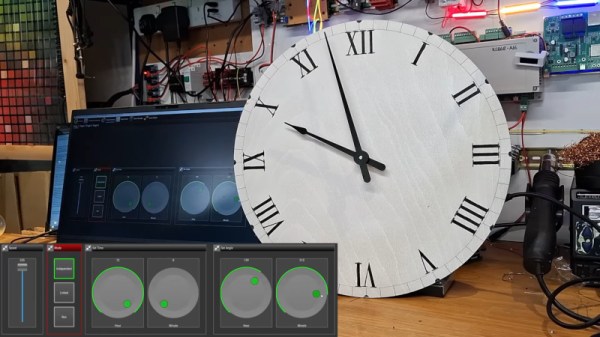
A clock is by its very nature a device for measuring time, and thus it moves forward at a constant rate. But how about in a theatrical setting, where time runs at the whim of the director? For the stage, a clock with more flexibility is required. To this endeavor [Playful Technology] has you covered, with a larger than life stage clock whose hands are independently controllable by DMX.

Behind the clock is a very unusual part, not the modified clock mechanism one might expect, but a dual stepper motor with a concentric shaft. This is driven by an Arduino with a stepper driver shield more familiar from the world of 3D printers, and an RS485 interface for DMX interfacing. The hands are built in OpenSCAD, and 3D printed to be an interference fit on the shafts. The DMX controller software has a handy rotating knob style interface, allowing easy hand manipulation.

You can see the results in the video below, complete with an exhaustive dissection of the Arduino code. Meanwhile DMX is itself a fascinating subject, and in the past we’ve taken a deep dive into RS485.

Continue reading “Time Never Moves Slowly With This Clock”

Yesterday’s Technology, Re-engineered Today

Watching [sprite_tm]’s build of a handheld 486-based gaming computer, we got to thinking about retro computers and the eternal questions of how much of the computer needs to be actually “old” for it it be retro. Where is the soul of a retro computer? The CPU? The old yellowing plastic case? Maybe it depends on what you’re trying to get out of the hobby.

There is of course a spectrum of people playing around with old computers. For some people, let’s call them “vintage computer enthusiasts”, half of the fun is in keeping the actual old hardware running. This group tends to know what teletype lubricant smells like, and how to tell which capacitors need replacing.

For others, “team retro”, the joy is in using the machine itself, whether that be teaching the old dogs new tricks, or simply loading up nostalgic video games. Team retro is more content with emulations or emulations that are wrapped up neatly in hardware workalikes. They know which registers need POKEing, and whether or not Commander Keen is running at the right framerate.

I think [sprite_tm]’s project falls in with yet another camp, the retro-reengineers. Here, the idea is to step through the engineering lessons of the past by re-designing something from a bygone era. So when [sprite_tm] went with a period 486 CPU backed up by a modern FPGA, perhaps ironically borrowing code from the modern MiSTer project, it makes sense for his goals. Retro-reengineers know the bus architecture and the memory timings, and they are reinventing the wheel as a learning experience. Or in the case of [Voja Antonic]’s imaginary four-bit machine, it’s a teaching experience.

How you work often reflects what you’d like to get out of the project, and at Hackaday, of course, we love all of the above! We’ve identified at least three broad schools of fooling around with old computers. Are we missing any?

Five Solar Air Heating Methods Tested

For as good as solar panels are at converting sunlight directly into usable electricity, especially for how cheap they’re becoming, they can still only gather around 20-30% of the energy that hits them. That’s fine if you have a large roof or a huge tract of land, but if you have limited space and need to do something like heat a home, there are better options available to capture more of that energy. [Greenhill Forge] has built five solar air heating panels to test this concept, and do it much more inexpensively than commercial options.

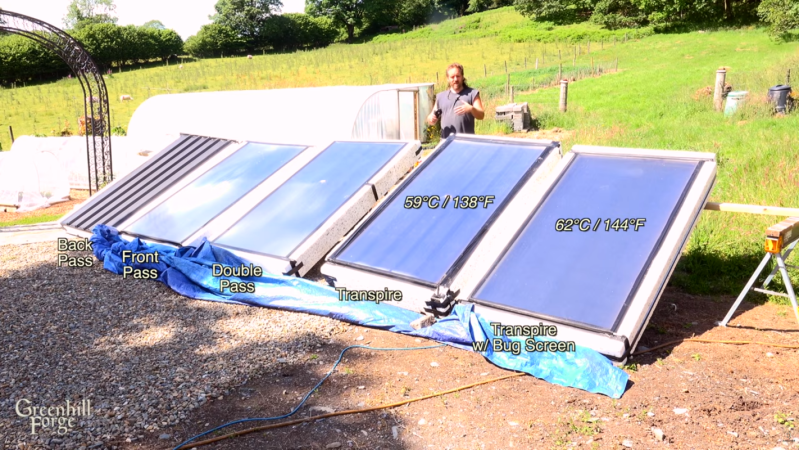
These solar heaters use sunlight to heat a fluid, in this case air, and move that heated fluid to another space. Each panel is about two square meters, insulated on all sides except the top, and configured in a way that air can flow past something that the sun has heated. The first panel, a control, does not use a glazing to help trap this heat, but the rest all have a polycarbonate window to increase the greenhouse effect of the panels. The four remaining all experiment with the way air flows around a black corrugated steel sheet to gather more of the heat, with the fifth panel using a set of black screen instead.

With the panels all set out in the sun, [Greenhill Forge] is using a set of thermocouples from a previous project to measure the efficiency of each panel. Surprisingly, he found that the panel using the layers of screen was the best at gathering energy, although he notes several times that these types of panels are extremely sensitive to changes in physical configuration, so this is not the most definitive test possible. However, at only around $100 per panel it’s quite a deal if the goal is a usable space heater that doesn’t use any fuel or grid electricity.

Continue reading “Five Solar Air Heating Methods Tested”

Warp Point: A Web Ring For Gaming Sites Built For 2026

At one point in time web rings were one of the best ways to find content on the World Wide Web — involving not just a directory of participating sites, but also each site linking to each other in a ring-like fashion. With search results these days becoming increasingly less useful, having such a focused resource sounds better and better, with the Warp Point directory and web ring now doing just that for video game websites. Topics range from reviews to retro gaming and game development, so there’s probably something for everyone here.

For the reasoning behind this effort take a look at this article by [Wes Fenlon] and [Matt Sayer]. The inspiration was part nostalgia and part longing for the return of a simple system that Just Works™ without algorithms, advertising, ‘AI’ and corporate overlords involved at any point in time. Everything is just focused on helping you find the content and community you were looking for as quickly as possible, though spending a few hours just clicking through the ring is also perfectly fine.

Everyone is free to submit their own awesome site to Warp Point, after which it’ll be manually reviewed. Even if not strictly curated, it would seem to be a refreshing return to a more simpler time, using an approach that should still hold up just as well as it did in 1999.

Although the big commercial web directories like those on Yahoo! quickly became unwieldy and unusable, there’s a lot to be said for having these small, focused web directories and rings to regain that sense of community and humanity that’s become so scarce on the WWW in 2026.

Building A Wireless Fingerprint Authorization Device

Once upon a time, there was a bit of a fad for fingerprint authentication in laptops and desktop computers. It has long since faded, but [superdog] wanted just such a device for Linux and Mac machines. Thus, it was time to build one.

[superdog] designed the device, nicknamed immurok, as a tool for people who use external keyboards, and do lots of terminal work on Mac and Linux machines. Repeat password requests can interrupt one’s flow when hustling at the keys, so immurok was designed to ease this pain.

The device is based on a WCH CH592F microcontroller, which comes with Bluetooth connectivity out of the box. This allows immurok to connect wirelessly to the machine of your choice, advertising itself as a standard Bluetooth HID keyboard device. Fingerprint-wise, scanning is done with an R559S capacitive sensor, which verifies the match locally so there’s no transmitting biometric data anywhere. On the computer side, Linux is setup to use a CLI/TUI app plus PAM integration to handle authorization for system logins and sudo in the terminal. On the Mac platform, it’s used with a menu bar app, with PAM integration for admin prompts. There’s also a separate helper path for using it with the lock screen.

If you’re sick of entering your password all the time and wish unlocking your PC was more like unlocking your phone, this might be the project for you. We’ve seen similar projects before, too. If you’re whipping up fun gear for biometric auth, don’t hesitate to let us know on the tipsline.

Microdistillery For Microchemistry

Much like radio operators being encouraged to use the least possible amount of power to make a contact, chemists have a similar rule encouraging using the least amount of materials in experiments. Not only is this rooted in economics, but in safety as well; if something goes wrong it’s generally good if there’s not excess amounts of reactants. With modern techniques, though, it’s possible to bring experimental chemistry down to incredibly small scales, and [Marb’s lab] found that they needed a custom built still for these new, diminutive experiments.

The first step is to build the heating component of the still. This is provided with a few custom aluminum parts for the base and a pair of heaters originally meant for 3D printers, with the assembled unit wrapped in insulation. The heater accomodates a 25 mL round-bottom flask. Temperature control of the heating mantle is provided by a controller mounted to a DIN rail which receives power from a 24V power supply, and an additional temperature probe is added to measure the temperature of the distillate. A test run with water shows the small still quickly and efficiently evaporating the water up to a condenser.

Although building a still doesn’t have to be technically difficult, building something this small that’s effective and safe is a bit more challenging than a backyard moonshining operation. Scaling chemical reactions down can often be a challenge but is possible with the right mindset and equipment. We’ve seen miniaturization of many things that we might not have expected including hydrogen production, aluminum smelting, and even the construction of a microscope.

Continue reading “Microdistillery For Microchemistry”

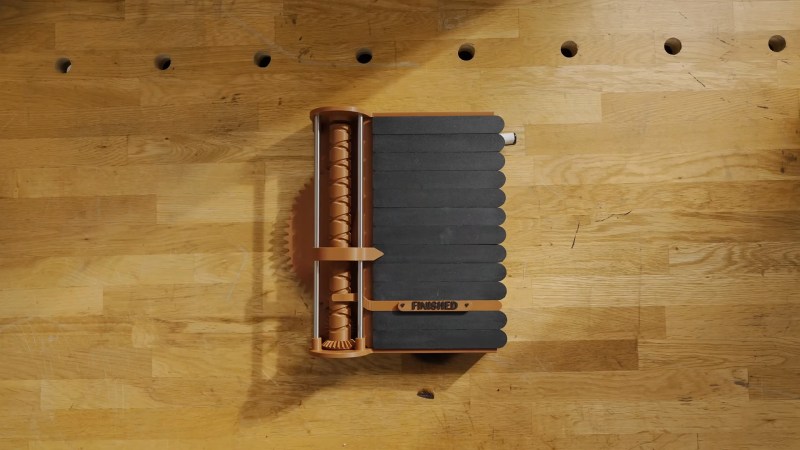
A device with a brown plastic gear cylinder and indicator on the left and a series of black pieces approximately the size of tongue depressors sits on a butcher block workbench. A thin brown divider with the word "Finished" sits between sets of the presumably chalkboard tongue depressors.

A New Twist On The To Do List

Humans are odd creatures, and no two are exactly alike, which is likely why so many different methods exist for tracking the progress of tasks that must be accomplished. [Simone Giertz] has graced us with her own spin on task tracking that adds an element of chance.

[Giertz] tells us that she started with written lists that she tackled in dice-determined order to keep her from overthinking or cherry-picking tasks. While this worked fine, she longed for a more elegant solution. Approaching the UI first, unlike any Open Source project ever, she determined that a marker that could randomly point to a task on a vertical list would be most pleasant.

The bulk of the project was evaluating different mechanisms to make the marker pick tasks at random while not selecting a task that had already been completed. A set of magnetic toggles that could repel the marker proved ineffective, but a simpler solution involving moving the completed tasks past a divider won the day. The finished product has a satisfying selection mechanism that makes interacting with the chore chart a joy, which probably helps make it more likely things get done.

We’ve seen many productivity hacks over the years, including Arya’s Hacking the Self, this rotary time tracker, or this e-ink macropad.

Continue reading “A New Twist On The To Do List”