Pocket Cheat Sheets For Electronics

What started as business cards for [Nerdonic]’s engineering clients unexpectedly expanded into a project in its own right. A CheatKard set consists of seven electronics cheat sheets made in the style of PCB rulers. Sized at 80 mm x 50 mm, they should fit in your business card holder or wallet regardless of the standard in your country. Alternatively, the set can be held together with a small ring in the top corner. The cards are made from fiberglass PCB stock, 0.6 mm thick with gold plating and matte black solder mask. The stackup goes like so:

  • Cover
  • Measurements
  • Schematic Symbols
  • Component Values
  • Footprints, SMD 1
  • Footprints, SMD 2
  • PCB Design
  • Laws and Theory

Even before shipping this electronics set, [Nerdonic] has already been asked to make sets of CheatKards for other fields, such as photography, chemistry, antenna design, mathematics, etc. While these aren’t as comprehensive as the Pocket Ref book from years gone by, we like a good cheat sheet. If you want to get a set, check out [Nerdonic]’s Kickstarter project which was funded within hours of going live, and see the short video clip below the break. He also makes a pledge to plant one tree in the Amazon rainforest for each set he sells.

Do you have any favorite cheat sheets or cheat sheet making techniques? Do you prefer your cheat sheets to be physical or stored on your computer? Share your comments down below.

Continue reading “Pocket Cheat Sheets For Electronics”

A Big Ship Chop Shop On The Georgia Coast

Last week we saw a hapless container ship vaulted to fame, where people converged on its combination of mind-boggling size suffering an easily relatable problem of getting stuck. Now that it is moving again, armchair engineers who crave more big ship problem-solving should check out [David Tracy]’s writeup on the salvage operation of an overturned car carrier ship, the MV Golden Ray published by Jalopnik. If the ship’s name doesn’t ring a bell, the writeup opens with a quick recap.

Written for an audience of gearheads, [Tracy]’s writeup walks through some technical aspects of the salvage plan and initial results of execution. Citing from the official entity in charge, the St. Simons Sound Incident Response Unified Command, and augmented with information from elsewhere. Even though the MV Golden Ray is “only’ half the length and a third of the gross tonnage of our meme darling MV Ever Given, it is still a huge ship. Every salvage operation this big is unique, requiring knowledge far beyond our everyday intuition. At this scale, most Internet “Why don’t they just…” comments range from impractical to absurd.

Fortunately, people who actually know how to perform salvage work designed plans, submitted by multiple bidders, each making a different tradeoff in cost and speed among other factors. The chosen plan was to cut the ship into sections small enough to be carried by barge for further processing elsewhere. This required a huge floating crane, a chain pressed into cutter duty, custom fabricated lugs for lifting, and similarly custom fabricated cradles for the barges.

But we all know that no plan survives contact with reality. While this plan was seemingly chosen for speed, it hasn’t gone nearly as fast as advertised. Certainly the pandemic was a huge hinderance, but cutting has also been slowed by pieces built far stronger than spec. Delays also meant more sediment buildup inside the wreck, compounding headaches. Other bidders have started saying that if their plan had been chosen the job would be done by now, but who’s to say their plan wouldn’t have encountered their own problems?

In time St. Simons Sound will be cleared as the Suez Canal has been. Results of their respective investigations should help make shipping safer, but salvage skills will still be needed in the future. At least this operation isn’t as controversial as trying to retrieve the radio room of RMS Titanic.

Cheat At Cornhole With A Bazillion-Dollar Robot

While the days of outdoor cookouts may be a few months away for most of us, that certainly leaves plenty of time to prepare for that moment. While some may spend that time perfecting recipies or doing various home improvement projects during their remaining isolation time, others are practicing their skills at the various games played at these events. Specifically, this group from [Dave’s Armory] which have trained a robot that helps play the perfect game of cornhole. (Video, embedded below.)

While the robot in question is an industrial-grade KUKA KR-20 robot with a hefty price tag of $32,000 USD, the software and control system that the group built are fairly accessible for most people. The computer vision is handled by an Nvidia Jetson board, a single-board computer with extra parallel computing abilities, which runs OpenCV. With this setup and a custom hand for holding the corn bags, as well as a decent amount of training, the software is easily able to identify the cornhole board and instruct the robot to play a perfect game.

While we don’t all have expensive industrial robots sitting around in our junk drawer, the use of OpenCV and an accessible computer might make this project a useful introduction to anyone interested in computer vision, and the group made the code public on their GitHub page. OpenCV can be used for a lot of other things besides robotics as well, such as identifying weeds in a field or using a Raspberry Pi for facial recognition.

Continue reading “Cheat At Cornhole With A Bazillion-Dollar Robot”

Color-Changing Sutures Detect Infection

If you’ve ever had surgery, you know firsthand how important it is to keep the wound from getting infected. There are special conductive sutures that sense changes in wound status via electrical signal and relay the information to a computer or smart phone. As awesome as those sound, they’re a first-world solution that is far too pricey for places that need it most — developing countries. And surgical wounds in developing countries are about four times more likely to get infected than those in the US.

Iowa high-school student [Dasia Taylor] found a much simpler solution that could drive down the infection rate. She used beets to develop color-changing sutures that turn from bright red to purple within five minutes if an infection is present.

Beets, and other fruits and vegetables like blackberries, plums, and blueberries are natural indicators of pH. They have a compound called anthocyanin that gives them both their pigment and this cool property. Beets are perfect because they change color at a pH of nine — the same pH level of infected human skin, which is normally around five.

[Dasia] experimented with several types of suture thread to see which ones would absorb the beet juice in the first place. She settled on a cotton-polyester blend that is braided. While it probably helps absorb the beet juice, it would also give bacteria several places to hide. Another problem is that many surgeries involve cutting muscle, too, and by the time a deeper infection would show up on the sutures, it would be pretty late in the game. But if these color-changing sutures can be made to be cost-effective, safe for skin, and of course, keep wounds together, this solution is way better than nothing at all and definitely worth producing. You can see [Dasia] talk about her project in the video below.

Want to know more about natural pH indicators? Sure you do.

Continue reading “Color-Changing Sutures Detect Infection”

Hiding Behind The Silkscreen: The Carolinacon 2021 Badge Has A Secret

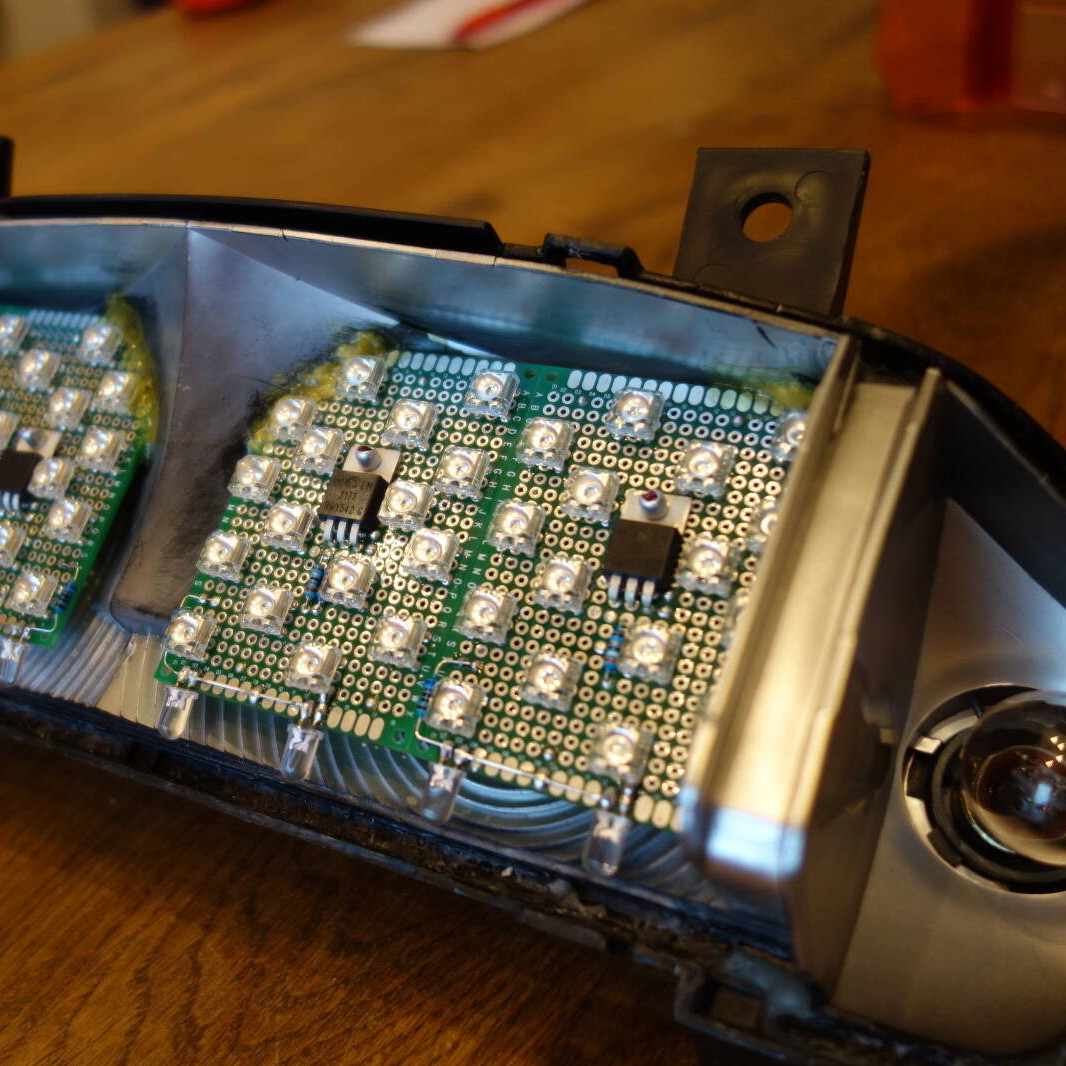
The pandemic may have taken away many of our real-world events, but as they’ve gone online their badge teams have often carried on regardless. One of these comes from Carolinacon, and it’s decided to eschew the bleeding edge of electronic wizardry and instead push slightly at the boundaries of PCB art. It contains a hidden message in a copper layer behind a band of white silkscreen, which is revealed by a set of LEDs on the reverse of the board shining through the translucent FR4.

Electronics-wise it’s a pretty simple design, sporting only an ATtiny microcontroller and a photoresistor alongside the LEDs, and with the secret message being triggered when the badge is placed in the dark. The conference’s pig logo is eye-catching, but it has no pretences towards being a dev board or similar. The technique of LEDs behind copper and silkscreen is an interesting one though, and something that we think could bear more investigation in future designs. It’s pleasing to see that there are still new avenues to be taken in the world of PCB-based art.

This isn’t the first time this event has had an eye-catching badge, we’ve covered one of their previous offerings.

3D Printer As Robot: The Functograph

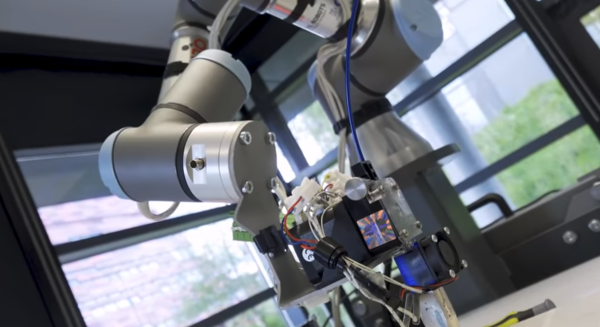
A 3D printer is really a specialized form of robot. Sure, it isn’t exactly Data from Star Trek, but it isn’t too far from many industrial robots. Researchers from Meiji University made the same observation and decided to create a 3D printer that could swap a hot end for other types of robotic manipulators. They call their creation the Functgraph. (Video, embedded below.)

Some of the tasks the Functgraph can do including joining printed parts into an assembly, breaking support material, and more. The surprise twist is that — unlike traditional tool change schemes — the printer prints its own end effectors together with the print job and picks them up off the build plate.

Continue reading “3D Printer As Robot: The Functograph”

Satellite Ground Station Upcycles Trash

While the term “upcycle” is relatively recent, we feel like [saveitforparts] has been doing it for a long time. He’d previously built gear to pick up low-Earth orbit satellites, but now wants to pick up geosynchronous birds which requires a better antenna. While his setup won’t win a beauty contest, it does seem to work, and saved some trash from a landfill, too. (Video, embedded below.)

Small dishes are cheap on the surplus market. A can makes a nice feedhorn using a classic cantenna design, although that required aluminum tape since the only can in the trash was a cardboard oatmeal carton. The tape came in handy when the dish turned out to be about 25% too small, as well.

Continue reading “Satellite Ground Station Upcycles Trash”