Escape Tunnel In Your Living Room: A Different Take On The Infinity Mirror

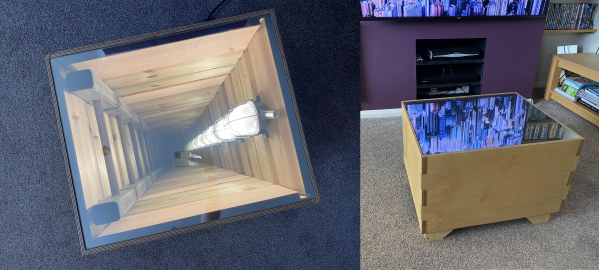
Most infinity mirrors are just minor variations on the same old recipe. Take a frame, add a normal mirror in the back, a one-way mirror on the front, and put some LEDs between them. [Stevens Workshop] took a slightly different approach and built an escape tunnel coffee table that really caught our attention.

To create the tunnel and ladder illusion, [Steven] kept the mirrors, but made a deeper wood frame, installed a light bulb in an industrial-looking socket instead of the usual LEDs, and added a single ladder rung. The end result makes for a very interesting conversation piece, and some of us prefer it to the multicolored LED look. Though he added his own touches, the idea was actually borrowed from from [asthhvdrt36] and [BreezleSprouts] on Reddit who used slightly different light and ladder designs.

While there’s nothing groundbreaking here, it’s certainly a case of “why didn’t I think of that”. Sometimes the old and familiar just needs a different perspective to create something fascinating. One of the advantages of the classic infinity mirror is the thin profile, which we’ve seen integrated into everything from guitars to coasters.
The Cost Of Moving Atoms In Space; Unpacking The Dubious Claims Of A $10 Quintillion Space Asteroid

The rest of the media were reporting on an asteroid named 16 Psyche last month worth $10 quintillion. Oddly enough they reported in July 2019 and again in February 2018 that the same asteroid was worth $700 quintillion, so it seems the space rock market is similar to cryptocurrency in its wild speculation. Those numbers are ridiculous, but it had us thinking about the economies of space transportation, and what atoms are worth based on where they are. Let’s break down how gravity wells, distance, and arbitrage work to figure out how much of this $10-$700 quintillion we can leverage for ourselves.

The value assigned to everything has to do with where a thing is, AND how much someone needs that thing to be somewhere else. If they need it in a different place, someone must pay for the transportation of it.

In international (and interplanetary) trade, this is where Incoterms come in. These are the terms used to describe who pays for and has responsibility for the goods between where they are and where they need to be. In this case, all those materials are sitting on an asteroid, and someone has to pay for all the transport and insurance and duties. Note that on the asteroid these materials need to be mined and refined as well; they’re not just sitting in a box on some space dock. On the other end of the spectrum, order something from Amazon and it’s Amazon that takes care of everything until it’s dropped on your doorstep. The buyer is paying for shipping either way; it’s just a matter of whether that cost is built into the price or handled separately. Another important term is arbitrage, which is the practice of taking a thing from one market and selling it in a different market at a higher price. In this case the two markets are Earth and space.

Continue reading “The Cost Of Moving Atoms In Space; Unpacking The Dubious Claims Of A $10 Quintillion Space Asteroid”

Full 8-Bit Computer On Breadboards

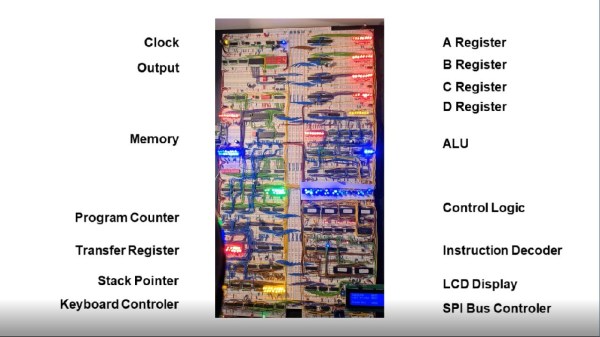
Getting into a big electronics project often involves the use of specialized tools, namely the use of some sort of soldering iron or other way to apply solder to often intricate, tiny, and heat-sensitive parts. While it’s best to learn to pick up this skill at some point, it’s not always necessary, even for big, complicated projects like [DerULF1]’s full 8-bit computer that he built entirely on breadboards.

For a fully featured 8-bit computer, this build goes deep into the details of how the computer works. The clock allows programs to be stepped through one cycle at a time, and even the memory can be individually accessed with a set of switches. There are plenty of other interesting features as well, such as using registers to access extra memory. It features an SPI port and PS/2 keyboard controller and also loads programs from an SD card.

The build was inspired by some of [Ben Eater]’s projects which famously focus on using logic gates and TTL chips to perform complex tasks, such as another breadboard computer which plays snake on a small display. It’s certainly a great way to learn about the inner function of computers, and better still that no soldering is required. But you may need a few extra breadboards.

Continue reading “Full 8-Bit Computer On Breadboards”

Booting A PC From Vinyl For A Warmer, Richer OS

If you’ve scrolled through the list of boot options offered on any PC’s BIOS, it reads like a history of storage technology. Up top we have the options to boot from disk, often a solid-state drive, then USB disk, optical drive, removable media, and down the bottom there’s usually an option to boot from the network. Practically no BIOS, however, has an option to boot a PC from a vinyl record — at least until now.

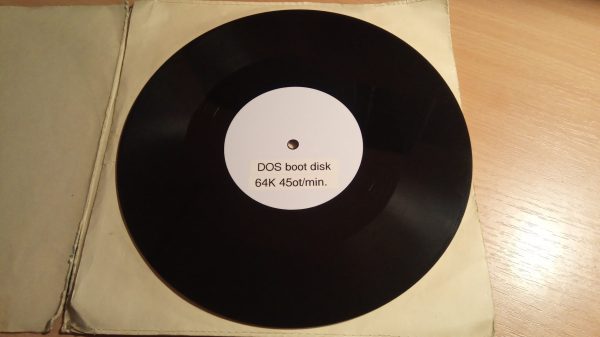
Clearly a project from the “Because why not?” school of hacking, [Jozef Bogin] came up with the twist to the normal booting process for an IBM-PC. As in the IBM-PC — a model 5150, with the putty-colored case, dual 5-1/4″ floppies, and one of those amazing monochrome displays with the green slow-decay phosphors. To pull off the trick, [Jozef] leverages the rarely used and little known cassette tape interface that PCs had back in the early days. This required building a new bootloader and burning it to ROM to make the PC listen to audio signals with its 8255 programmable peripheral interface chip.

Once the PC had the right bootloader, a 64k FreeDOS bootable disk image was recorded on vinyl. [Jozef] provides infuriatingly little detail about the process other than to mention that the audio was sent directly to the vinyl lathe; we’d have loved to learn more about that. Nonetheless, the resulting 10″ record, played back at 45 RPM with some equalization tweaks to adapt for the RIAA equalization curve of the preamp, boots the PC into FreeDOS just fine, probably in no more time than it would have taken to boot from floppy.

It’s may not be the first time we’ve seen software on vinyl, but it’s still a pretty cool hack. Want to try it yourself but lack a record-cutting lathe? Maybe laser-cutting your boot disc will work.

Continue reading “Booting A PC From Vinyl For A Warmer, Richer OS”

The Most Annoying Among Us Tasks Created In Real Life

Among Us is a hit game of deception and intrigue. Those who have played it know the frustration of trying to complete some of the intentionally difficult tasks onboard the Skeld. [Zach Freedman] decided to recreate some of these in real life.

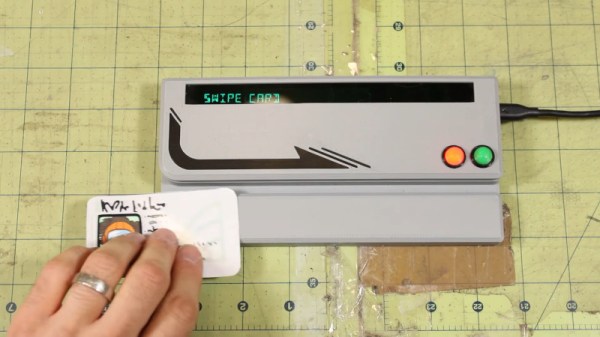
[Zach] built what are arguably the three most frustrating tasks from the game. There’s the excruciatingly slow upload/download station built out of an old Samsung tablet and an NFC tag, and the reactor start console created using a Raspberry Pi 3B, Teensy 3.2, and a custom mechanical keyboard. But perhaps most annoying of all is the infamous card reader. Built with another Teensy, it requires the user to swipe their ID card at just the right speed, except that speed is randomly generated for every swipe. Also, the machine fails 20% of good swipes just because. Perhaps what we love most is the way [Zach] recreated the classic VFD look by putting an OLED display behind bottle-green plastic and using a 14-segment font.

It’s a fun homage to a wildly successful indie game, and we could imagine these props would be a hit at a makerspace party. We’ve featured other Among Us themed builds before, too. Video after the break.

Continue reading “The Most Annoying Among Us Tasks Created In Real Life”

Hackaday Links Column Banner

Hackaday Links: November 22, 2020

Remember DSRC? If the initialism doesn’t ring a bell, don’t worry — Dedicated Short-Range Communications, a radio service intended to let cars in traffic talk to each other, never really caught on. Back in 1999, when the Federal Communications Commission set aside 75 MHz of spectrum in the 5.9-GHz band, it probably seemed like a good idea — after all, the flying cars of the future would surely need a way to communicate with each other. Only about 15,000 vehicles in the US have DSRC, and so the FCC decided to snatch back the whole 75-MHz slice and reallocate it. The lower 45 MHz will be tacked onto the existing unlicensed 5.8-GHz band where WiFi now lives, providing interesting opportunities in wireless networking. Fans of chatty cars need not fret, though — the upper 30 MHz block is being reallocated to a different Intelligent Transportation System Service called C-V2X, for Cellular Vehicle to Everything, which by its name alone is far cooler and therefore more likely to succeed.

NASA keeps dropping cool teasers of the Mars 2020 mission as the package containing the Perseverance rover hurtles across space on its way to a February rendezvous with the Red Planet. The latest: you can listen to the faint sounds the rover is making as it gets ready for its date with destiny. While we’ve heard sounds from Mars before — the InSight lander used its seismometer to record the Martian windPerseverance is the first Mars rover equipped with actual microphones. It’s pretty neat to hear the faint whirring of the rover’s thermal management system pump doing its thing in interplanetary space, and even cooler to think that we’ll soon hear what it sounds like to land on Mars.

Speaking of space, back at the beginning of 2020 — you know, a couple of million years ago — we kicked off the Hack Chat series by talking with Alberto Caballero about his “Habitable Exoplanets” project, a crowd-sourced search for “Earth 2.0”. We found it fascinating that amateur astronomers using off-the-shelf gear could detect the subtle signs of planets orbiting stars half a galaxy away. We’ve kept in touch with Alberto since then, and he recently tipped us off to his new SETI Project. Following the citizen-science model of the Habitable Exoplanets project, Alberto is looking to recruit amateur radio astronomers willing to turn their antennas in the direction of stars similar to the Sun, where it just might be possible for intelligent life to have formed. Check out the PDF summary of the project which includes the modest technical requirements for getting in on the SETI action.

Continue reading “Hackaday Links: November 22, 2020”

Espressif Leaks ESP32-C3: A WiFi SoC That’s RISC-V And Is ESP8266 Pin-Compatible

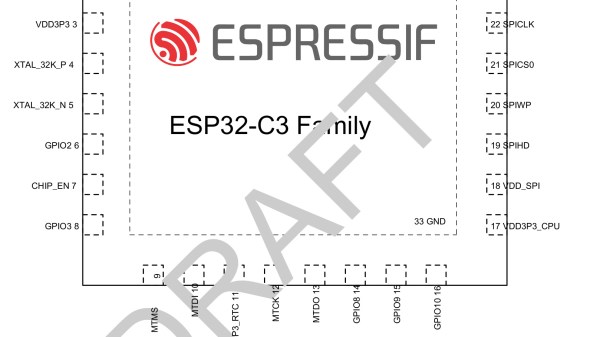
Six years on from the emergence of the Espressif ESP8266 we might believe that the focus had shifted to the newer dual-core ESP32. But here comes a twist in the form of the newly-revealed ESP32-C3. It’s a WiFi SoC that despite its ESP32 name contains a RISC-V core in place of the Tensilica core in the ESP32s we know, and uses the ESP8266 pin-out rather than that of its newer sibling. There’s relatively little information about it at the time of writing, but CNX Software have gathered together what there is including a draft datasheet whose English translation is available as a Mega download. As with other ESP32 family members, this one delivers b/g/n WiFi and Bluetooth Low-Energy (BLE) 5, where it differs is the RISC-V 32 Single-core processor with a clock speed of up to 160 MHz. There is 400 kB of SRAM and 384 kB ROM storage space built in.

While there is no official announcement yet, Espressif has been dropping hints. There’s been an OpenOCD configuration file for it in the Espressif repositories since the end of last month. And on Friday, Espressif Software Engineering Manager [Sprite_tm] answered a reddit comment, confirming the RISC-V core.

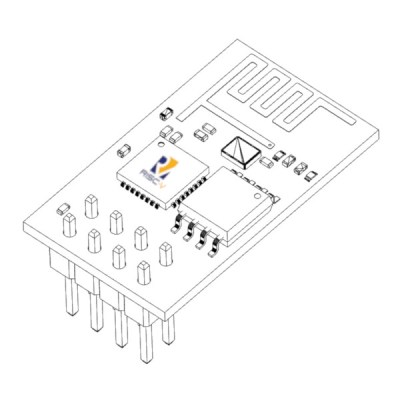
ESP-01: Kjerish, CC BY-SA 4.0, RISC-V logo: RISC-V foundation, Public domain.

Why they are releasing the part as an ESP32 rather than giving it a series number of its own remains a mystery, but it’s not hard to see why it makes commercial sense to create it in an ESP8266-compatible footprint. The arrival of competing parts in the cheap wireless SoC space such as the Bouffalo Labs BL602 we mentioned recently is likely to be eating into sales of the six-year-old chip, so an upgrade path to a more capable part with minimal new hardware design requirements could be a powerful incentive for large customers to stay with Espressif.

We’re left to guess on how exactly the rollout will proceed. We expect to see similar developer support to that they now provide for their other chips, and then ESP32-C3 powered versions of existing ESP8266 boards in short order. It’s also to be hoped that a standard RISC-V toolchain could be used instead of the device-specific ones for current Espressif offerings. What we should not expect are open-source replacements for the blobs that drive the on-board peripherals, as the new chip will share the same closed-source IP as its predecessors for them. Perhaps if the PINE64 initiative to reverse engineer blobs for the BL602 bears fruit, we might see a similar effort for this chip.