Hacking The Ortur Laser With Spoil Board, Z-Height, And Air Assist

Last month in my hands-on review of the Ortur Laser I hinted that I had done a few things to make it work a little better. I made three significant changes in particular: I anchored the machine to a spoil board with markings, I added a moving Z axis to adjust focus by moving the entire laser head, and I added an air assist.

Turns out, you can find designs for all of these things all over the Internet and I did, in fact, use other people’s designs. The problem is the designs often conflict with one another or don’t exactly work for your setup. So what I’ll tell you about is the combination that worked for me and what I had to do to get it all working together. The air assist is going to take a post all by itself, but some of the attempts at air assist led to some of the other changes I made, so we’ll talk about it some in this post, as well.

One of the modifications — the spoil board mount — I simply downloaded and the link for that is below. However, I modified the moving Z axis and air assist parts and you can find my very simple modifications on Thingiverse. You’ll also find links to the original designs and you’ll need them for extra parts and instructions, too.

Continue reading “Hacking The Ortur Laser With Spoil Board, Z-Height, And Air Assist”

Fire At Renesas Plant Fuels Chip Supply Woes

The small city of Naka (pop. 53K), a two-hour train ride from Tokyo on the eastern coast of Japan, was thrust into the international spotlight in the early dawn of Friday morning. A fire broke out among electroplating equipment in Renesas’s 300 nm N3 fabrication facility. It was extinguished before breakfast time, and fortunately nobody was injured nor were there any toxic chemical leaks. Only six hundred square meters on the first floor of the plant was damaged, but the entire building has to be closed for repairs. It will take approximately one month to restore normal operations, and CEO Hidetoshi Shibata is “concerned that there will be a massive impact on chip supplies”.

Renesas Naka Plant Location

In a press conference on Sunday afternoon, Renesas reports that the source of the fire has been determined, but the details are still unclear:

The casing of the equipment and the plating tank have relatively low resistance to heat, and the equipment ignited due to overcurrent. However, the cause of the overcurrent and the reason for the ignition is currently being investigated.

Semiconductors are already in short supply, as we reported back in January, forcing slowdowns at many auto manufacturers. The Naka plant primarily makes automotive semiconductors, worsening an already stressed supply chain. While the news focuses on the automotive sector, this shortage spills over into many other industries as well.

Continue reading “Fire At Renesas Plant Fuels Chip Supply Woes”

Playstation 3 controller and console

Digital PlayStation 3 Purchases May Only Live As Long As Your PRAM Battery Without Sony Servers

Word of Sony shutting down PlayStation storefront servers for PS3 this summer spread like wildfire on the internet Monday. The discourse in comment sections were filled with anti-DRM rhetoric and renewed pledges of physical-only game collections, because without content servers to connect to, your digital PS3 purchases will eventually become unplayable. Even if legitimate purchases are installed to the console’s hard drive before Sony “flips the switch”, they may only live on as long as the internal clock stays in sync. Which is why this guide to replace a PS3 PRAM battery written by [Andrew] has renewed importance. After a battery replacement the internal clock needs to be reset and this requires validation from the PlayStation network (you know, the one that’s soon to be shut down).

Game preservationist group [Does it play?] drove home the impact of such a business decision by Sony on Twitter. The thread is quick to point out that even if users are quick to re-download all of their purchases to a PS3 system before the purported July 2nd deadline, those games will eventually become unplayable if the system clock becomes desynchronized. Replacing the PRAM battery and reconnecting to the PlayStation Network prior to Sony shuttering their servers should buy the user some more playtime. However, without any further changes to Sony’s licensing policy little else can be done physically to ensure those digital PS3 games will work in perpetuity.

Sony isn’t the only one to have drawn the ire of digital rights advocates in regards to terminating their online services. Nintendo shuttered the DSI-Shop in 2017 and Microsoft turned off access to the original Xbox LIVE servers in 2010. The big three console makers have all let their consumers down by removing the ability to reacquire purchases in some way, but the fact that so many PS3 exclusives were only ever available digitally just further exacerbates issues with digital rights. Dropping in a fresh coin-cell may not be the permanent solution everyone is looking for at the moment, but it couldn’t hurt to re-familiarize yourself with the Cell processor.

Continue reading “Digital PlayStation 3 Purchases May Only Live As Long As Your PRAM Battery Without Sony Servers”

Hey Google, Is My Heart Still Beating?

University of Washington researchers studying the potential medical use of smart speakers such as Amazon’s Echo and Google’s Nest have recently released a paper detailing their experiments with non-contact acoustic heartbeat detection. Thanks to their sensitive microphone arrays, normally used to help localize voice commands from the user, the team proposes these affordable and increasingly popular smart home gadgets could lead a double life as unobtrusive life sign monitors. The paper goes so far as to say that even with multiple people in the room, their technique can be used to monitor the heart and respiratory rate of a specific target individual.

Those are some bold claims, but they aren’t without precedent. Previous studies performed at UW in 2019 demonstrated how smart speaker technology could be used to detect cardiac arrest and monitor infant breathing. This latest paper could be seen as the culmination of those earlier experiments: a single piece of software that could not just monitor the vitals of nearby patients, but actually detect a medical emergency. The lifesaving potential of such a program, especially for the very young and elderly, would be incredible.

So when will you be able to install a heart monitor skill on the cheap Echo Dot you picked up on Prime Day? Well, as is often the case with this kind of research, putting the technique to work in the real-world isn’t nearly as easy as in the laboratory. While the concept is promising and is more than worthy of further research, it may be some time before our lowly smart speakers are capable of Star Trek style life-sign detection.

Continue reading “Hey Google, Is My Heart Still Beating?”

Machine Learning Current Sensor Snoops On MCUs

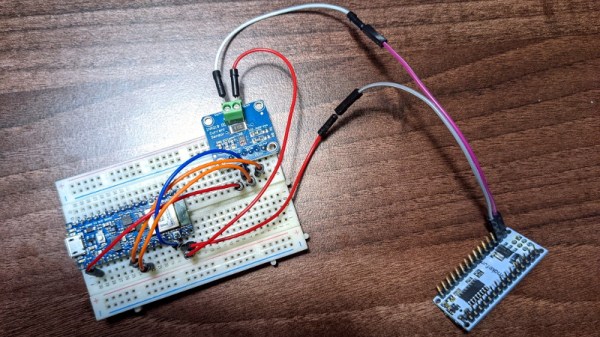
Anyone who’s ever tried their hand at reverse engineering a piece of hardware has wished there was some kind of magic wand you could tap on a PCB to understand what its doing and why. We imagine that’s what put security researcher [Mark C] on the path to developing CurrentSense-TinyML, a fascinating proof of concept that uses machine learning and sensitive current measurements to try and determine what a microcontroller is up to.

Energy consumption as the LED blinks.

The idea is simple enough: just place a INA219 current sensor between the power supply and the microcontroller under observation, and record the resulting measurements as it goes about its business. Of course in this case, [Mark] knew what the target Arduino Nano was doing because he wrote the code that blinks its onboard LED.

This allowed him to create training data for TensorFlow, which was ultimately optimized into a model that could fit onto the Arduino Nano 33 BLE Sense which stands in for our magic wand. The end result is that the model can accurately predict when the Nano has fired up its LED based on the amount of power it’s using. [Mark] has done a fantastic job of documenting the whole process, which also doubles as a great intro for putting machine learning to work on a microcontroller.

Now we already know what you’re thinking: obviously the current would go up when the LED was lit, so the machine learning aspect is completely unnecessary. That may be true in this limited context, but remember, this is just a proof of concept to base further work on. In the future, with more training data, this technique could potentially be used to identify a whole range of nuanced activities. You’d be able to see when the MCU was sitting idle, when it was writing to flash, or when it was reading from sensors. In fact, with a good enough model, it might even be possible to identify the individual sensors that are being polled.

These are early days, but we’re very interested in seeing where this research goes. It might not be magic, but if analyzing the current draw of a coffee maker can tell you how much everyone in the office is drinking, then maybe it can help us figure out what all these unlabeled ICs are doing.

A Crash Course On Sniffing Bluetooth Low Energy

Bluetooth Low Energy (BLE) is everywhere these days. If you fire up a scanner on your phone and walk around the neighborhood, we’d be willing to bet you’d pick up dozens if not hundreds of devices. By extension, from fitness bands to light bulbs, it’s equally likely that you’re going to want to talk to some of these BLE gadgets at some point. But how?

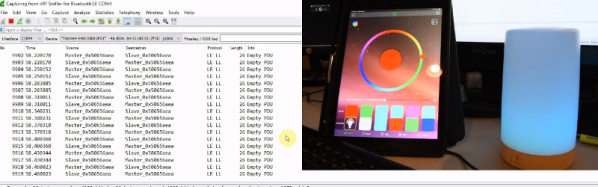
Well, watching this three part video series from [Stuart Patterson] would be a good start. He covers how to get a cheap nRF52480 BLE dongle configured for sniffing, pulling the packets out of the air with Wireshark, and perhaps most crucially, how to duplicate the commands coming from a device’s companion application on the ESP32.

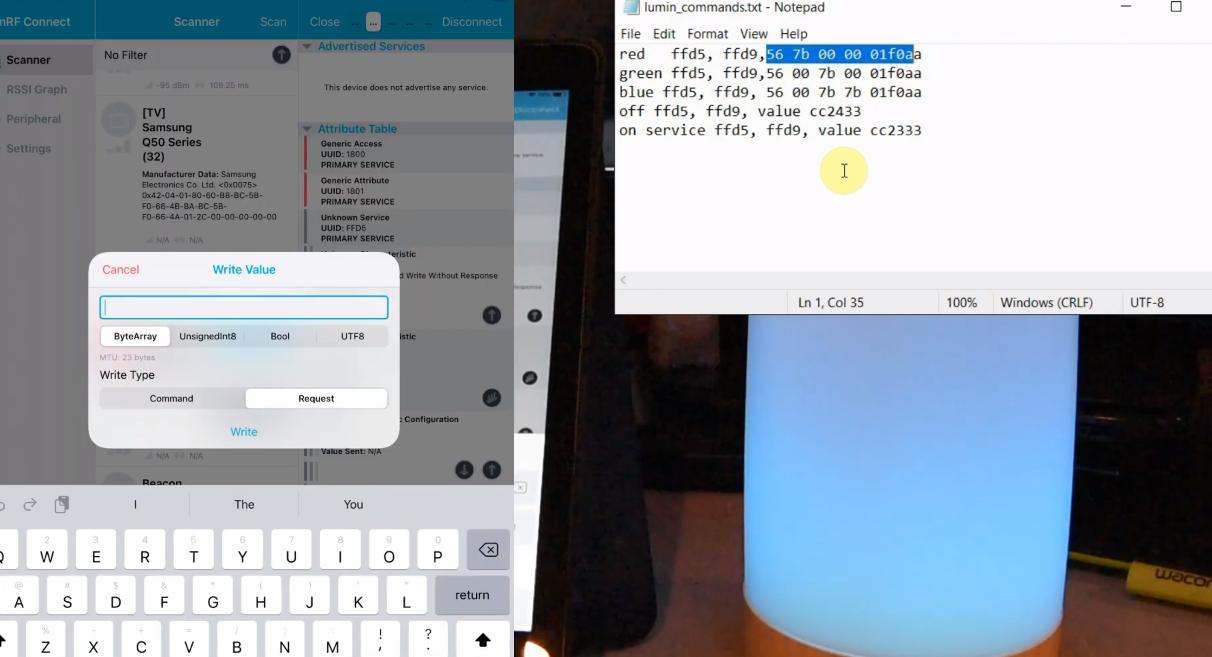
Testing out the sniffed commands.

The first video in the series is focused on getting a Windows box setup for BLE sniffing, so readers who aren’t currently living under Microsoft’s boot heel may want to skip ahead to the second installment. That’s where things really start heating up, as [Stuart] demonstrates how you can intercept commands being sent to the target device.

It’s worth noting that little attempt is made to actually decode what the commands mean. In this particular application, it’s enough to simply replay the commands using the ESP32’s BLE hardware, which is explained in the third video. Obviously this technique might not work on more advanced devices, but it should still give you a solid base to work from.

In the end, [Stuart] takes an LED lamp that could only be controlled with a smartphone application and turns it into something he can talk to on his own terms. Once the ESP32 can send commands to the lamp, it only takes a bit more code to spin up a web interface or REST API so you can control the device from your computer or other gadget on the network. While naturally the finer points will differ, this same overall workflow should allow you to get control of whatever BLE gizmo you’ve got your eye on.

Continue reading “A Crash Course On Sniffing Bluetooth Low Energy”

A Hi-Fi Speaker From Some Foil And Magnets

In the world of speakers, mass is the enemy of high frequency response. In order to get the crispest highs, some audiophiles swear by speakers in which the moving element is just a thin ribbon of metal foil. As the first step towards building a set of ribbon headphones, [JGJMatt] has designed a compact ribbon speaker made from aluminum foil.

A 3D-printed body holds six permanent magnets, which produce the static magnetic field necessary for the speaker to work. The sound itself is produced by a corrugated aluminum diaphragm made by taking a strip of foil and creasing it with a gear. Aluminum is difficult to solder, so electrical contact is made with a couple of short segments of copper tape. A little Blu Tack and glue hold it all together, and the result is stunning in its simplicity.

Check out the video after the break to hear how it sounds. If you want to try this yourself, it’s important to remember that ribbon speakers have very low input impedances (0.1 Ω for this design), so in order to prevent damage to your amplifier, a transformer or series resistor must be used to bring the impedance up to the 4-8 Ω your amplifier expects.

[JGJMatt] is no newcomer to exotic speaker technology—check out these thin distributed-mode loudspeakers they made! If you’re more interested in recording music than playing it, you might want to read about how a metal ribbon suspended in a magnetic field is used to make incredible microphones. Shout out to [Itay] for the tip. Continue reading “A Hi-Fi Speaker From Some Foil And Magnets”