Perovskites: Not Just For Solar Cells Anymore

If you’ve been around long enough, you’ll know there’s a long history of advances in materials science that get blown far out of proportion by both the technical and the popular media. Most of the recent ones seem to center on the chemistry of carbon, particularly graphene and nanotubes. Head back a little in time and superconductors were all the rage, and before that it was advanced ceramics, semiconductors, and synthetic diamonds. There’s always some new miracle material to be breathlessly and endlessly reported on by the media, with hopeful tales of how one or the other will be our salvation from <insert catastrophe du jour here>.

While there’s no denying that each of these materials has led to huge advancements in science, industry, and the quality of life for billions, the development cycle from lab to commercialization is generally a tad slower than the press would have one believe. And so when a new material starts to gain traction in the headlines, as perovskites have recently, we feel like it’s a good opportunity to take a close look, to try to smooth out the ups and downs of the hype curve and manage expectations.

Continue reading “Perovskites: Not Just For Solar Cells Anymore”

Self-Cleaning Camera Lens Makes For Speckle-Free Video

People making videos about machining have a problem: the coolant gets everywhere. When you take a video to show the process of creating a device, the milky gunk that keeps everything cool gets all over your camera lens. AvE is experimenting with an interesting fix for this problem, with a self-cleaning camera lens. (Video embedded below, some salty language.) His prototype uses a spinning piece of clear PVC mounted on BB gun pellets, driven by compressed air. The camera can see through this spinning piece, but when the coolant hits the spinning piece, it is thrown off.

Continue reading “Self-Cleaning Camera Lens Makes For Speckle-Free Video”

SOICbite: A Program/Debug Connector For An SOIC Test Clip

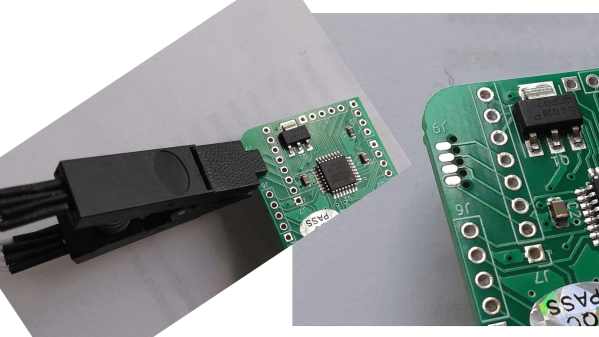
The problem is well-known: programming and debug headers consume valuable board space and the connectors cost money. Especially troublesome are the ubiquitous 100-mil pin headers, not because they’re expensive, but because they’re huge, especially along the z-axis. If you’re building miniature devices, these things can take up a ridiculous amount of space. With some clever thinking, [Simon Merrett] has found a way to re-use something many of us already have — an SOIC-8 test clip — to connect to a special footprint on the PCB without requiring another connector. He calls the system SOICbite.

The SOIC clip attaches to a footprint consisting of eight pads, four on each side of the PCB, plus five non-plated-through holes, which serve to anchor the clip in place. The idea of mating a PCB footprint directly with a removable connector isn’t entirely new — Tag Connect has been doing this for a while, but the connectors are expensive and single-sourced. On the other hand, SOIC test clips of varying quality are available from a number of vendors, including dirt-cheap deals on your favorite websites. The one disadvantage we can see is that the SOICbite footprint must be at the edge of the PCB to properly mate with the clip. The savings in space and cost may well make up for this, however.

[Simon] has made his KiCAD footprint available in a GitHub repo, and has offered to host footprints for any other CAD package there as well. So, fire up your preferred tool and draw one up for him to get these things widely adopted, because we think this is a great idea.

For the commercial alternative, check out our coverage of Tag Connect back in 2014.


Magic Record Stand Can Play Your Records For You

Vinyl remains a popular format, despite taking a huge hit in popularity for a couple decades while CDs ruled the roost. It has a charm that keeps it relevant, and likely will continue to do so until everyone who grew up with a record player dies out. In the meantime, [sp_cecamp] has come up with a great way to experience your collection, with the magic of modern technology. It goes by the name of Plynth.

Fundamentally, it’s a small record stand with an excellent party trick. The prototype consists of a 3D-printed body, which holds a record sleeve at an attractive angle for display. A camera built into the base then images the artwork. The first image taken is run through the Google Vision API, and further images are then run through OpenCV to identify the record. This data is then passed to the Spotify API to play the track. The whole process takes a couple of seconds, and the music is then pumped out of whatever streaming device is connected to the rig.

It’s a fun way to play your old records, and would be a welcome change to those tired of screaming at Siri to play Weezer (Blue Album), not Weezer (Green Album). For those interested, [sp_cecamp] has thrown up a site to gauge interest in the project, and may make a limited production run in future.

Of course, you could instead just go about building your own turntable. To each their own!

He Comes To Bury Sensors, Not To Praise Them

[Adosia] has some interesting videos about their IoT platform controlling self-watering plant pots. However, the video that really caught our eye was the experience in sealing up sensors that are going to be out in the field. Even if you aren’t using the exact sensors, the techniques are useful.

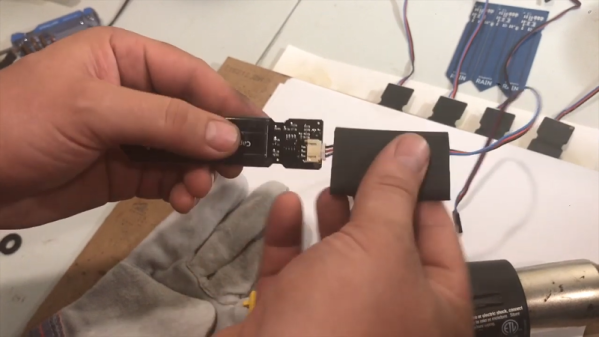
We would have expected to see potting compound, but that’s messy and hard to use so their process is simpler. First, a few coats of clear urethane sealant goes over the electronics. Next, heat shrink goes over the assembly. It isn’t ordinary heat shrink though, instead it’s the kind that has heat-activated adhesive inside.

Continue reading “He Comes To Bury Sensors, Not To Praise Them”

Mechanical Tremolo Does Things The Old-School Way

The word “tremolo” has a wide variety of meanings in the musical lexicon. A tremolo effect, in the guitar community at least, refers to a periodic variation in amplitude. This is often achieved with solid state electronics, but also recalls the sounds created by Hammond organs of years past with their rotating Leslie speakers. [HackaweekTV] decided to do things the old fashioned way, building a mechanical tremolo effect of his own (Youtube link, embedded below).

Electronically, the signal is simply passed through a linear audio potentiometer. The effect is generated by rapidly cycling this potentiometer up and down. The motion is achieved through a geared motor salvaged from a Roomba, which turns a cam. A sprung follower sits on top of the cam, and is attached to the potentiometer.

There were some challenges in development. Rigidity of the frame was an issue, and the follower had issues with snagging on the cam. However, with some careful iteration they were able to get everything up and running. The final project sounds great, and with the amplifier turned up, there’s no need to worry about the sound of the moving parts.

Naturally, you can always build a tremolo with a 555 instead. Video after the break.

Continue reading “Mechanical Tremolo Does Things The Old-School Way”

IKEA Cloud Lamp Displays The Weather With An ESP8266

The IKEA DRÖMSYN is a wall mounted cloud night light that’s perfect for a kid’s room. For $10 USD, it’s just begging for somebody to cram some electronics in there and make it do something cool. Luckily for us, [Jodgson] decided to take on the challenge and turned this once simple lamp into a clever weather display. It even still works as an LED lamp, if you’re into that sort of thing.

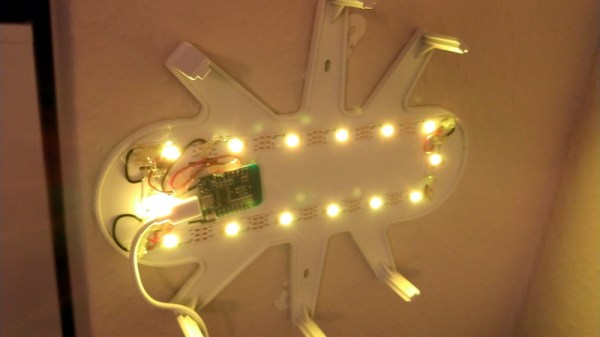
After stripping out the original hardware, [Jodgson] installed a Wemos D1 Mini and a string of fourteen SK6812 RGB LEDs that run down the length of the cloud’s internal structure. Weather data is pulled down with the OpenWeatherMap API, and conditions are displayed through various lighting colors and effects.

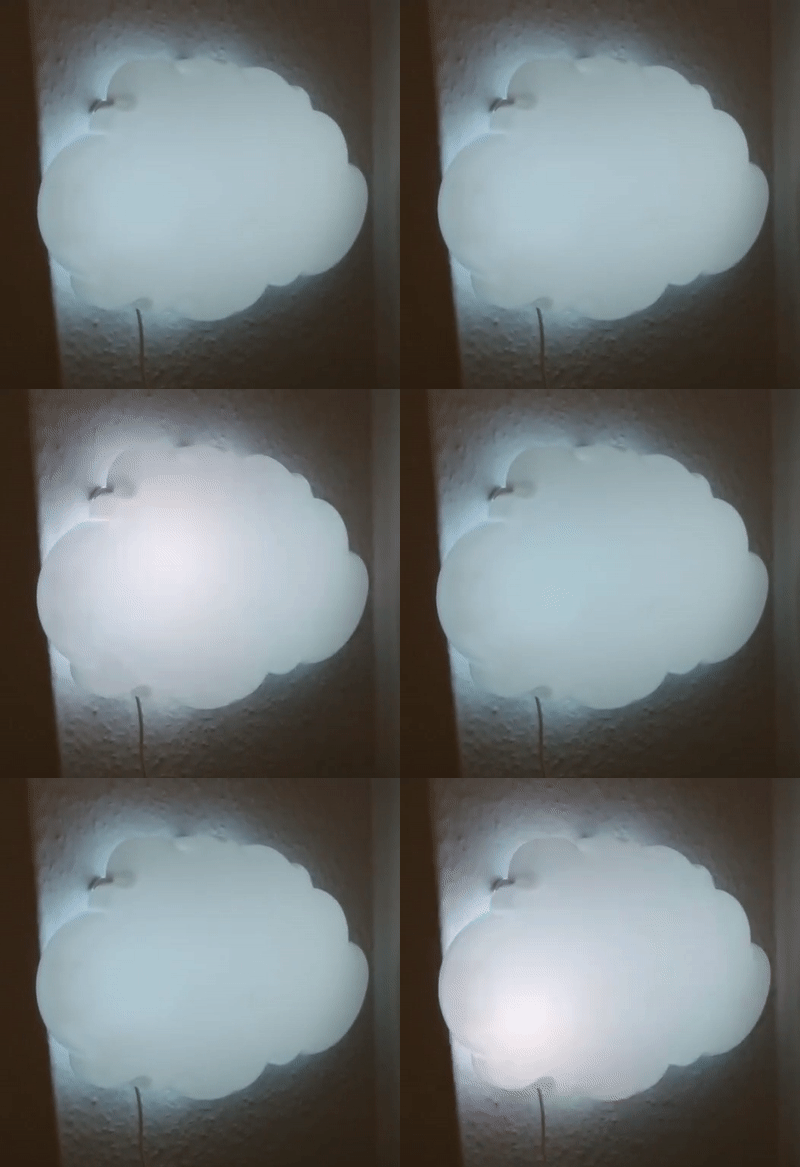
Sunny days are represented with a nice yellow glow, and a cloudy forecast looks like…well it’s already a white cloud so that one’s pretty easy. If rain is expected the cloud turns blue and the bottom LEDs flicker a bit to represent raindrops. When there’s a thunderstorm, the cloud will intermittently flash random LEDs on the strip a bit brighter than their peers; a really slick effect that gets the point across immediately.

This isn’t the first time we’ve seen somebody take a cheap light from IKEA and turn it into something much more impressive with the ESP8266. Just like with that previous project, we wouldn’t be surprised to see this particular modification popping up more in the future.