Locating Targets With Charm Courtesy Of A Life Size Portal Turret

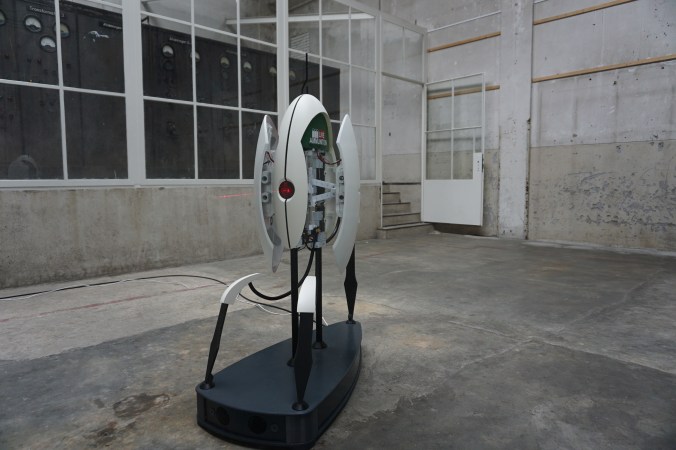
What better way to count down the last 7 weeks to a big hacker camp like SHA2017 than by embarking on a last-minute, frantic build? That was [Yvo]’s thought when he decided to make a life-sized version of the adorably lethal turrets from the Valve’s Portal video games. Since that build made it to the finish line back then with not all features added, he finished it up for the CCC camp 2019 event, including the ability to close, open, target and shoot Nerf darts.

Originally based on the miniature 2014 turret (covered on Hackaday as well), [Yvo] details this new project in a first and second work log, along with a detailed explanation of how it all goes together and works. While the 2017 version took a mere 50 days to put together, the whole project took about 300 hours of 3D printing. It also comes with four Nerf guns which use flywheels to launch the darts.  The wheels are powered using quadcopter outrunner motors that spin at 25,000 RPM. The theoretical speed of a launched dart is over 100km/h, with 18 darts per gun and a fire rate of 2 darts per second.

The basic movement control for the system is handled by an Arduino Mega, while the talking and vision aspects are taken care of by a Raspberry Pi 3+, which ultimately also makes the decisions about how to move the system. As one can see in the video after the link, the system seems to work pretty well, with a negligible number of fatalities among company employees.

Though decidedly not a project for the inexperienced tinkerer, [Yvo] has made all of the design files available along with the software. We’re still dubious about the claims about the promised cake for completing one of these turrets, however.

Continue reading “Locating Targets With Charm Courtesy Of A Life Size Portal Turret”

What Happens To Tesla When The Sleeping Auto Giants Awake?

The history of automotive production is littered with the fallen badges of car companies that shone brightly but fell by the wayside in the face of competition from the industry’s giants. Whether you pine for an AMC, a Studebaker, or a Saab, it’s a Ford or a Honda you’ll be driving in 2019.

In the world of electric cars it has been a slightly different story. Though the big names have dipped a toe in the water they have been usurped by a genuinely disruptive contender. If you drive an electric car in 2019 it won’t be that Ford or Honda, it could be a Nissan, but by far the dominant name in EV right now is Tesla.

Motor vehicles are standing at the brink of a generational shift from internal combustion to electric drive. Will Tesla become the giant it hopes, or will history repeat itself?

Continue reading “What Happens To Tesla When The Sleeping Auto Giants Awake?”

Latex Bellows From Scratch

You would be forgiven for thinking that the semi-spherical bulb [Len], from the Bellowphone channel, is holding is a toilet bowl float. It is a bellows of his design that is similar to the squeezable part of a bike horn but is more substantial and less irritating at six in the morning. These rubber squeeze balls are old-school in the best way, and craftsmanship rolls out from every second of his videos. The backdrops to [Len’s] videos are alive with tools, materials, examples, and instruments the same way our offices and maker spaces erupt with soldering irons, LEDs, and passives.

His video walks through all the steps to make latex bellows starting with a rigid stemmed bulb and painting it with latex. This takes a bunch of coats with the associated drying time, so if you need a lot of bellows, you will want multiple bulbs. After coating of latex, we move to the contraption known as the Snout Master 5000. The SM5K looks like a wooden jig held in a table vise, but it is a purpose-built over-engineered chuck with four ball bearings held in a vise. When the latex is thick enough, the form is removed, and the bulb is repaired, then, more coats. Each ball has roughly twenty layers, and with three hours between coats, this is a weekend job at a minimum. Good things come to those who coat. The final steps are boiling the bulbs and adding a silicone preservative. They can last up to a decade with proper maintenance.

We see lots of electronic and automated instruments here, and spherical balls are definitely on the human interface spectrum, but the techniques we see from [Len] would allow anyone to design their own bellows more conducive to mechanization. [Len] says one of his inspiration is [Harry Partch] and his Blo-Boy, an organ powered by fireplace bellows. We think these squeeze balls are even better.

Continue reading “Latex Bellows From Scratch”

An MSX With A Nintendo Controller

Console owners inhabit their own individual tribes depending upon their manufacturer of choice, and so often never the twain shall meet. But sometimes there are those what-if moments, could Mario have saved the princess more quickly through PlayStation buttons, or how would Sonic the Hedgehog have been with a Nintendo controller? [Danjovic] is finding the answer to one of those questions, with an interface between Nintendo 64 controllers and MSX hardware including the earlier Sega consoles.

In hardware terms, it’s a pretty simple device in the manner of many such projects, an Arduino Nano, a resistor, and a couple of sockets. The clever part lies not in its choice of microcontroller, but in the way it uses the Nano-s timing to ensure the minimum delay between button press and game action. The detail is in the write-up, but in short it makes use of the MSX’s need to attend to video lines to buy extra time for any conversion steps.

The MSX computers have had their share of controller upgrade courtesy of Nintendo hardware in the past, we’ve seen a Wii nunchuck controller talk to them before, as well as a SNES one.

Header image: [mboverload] (Public-domain).

Fitness Trackers Don’t Have To Be Proprietary

Fitness trackers have become a popular piece of consumer electronic equipment, with a range of models from a variety of manufacturers. Many of these commercial offerings, however, leave the consumer with the prospect of their data being drawn off to a cloud server and sold to the highest bidder, trading convenience for a loss of privacy. If only there were a fitness tracker offering complete control!

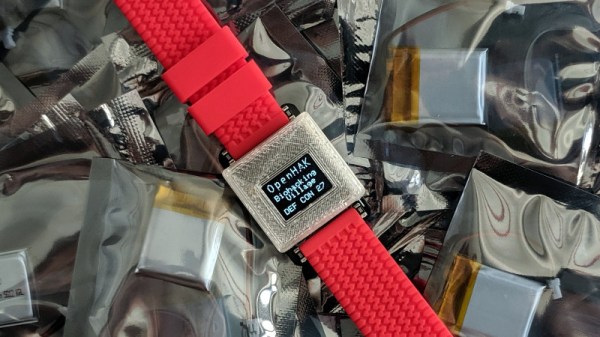
The OpenHAK is an open-source fitness tracker in a 3D printed wristwatch case that measures your heart rate and counts your steps, offering the resultant data for you to collect via Bluetooth. At its heart is a Sparkfun Simblee module, with heart rate sensing through a Maxim MAX30101 and step counting .by a Bocsh BMI160. It’s designed for expandability from the start with a header bringing out useful interface lines. In the prototype, they’ve used this to support a small OLED display. The result is a fitness tracker watch that may not match some of the well-known proprietary devices, but which remains completely open and probably costs a lot less too.

We’ve seen quite a few fitness tracker apps over the years, including a conversion to an EEG, and custom firmware for some commercial trackers.

Bearing-reinforced Stepper Tackles Hefty Axial Loads

These days, it’s common among us hackers to load a stepper motor with forces in-line with their shaft–especially when we couple them to leadscrews or worm gears. Unfortunately, steppers aren’t really intended for this sort of loading, and doing so with high forces can destroy the motor. Fear not, though. If you find yourself in this situation, [Voind Robot] has the solution for you with a dead-simple-yet-dead-effective upgrade to get your steppers tackling axial loads without issue.

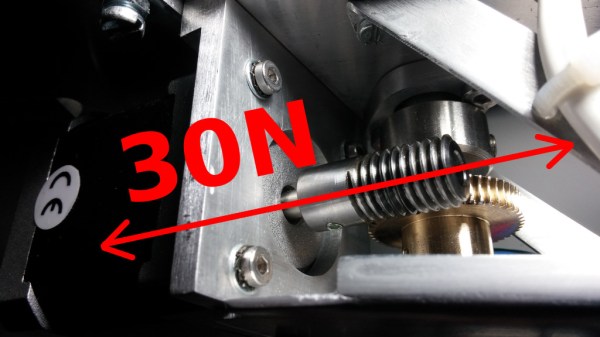
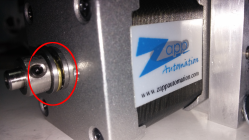
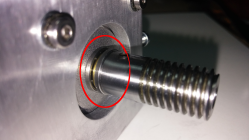
In [Voind Robot’s] case, they started with a worm-gear-drive on a robot arm. In their circumstances, moving the arm could put tremendous axial loads onto the stepper shaft through the worm–as much as 30 Newtons. Such loads could easily destroy the internal stepper motor bearings in a short time, so they opted for some double-sided reinforcement. To alleviate the problem, the introduced two thrust bearings, one on either side of the shaft. These thrust bearings do the work of redirecting the force off the shaft and directly onto the motor casing, a much more rigid place to apply such loads.

This trick is dead simple, and it’s actually over five years old. Nevertheless, it’s still incredibly relevant today for any 3D printer builder who’s considering coupling a leadscrew to a stepper motor for their Z-axis. There, a single thrust bearing could take out any axial play and lead to an overall rigid build. We love simple machine-design nuggets of wisdom like these. If you’re looking for more printer-design tricks, look no further than [Moritz’s] Workhorse Printer article.

Hackaday Links Column Banner

Hackaday Links: August 11, 2019

By the time this goes to press, DEFCON 27 will pretty much be history. But badgelife continues, and it’d be nice to have a way of keeping track of all the badges offered. Martin Lebel stepped up to the challenge with a DEF CON 27 badgelife tracker. He’s been tracking the scene since March, and there are currently more than 170 badges, tokens, and shitty add-ons listed. Gotta catch ’em all!

Nice tease, Reuters. We spotted this story about the FAA signing off on beyond-visual-line-of-sight, or BVLOS, operation of a UAV. The article was accompanied by the familiar smiling Amazon logo, leading readers to believe that fleets of Amazon Prime Air drones would surely soon darken the skies with cargoes of Huggies and Tide Pods across the US. It turns out that the test reported was conducted by the University of Alaska Fairbanks along an oil pipeline in the Last Frontier state, and was intended to explore medical deliveries and pipeline surveillance for the oil industry. The only mention of Amazon was that the company reported they’d start drone deliveries in the US “in months.” Yep.

Ever wonder what it takes to get your widget into the market? Between all the testing and compliance requirements, it can be a real chore. Nathaniel tipped us off to a handy guide written by his friend Skippy that goes through the alphabet soup of agencies and regulations needed to get a product to market – CE, RoHS, WEEE, LVD, RED, CE for EMC. Take care of all that paperwork and you’ll eventually get a DoC and be A-OK.

A French daredevil inventor made the first crossing of the English Channel on a hoverboard on Sunday. Yes, we know it’s not an “actual” hoverboard, but it’s as close as we’re going to get with the physics we have access to right now, and being a stand-upon jet engine powered by a backpack full of fuel, it qualifies as pretty awesome. The report says it took him a mere 20 minutes to make the 22-mile (35-km) crossing.


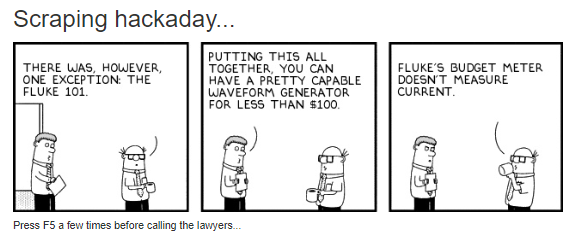
We had a grand time last week around the Hackaday writing crew’s secret underground lair with this delightful Hackaday-Dilbert mashup-inator. Scroll down to the second item on the page and you’ll see what appears to be a standard three-panel Dilbert strip; closer inspection reveals that the text has been replaced by random phrases scraped from a single Hackaday article. It looks just like a Dilbert strip, and sometimes the text even makes sense with what’s going on in the art. We’d love to see the code behind this little gem. The strip updates at each page load, so have fun.

And of course, the aforementioned secret headquarters is exactly what you’d picture – a dark room with rows of monitors scrolling green text, each with a black hoodie-wearing writer furiously documenting the black arts of hacking. OpenIDEO, the “open innovation practice” of global design company IDEO, has issued a challenge to “reimagine a more compelling and relatable visual language for cybersecurity.” In other words, no more scrolling random code and no more hoodies. Do you have kinder, gentler visual metaphors for cybersecurity? You might win some pretty decent prizes for your effort to “represent different terms and ideas in the cybersecurity space in an accessible and compelling way.”