Nancy Grace Roman, Mother Of The Hubble

When she was four years old, Nancy Grace Roman loved drawing pictures of the Moon. By the time she was forty, she was in charge of convincing the U.S. government to fund a space telescope that would give us the clearest, sharpest pictures of the Moon that anyone had ever seen. Her interest in astronomy was always academic, and she herself never owned a telescope. But without Nancy, there would be no Hubble.

Goodnight, Moon

A view of the Milky Way from Reno, Nevada. Via Lonely Speck

Nancy was born May 16, 1925 in Nashville, Tennessee. Her father was a geophysicist, and the family moved around often. Nancy’s parents influenced her scientific curiosities, but they also satisfied them. Her father handled the hard science questions, and Nancy’s mother, who was quite interested in the natural world, would point out birds, plants, and constellations to her.

For two years, the family lived on the outskirts of Reno, Nevada. The wide expanse of desert and low levels of light pollution made stargazing easy, and Nancy was hooked. She formed an astronomy club with some neighborhood girls, and they met once a week in the Romans’ backyard to study constellations. Nancy would later reminisce that her experience in Reno was the single greatest influence on her future career.

By the time Nancy was ready for high school, she was dead-set on becoming an astronomer despite a near-complete lack of support from her teachers. When she asked her guidance counselor for permission to take a second semester of Algebra instead of a fifth semester of Latin, the counselor was appalled. She looked down her nose at Nancy and sneered, “What lady would take mathematics instead of Latin?”
Continue reading “Nancy Grace Roman, Mother Of The Hubble”

Handheld Propulsion Is Noisy, Awesome

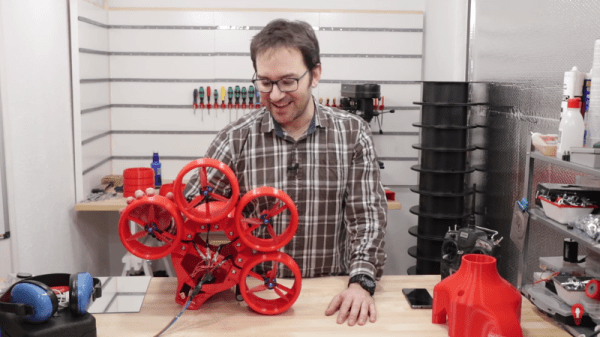
Lithium batteries are ubiquitous, cheap, and incredibly powerful. Combine them with some brushless DC motors and you’ve got serious power in a compact package. [Ivan Miranda] decided to use this to his advantage, building the Handheld Self Propelling System #1. 

Yes, we’ll come right out and say it – it’s a giant fan, and it blows. Or more accurately, it’s four moderately sized fans in one fetching wrist-mounted package. The one thing that seems completely absent from the video is an answer to the obvious question – why? Other than doing damage to the hearing of anyone nearby in an enclosed space, [Ivan] demonstrates its use with the help of a skateboard in the back end of the video.

It’s built with off-the-shelf RC parts and the body is 3D printed. This is the kind of print you want to get right first time – it takes several days to print and uses a significant amount of filament.

Overall, it’s a terrifying device that promises to do something awesome when finished. [Ivan]’s just finished the thrust test and we can’t wait to see what comes next. 

If you’re looking for another way to propel yourself on a skateboard, well – there’s always the more conventional electric path.

https://youtu.be/WmMkUWvBC64

What’s The Deal With Transparent Aluminum?

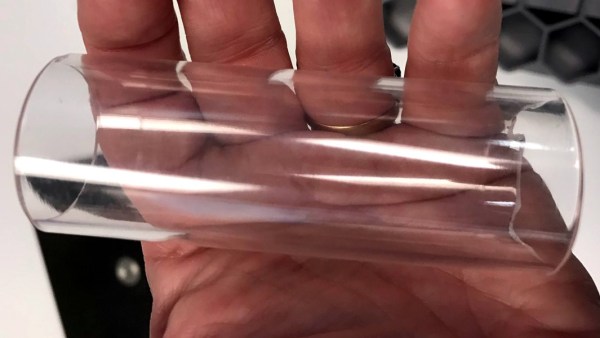
It looks like a tube made of glass but it’s actually aluminum. Well, aluminum with an asterisk beside it — this is not elemental aluminum but rather a material made using it.

We got onto the buzz about “transparent aluminum” as a result of a Tweet from whence the image above came. This Tweet was posted by [Jo Pitesky], a Science Systems Engineer at the Jet Propulsion Lab in Pasadena. [Jo] reported that at a recent JPL technology open house she had the chance to handle a tube of material that looks for all the world like a section of glass tubing, but was billed as transparent aluminum. [Jo] tweeted this because it was an interesting artifact that few people get to play with and she’s right, this is fascinating!

The the material itself is intriguing, and I immediately had practical questions like what is this stuff? What is it good for? How is it made? And is it really aluminum rendered transparent by some science fiction process?

Continue reading “What’s The Deal With Transparent Aluminum?”

Soldering Saves Data From Waterlogged Laptop

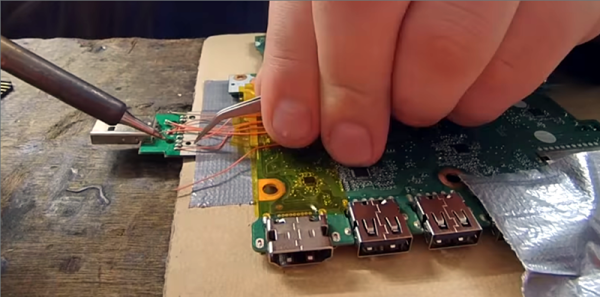
What happens when you drop your laptop in the pool? Well, yes, you buy a new laptop. But what about your data. You do have backups, right? No, of course, you don’t. But if you can solder like [TheRasteri] you could wire into the flash memory on the motherboard and read it one last time. You can see the whole exploit in the video below.

There’s really three tasks involved. First is finding the schematic and board layout for motherboard. Apparently, these aren’t usually available from the manufacturer but can be acquired in some of the seedier parts of the Internet for a small fee. Once you have the layout, you have to arrange to solder wires to the parts of the flash memory you need to access.

Continue reading “Soldering Saves Data From Waterlogged Laptop”

Hackaday X Tindie Meetup In Dublin This Friday

Hackaday and Tindie are coming to Dublin at the end of this week. Join us on Friday night as we host a meetup in the company of our friends at TOG hackerspace. Please RSVP to tell us you’re coming.

This is a Bring-a-Hack style event, so come out for a casual meetup and bring a project to show off. It’s a great way to get conversation started and often the most amazing projects are the ones whose creators imagine them to be inconsequential. Keep them to a manageable size though, space may be at a premium.

We’ll supply beverages and light snacks to oil the wheels, and Hackaday Editors [Mike Szczys] and [Jenny List], Tindie Product Manager [Jasmie Brackett], and SupplyFrame Product Manager [Sophi Kravitz] will be on hand. It doesn’t matter what it is you’ve got to show us, whatever you have we’d love to see it. Thank you to TOG for opening their doors to this event!

Saturday is the Hackaday Dublin Unconference!

Act fast to grab one of the last five tickets to the Hackaday Dublin Unconference this Saturday. All tickets have been sold out, but a few people who had a ticket but are now unable to attend were nice enough to return them so that someone else may take their place. Everyone one who attends should be ready to give a 7-minute talk on what they’re excited about right now. We can’t get through everyone in one day so don’t worry if public speaking mortifies you (but still come prepared). We’ll do our best to get through a ton of presenters. We’ll have food and drink on hand and head to the pub afterward for those still standing that evening! Need proof that this is not to be missed? We did it in London last September and it was epic!

This is Hackaday’s first visit en masse to the Irish capital, and we’re looking forward to correcting that oversight and meeting the masses of our Irish readership. Thanks to the generous support of DesignSpark, the innovation arm of RS Components and the exclusive sponsor of the event, we hare happy to offer Hackaday Dublin Unconference free of charge to all who attend.

We’re excited about what will come from this weekend and are looking forward to it. See you soon!

Waterjet plasma production

[Ben Krasnow] Tests Novel Plasma

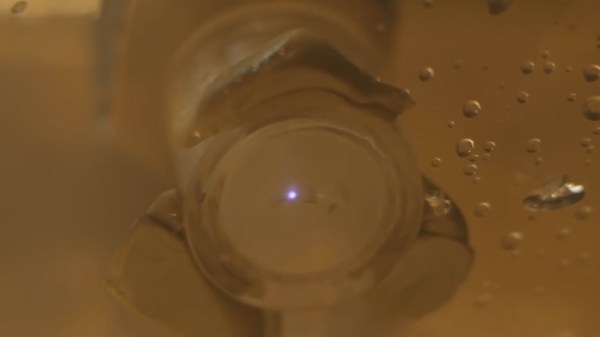
When [Ben Krasnow] sees an interesting phenomenon he pursues it with a true scientist’s mentality, though it doesn’t hurt that he also has the skills and the workshop. This time he’s produced a glowing plasma by impacting fused quartz and other materials with a high-speed water jet.

The jet of pure water emerges from a 0.004″, or 100 micron, diameter sapphire orifice with a flow rate of around 2 milliliters per second giving a speed of 240 meters per second. It collides at 90° with a dielectric material where the plasma is produced as a toroid surrounding the collision point.

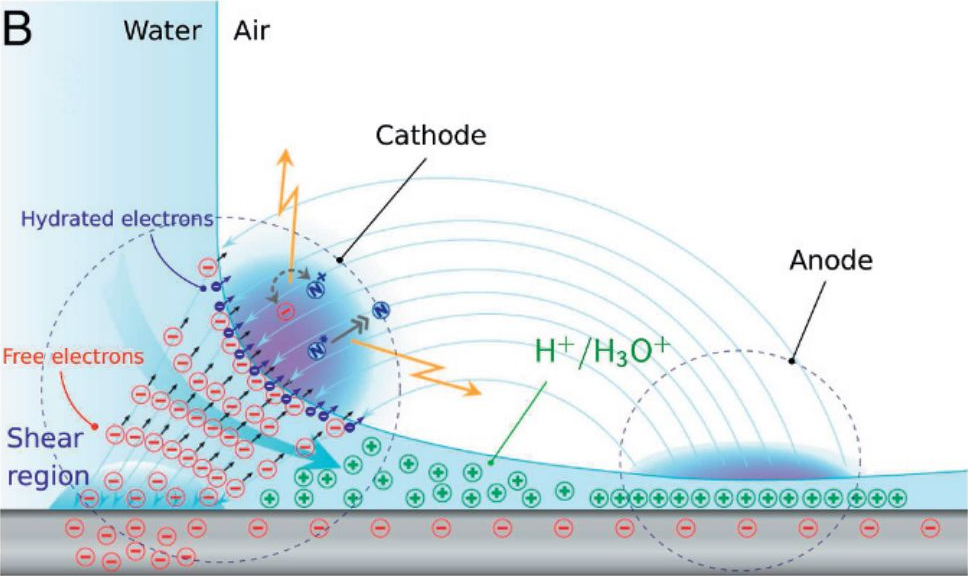
How a waterjet plasma works

There’s been very little research into the phenomena but a proposal from one research paper which [Ben] found is that the plasma is a result of charging due to the triboelectric effect. This is the same effect which charges a balloon when you rub it against your hair, except that here there are water molecules running across a clear dielectric such as fused quartz. This effect results in a positively charged anode downstream of the collision while the water near the point of highest shear becomes conductive and conducts negative charge to the point of smallest curvature, producing a cathode. The electric field at the small-radius cathode acts like a short point with a high voltage on it, ionizing the air and forming the plasma. If this form of ionization sounds familiar, that’s because we’ve talked it occurring between the sharp wire and rounded foil skirt of a flying lifter.

[Ben] found support for the triboelectric theory when he substituted oil for the water. This didn’t produce any plasma, which is be expected since unlike water, oil is a non-polar molecule. However, while the researchers tried just a few dielectric materials, [Ben] had success with every transparent dielectric which he tried, including fused quartz, lithium niobate, glass, polycarbonate, and acrylic, some of which are very triboelectrically different from each other. So there’s room here for more theorizing. But check out his full video showing his equipment for producing the waterjet as well as his demonstrations and explanation.

Continue reading “[Ben Krasnow] Tests Novel Plasma”

It Looks Like A Nintendo, But It’s Running A Pi: A Gamer’s Long-Sought Dream Handheld

[Christopher Foote] didn’t play quite as many games as he wanted to as a child. After years of catching up using the RetroPie and the PiGRRL 2, it was when he first picked up a Switch’s joy-cons that inspiration struck. Behold: the PiSwitch!

Realizing they operated on Bluetooth tech, [Foote] spent a fair chunk of time getting the joy-cons to properly pair to the Raspberry Pi 3 and function as one controller. Once done, he relied on Linux Joystick Mapper to manage the keybindings with some extra legwork besides to get the analog sticks working properly.

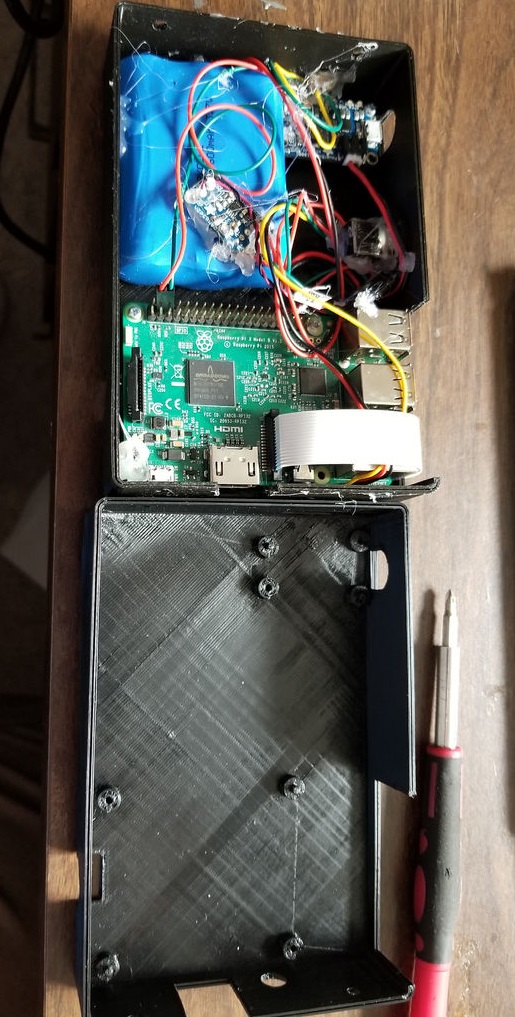
To make this console mobile, he’s packed a 6600mAh battery and Adafruit Powerboost 1000c into the device, added a second headphone jack and speaker for commuting and home enjoyment, and a Pi V2 camera module. A 3D printed case, encapsulating these components and a seven-inch touchscreen, also allows the joy-cons to be detached — though he plans on updating its design in the future.

The PiSwitch boots into a custom UI  that lets you select different services — RetroPie, Kodi, Debian, and the terminal — while the joy-cons seamlessly function together or individually regardless of the activity. Check out the quick intro tour for this project after the break!

Continue reading “It Looks Like A Nintendo, But It’s Running A Pi: A Gamer’s Long-Sought Dream Handheld”