Coin Cell Powered Sea Turtle Research

Hacking and tinkering are always fun and games, but one just has to appreciate when all efforts are additionally aimed towards doing something good. [Nikos] sets an example by combining his interest in technology with his passion for wildlife conservation by creating a low cost and ultra-low power temperature logger — and he is using a coin cell for it.

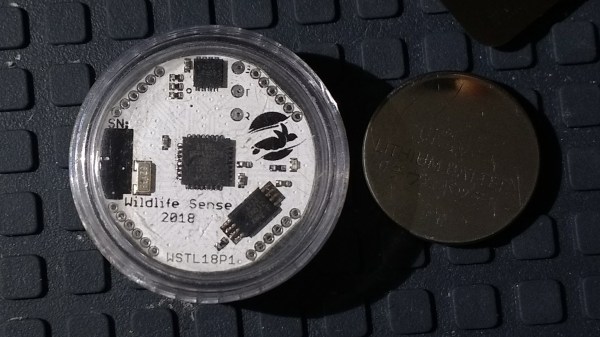
As the founder of a sea turtle conservation project in Greece, [Nikos] enjoys building scientific instruments that help him and his team on their mission. With a goal to log the temperature every 10 minutes over a period of at least 180 days, he designed a PCB just big enough to hold a CR2032 coin cell. Fifty of them will eventually be sealed in waterproof enclosures, and buried in the sand for the whole research duration.

Limiting the design to its bare necessities, the rest of the PCB is housing a digital temperature sensor, an SPI EEPROM to hold all the recorded sensor values over those 180 days, and an ATmega328PB clocked by a 32.768kHz crystal. Wondering what to do with all the extra, unused pins of the ATmega, [Nikos] simply routed them to be accessible through pin headers, thus turning the data logger alternatively into a coin cell powered development board.

Assuming your logging interval requirements are significantly lower, you might be thrilled to hear that [Nikos] estimates a theoretical 7+ years an average coin cell could power the data logger in sleep mode, which makes him confident to reach the 180 days goal.
A Robot Arm For Virtual Beer Pong

Leave it to engineering students to redefine partying. [Hyun], [Justin], and [Daniel] have done exactly that for their final project by building a virtually-controlled robotic arm that plays beer pong.

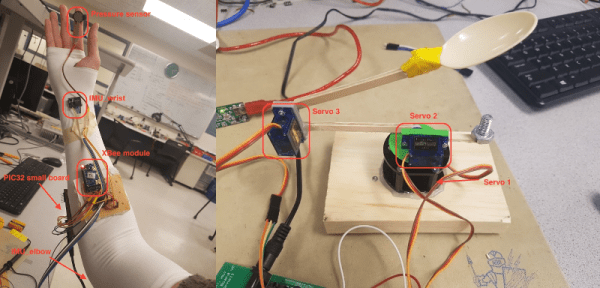
There are two main parts to this build: a sleeve worn by the user, and the robotic arm itself. The sleeve has IMUs at the elbow and wrist and a PIC32 that calculates their respective angles. The sleeve sends angle data to a second PIC32 where it is translated it into PWM signals and sent to the arm.

There’s a pressure sensor wired sleeve-side that’s worn between forefinger and thumb and functions as a release mechanism. You don’t actually have to fling your forearm forward to get the robot to throw, but you can if you want to. The arm itself is built from three micro servos and mounted for stability. The spoon was a compromise. They tried for a while to mimic fingers, but didn’t have enough time to implement grasping and releasing on top of everything else.

Initially, the team wanted wireless communication between the sleeve and the arm. They got it to work with a pair of XBees, but found that RF was only good for short periods of use. Communication is much smoother over UART, which you can see in the video below.

You don’t have to have a machine shop or even a 3-D printer to build a robot arm. Here’s another bot made from scrap wood whose sole purpose is to dunk tea bags.

Continue reading “A Robot Arm For Virtual Beer Pong”

Brute Forcing Passwords With A 3D Printer

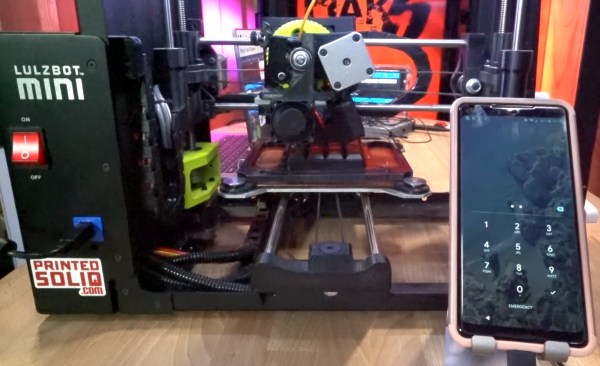
Many of us use a 4 digit pin code to lock our phones. [David Randolph] over at Hak5 has come up a simple way to use a 3D printer to brute force these passwords. Just about every 3D printer out there speaks the same language, G-code. The same language used in CAD and CNC machines for decades.

[David] placed a numeric keypad on the bed of his printer. He then mapped out the height and positions of each key. Once he knew the absolute positions of the keys, it was easy to tell the printer to move to a key, then press and release. He even created a G-code file which would press every one of the 10,000 4 key pin combinations.

A file this large was a bit unwieldy though, so [David] also created a python script which will do the same thing — outputting the G-code and coordinates to brute force any 4 pin keypad. While a printer is quite a bit slower than Hak5’s own USB Rubber Ducky device (which acts as an automated keyboard), it will successfully brute force a password. Although most phones these days do limit the number of password attempts a user gets.

[David] admits this is probably useless in a clandestine/hacking application, but the video is still a great introduction to G-code and using 3D printers for non-printing functions.

Continue reading “Brute Forcing Passwords With A 3D Printer”

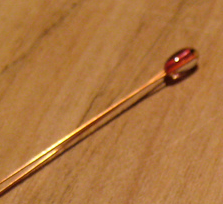
Thermistors And 3D Printing

I always find it interesting that 3D printers — at least the kind most of us have — are mostly open-loop devices. You tell the head to move four millimeters in the X direction and you assume that the stepper motors will make it so. Because of the mechanics, you can calculate that four millimeters is so many steps and direct the motor to take them. If something prevents that amount of travel you get a failed print. But there is one part of the printer that is part of a closed loop. It is very tiny, very important, but you don’t hear a whole lot about it. The thermistor.

The hot end and the heated bed will both have a temperature sensor that the firmware uses to keep temperatures at least in the ballpark. Depending on the controller it might just do on-and-off “bang-bang” control or it might do something as sophisticated as PID control. But either way, you set the desired temperature and the controller uses feedback from the thermistor to try to keep it there.

If you print with high-temperature materials you might have a thermocouple in your hot end, but most machines use a thermistor. These are usually good to about 300 °C. What got me thinking about this was the installation of an E3D V6 clone hot end into my oldest printer which had a five-year-old hot end in it. I had accumulated a variety of clone parts and had no idea what kind of thermistor was in the heat block I was using.

Continue reading “Thermistors And 3D Printing”

Mount Sopris

Design A Microcontroller With Security In Mind

There are many parts to building a secure networked device, and the entire industry is still learning how to do it right. Resources are especially constrained for low-cost microcontroller devices. Would it be easier to build more secure devices if microcontrollers had security hardware built-in? That is the investigation of Project Sopris by Microsoft Research.

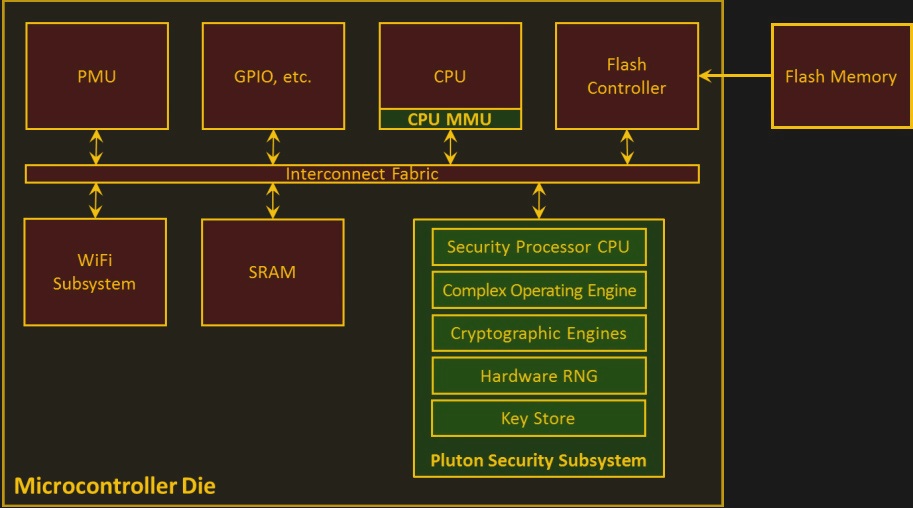
The researchers customized the MediaTek MT7687, a chip roughly comparable to the hacker darling ESP32. The most significant addition was a security subsystem. It performs tasks notoriously difficult to do correctly in software, such as random number generation and security key storage. It forms the core of what they called the “hardware-based secure root of trust.”

Doing these tasks in a security-specific module solves many problems. If a key is not stored in memory, a memory dump can’t compromise what isn’t there. Performing encryption/decryption in task-specific hardware makes it more difficult to execute successful side-channel attacks against them. Keeping things small keeps the cost down and also eases verifying correctness of the code.

But the security module can also be viewed from a less-favorable perspective. Its description resembles a scaled-down version of the Trusted Platform Module. As a self-contained module running its own code, it resembles the Intel Management Engine, which is currently under close scrutiny.

Will we welcome Project Sopris as a time-saving toolkit for building secure networked devices? Or will we become suspicious of hidden vulnerabilities? The researchers could open-source their work to ease these concerns, but value of their work will ultimately depend on the fast-moving field of networked device security.

Do you know of other efforts to add hardware-assisted security to microcontrollers? Comment below or let us know via the tip line!

[via Wired]

Image of Mount Sopris, namesake of the project, by [Hogs555] (CC-BY 4.0)


Hardware Heroes: Isambard Kingdom Brunel

There are some notable figures in history that you know of for just one single thing. They may have achieved much in their lifetimes or they may have only been famous for Andy Warhol’s fifteen minutes, but through the lens of time we only know them for that single achievement. Then on the other hand there are those historic figures for whom there is such a choice of their achievements that have stood the test of time, that it is difficult to characterize them by a single one.

[Isambard Kingdom Brunel], in front of the launching chains for the Great Eastern. [Public domain]
Isambard Kingdom Brunel, in front of the launching chains for the Great Eastern. [Public domain]
Such is the case of Isambard Kingdom Brunel, the subject of today’s Hardware Heroes piece. Do we remember him for his involvement in the first successful tunnel to pass beneath a river, as a builder of some of the most impressive bridges on the 19th century, the innovator in all aspects of rail engineering, the man behind the first screw-driven ocean-going iron ship, or do we remember him as all of those and more?

It is possible that if you are not British, or in particular you are not from the West of England, this is the first you’ve heard of Brunel. In which case he is best described as a towering figure of many aspects of engineering over the middle years of the 19th century. His influence extended from civil engineering through the then-emerging rail industry, to shipbuilding and more, and his legacy lives on today in that many of his works are still with us.

Engineering: The Family Trade

Brunel’s father, Marc Brunel, was an engineer and refugee from the French Revolution who found success in providing the British Navy with a mass-production system for wooden pulley blocks as used in the rigging of sailing ships. He enters this story for his grand project, the world’s first tunnel to be dug under a navigable river, beneath London’s River Thames from Rotherhithe to Wapping, and for his patented tunneling shield which made it possible to be dug.

Continue reading “Hardware Heroes: Isambard Kingdom Brunel”

Modernizing Puerto Rico’s Grid

After two massive hurricanes impacted Puerto Rico three months ago, the island was left with extensive damage to its electrical infrastructure. Part of the problem was that the infrastructure was woefully inadequate to withstand a hurricane impact at all. It is possible to harden buildings and infrastructure against extreme weather, and a new plan to restore Puerto Rico’s power grid will address many of these changes that, frankly, should have been made long ago.

Among the upgrades to the power distribution system are improvements to SCADA systems. SCADA allows for remote monitoring and control of substations, switchgear, and other equipment which minimizes the need for crews to investigate problems and improves reliability. SCADA can also be used for automation on a large scale, in addition to the installation of other autonomous equipment meant to isolate faults and restore power quickly. The grid will get physical upgrades as well, including equipment like poles, wire, and substations that are designed and installed to a more rigorous standard in order to make them more wind- and flood-tolerant. Additional infrastructure will be placed underground as well, and a more aggressive tree trimming program will be put in place.

The plan also calls for some 21st-century improvements as well, including the implementation of “micro grids”. These micro grids reduce the power system’s reliance on centralized power plants by placing small generation facilities (generators, rooftop solar, etc) in critical areas, like at hospitals. Micro grids can also be used in remote areas to improve reliability where it is often impractical or uneconomical to service.

While hurricanes are inevitable in certain parts of the world, the damage that they cause is often exacerbated by poor design and bad planning. Especially in the mysterious world of power generation and distribution, a robust infrastructure is extremely important for the health, safety, and well-being of the people who rely on it. Hopefully these steps will improve Puerto Rico’s situation, especially since this won’t be the last time a major storm impacts the island.