Ancient Insect Scales Analyzed With Help Of Nose Hair

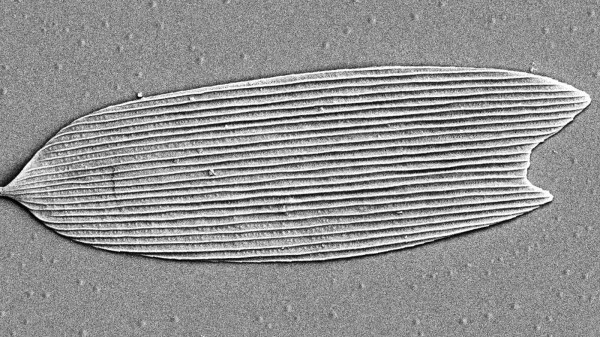
Scientists working to advance the frontier of knowledge frequently also need to invent their tools along the way. Sometimes these are interesting little hacks to get a job done. Recently some researchers found ancestors of moths and butterflies older than any previously known by analyzing tiny scales found alongside ancient pollen. They needed a tool to manipulate these scales: separating them from surrounding debris, transferring them to microscope slides. The special tool was a needle tipped with a single human nostril hair.

As ancient insects were the published paper‘s focus, their use of nose hair tipped needle was only given a brief mention in the “Materials and Methods” section. Interviews by press quoted researchers’ claim that nose hair has the right mechanical properties for the job, without further details. Not even a picture of the tool itself. What properties of insect scales made them a good match with the properties of nose hair? Was there a comprehensive evaluation of multiple types of hair for the task? Would we regret asking these questions?

Novel approaches to fine-tipped tools would be interesting to examine under other contexts, like the tweezers we use to build surface-mount electronics. As SMD parts continue to shrink in size, will we reach a point where hair-tipped tools are the best DIY alternative to an expensive pick-and-place machine? It would be another creative approach to deal with the challenges of hand-built SMD. From simple but effective mechanical helpers, to handy 3D printed tools, to building hybrid Manual + CNC pick-and-place more affordable than their fully automated counterparts.

[via Washington Post]
Trio Of Tips For A Cetus Printer

Thanks to the holiday gifting cycle, many homes are newly adorned with 3D printers. Some noobs are clearly in the “plug and play” camp, looking for a user experience no more complicated than installing a new 2D printer. But most of us quickly learn that adding a dimension increases the level of difficulty substantially, and tinkering ensues.

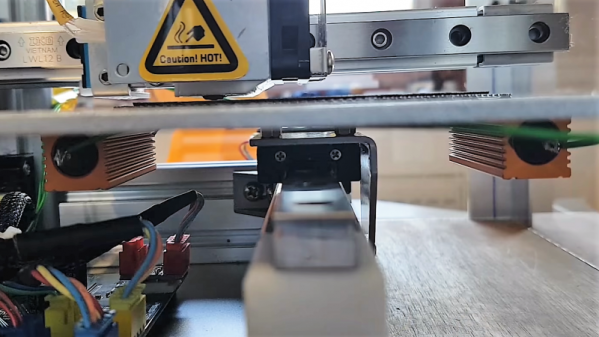
One such tinkerer, [Marco Reps], has been taking his new Cetus 3D printer to new places, and his latest video offers a trio of tips to enhance the user experience of this bare-bones but capable printer. First tip: adding a heated bed. While the company offers a heated aluminum bed for ABS and PETG printing at a very reasonable price, [Marco] rolled his own. He bolted some power resistors to the aluminum platen, built a simple controller, and used the oversized stock power supply to run everything.

To contain the heat, tip two is an enclosure for the printer. Nothing revolutionary here — [Marco] just built a quick cover from aluminum profiles and acrylic.

But the clear case allows for tip number three, the gem of this video: synchronized time-lapse photography. Unhappy with the jerky time-lapse sequences that are standard fare, he wrote a Python program that uses OpenCV to compare webcam frames and save those that are similar to the last saved frame. This results in super smooth time-lapse sequences that make it look like the print is being extruded as a unit. Pretty neat stuff.

Did you find a 3D printer under your Festivus Pole, and now you’re wondering what’s next? Check out [Tom Nardi]’s guide for 3D newbies for more tips.

Continue reading “Trio Of Tips For A Cetus Printer”

Color Organ Dress, A Wearable With Audio Feedback

There is a huge amount of interest among our community in wearable electronics, but it is fair to say that it is a technology that has a way to go at our level in terms of its application. Some twinkly LEDs are all very well, but unless you have the arrived-on-a-spaceship-from-the-future aesthetic of someone like [Naomi Wu] to carry them off they get old rather quickly.

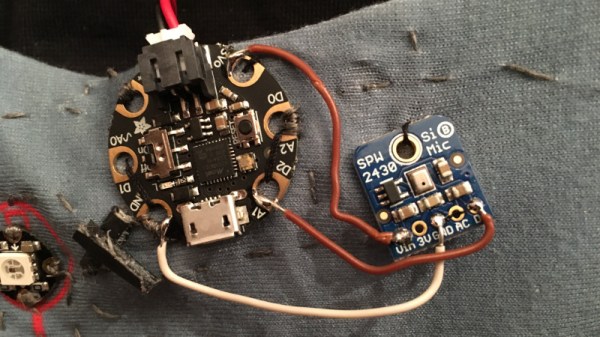
What the sew-on LED sector of wearable electronics is waiting for are some applications, wearable lights that do something rather than just look pretty. And [Moko] has a project that takes them in that direction, with her color organ dress, a garment whose LEDs react to ambient sound with the aid of a MEMS microphone and an Adafruit Gemma M0 microcontroller board. The LEDs form a color wheel which rotates, and stops at a point proportional to the sound level at the time.
The write-up is an interesting one, going into a little detail as it does in the images on the construction of an electronically-enhanced piece of clothing. Wiring everything up is one thing, but there are other considerations such as the incorporation of extra panels to protect them from mechanical stress, and from sweat. From a dressmaker’s perspective it’s a well constructed garment in its own right with an attractive PCB-style pattern (Where did she get that fabric? Or did she print it herself?) and it appears that she’s the fortunate owner of a serger (overlocker).

Well-assembled clothing has made it here before, for example an impressive jellyfish skirt or this laser-cut arcsin dress. And should you wish to make a garment for your next wearable project, you’ll be sure to need a well-stocked textile bench.

Tomu: A Microcontroller For Your USB Port

Looking for a ultra tiny development board? Tomu is an ARM Cortex M0+ device that fits inside your USB port. We’ve seen these in person, and they’re tiny.

There’s a few commercial devices in this form factor on the market. For example, the Yubikey Nano emulates a keyboard to provide codes for two-factor authentication. The Yubikey’s tiny hardware does this job well, but the closed-source device isn’t something you can modify.

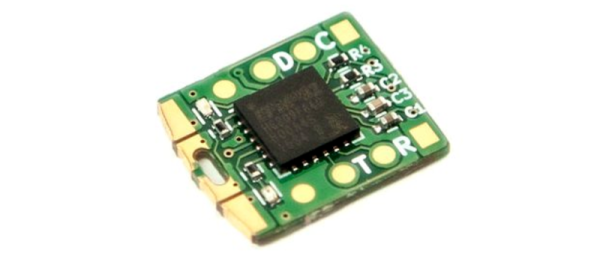
Tomu is a new device for your USB port. It sports a Silicon Labs EFM32 microcontroller, two buttons, and two LEDs. This particular microcontroller is well suited to the task. It can talk USB without a crystal for timing, and has an internal regulator to generate the core voltage from a 5 V USB supply. Since it supports DFU firmware updates, it can be reprogrammed without any special tools.

Unfortunately, the EFM32 device lacks secure storage options, so the Tomu might not be the best device to keep your secrets on. That being said, it will be interesting to see what applications people come up with. The creators have suggested using the device for media buttons, sleeping and waking a computer, and as a U2F key.

The project is currently available on CrowdSupply, and all design files and source is available on their Github. If you like soldering tiny things, the twelve-part bill of materials should be fairly easy to assemble at home.

Vacuum Tubes: Shipping Through EBay Now Challenging?

There is disquiet in the world of vacuum electronics, that something as simple as shipping a vacuum tube could now be very difficult to achieve. It’s a concern expressed among other places in a video by [Guitologist] that we’ve included below, and includes tales of vacuum tubes being impounded as either dangerous to ship, or not allowed to be shipped across international borders.

Upon investigation it appears that the common thread in all the stories lies with eBay’s Global Shipping Program, the centralised shipping service operated by the online auction giant. We reached out to eBay’s press office on the subject but have yet to receive a reply. It’s best to ask someone who ships a lot of tubes for comment when you have a tube shipping story, so we also had a conversation with TC Tubes. They’re a small company dealing in tubes, and as you might imagine they ship a lot of them (Their website is likely to detain you for a while if you are a tube-head). [Chelsea] from TC Tubes told us that they have encountered no regulatory barriers to tube shipping, and that their only bad experience has been yet again with eBay’s Global Shipping Program.

So it seems there is no cause for panic if you ship tubes, CE marking or RoHS rules haven’t come for your EL34s and your 6550s. Ebay have evidently got some kind of issue with tubes in their shipping operation, and perhaps you should ship by other means if you wish to avoid your tubes going astray. The consensus here among the Hackaday crew is that it could be as simple as uninformed employees not being aware of what tubes are because they aren’t as common as they used to be. After all, with over a hundred years of history behind them it’s not as though any potential issues with their shipping haven’t been comprehensively explored.

We’d still be interested to hear from eBay on the matter though, if they would care to comment.

Continue reading “Vacuum Tubes: Shipping Through EBay Now Challenging?”

The (Unnecessary?) Art Of Connector Crimping

The “Completion Backwards Principle” is a method of reasoning through a problem by visualizing the end result and then working your way backwards from that point. The blog post that [Alan Hawse] has recently written about the intricacies of crimping wires for plug connectors is a perfect example of this principle. The end result of his work is the realization that you probably shouldn’t bother crimping your own connectors, but watching him work backwards from that point is still fascinating. It’s also the name of a rock album from the 80’s by The Tubes, but this is not a useful piece of information in regards to electrical wiring.

Of course, sometimes people do silly things. Even though there are pre-crimped wires available online for a pittance, you might still want to do your own. With this in mind, [Alan] has put together an exceptionally detailed and well-research post that gives you all the information you could possibly want to know about crimping what is often erroneously referred to as the “JST connector”.

He starts by showing off some common examples of this connector, which if you’ve ever opened a piece of consumer electronics will be like looking through a High School yearbook. You might not know their names without reading them, but you definitely remember what they look like.

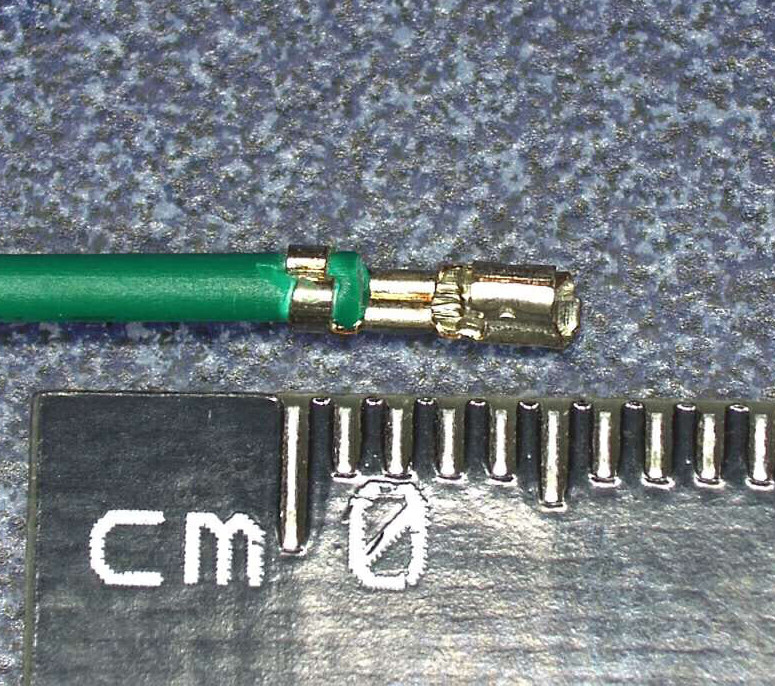
We’re then treated to an array of macro shots showing the scale of the pieces involved. If getting up close and personal with metal bits that are only a few millimeters long is your kind of thing, then you’re really going to love this part.

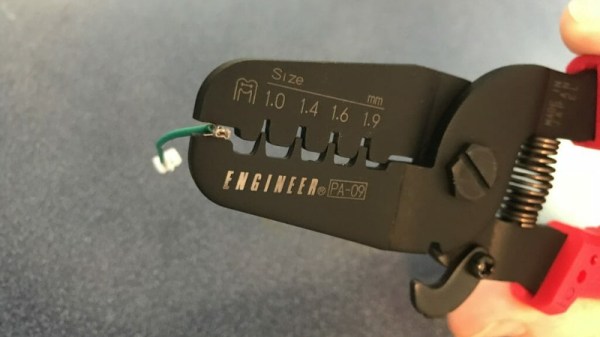
Finally, the post is wrapped up with a few words about the kind of crimping tools that are available on the market, and then a demonstration of his personal crimping method. While some tools would have you crimp both sets of “wings” at the same time, [Alan] tells us he finds taking them on individually leads to better results in his experience.

If this this little taste has left you hungry for a true feast of hyper-specialized knowledge, be sure to check out the Superconference talk by [Bradley Gawthrop].

Continue reading “The (Unnecessary?) Art Of Connector Crimping”

Nintendo Switch Gets Making With Labo

Over the years, Nintendo has had little trouble printing money with their various gaming systems. While they’ve had the odd misstep here and there since the original Nintendo Entertainment System was released in 1983, overall business has been good. But even for the company that essentially brought home video games to the mainstream, this last year has been pretty huge. The release of the Nintendo Switch has rocketed the Japanese gaming giant back into the limelight in a way they haven’t enjoyed in a number of years, and now they’re looking to keep that momentum going into 2018 with a killer new gaming accessory: a cardboard box.

Some of the contraptions feature surprisingly complex internal mechanisms.

Well, it doesn’t have to be a box, necessarily. But no matter which way you fold it, it’s definitely a piece of cardboard. Maybe a few bits of string here and there. This is the world of “Nintendo Labo”, a recently announced program which promises to let Switch owners create physical objects which they can interact with via specially designed software for the console.

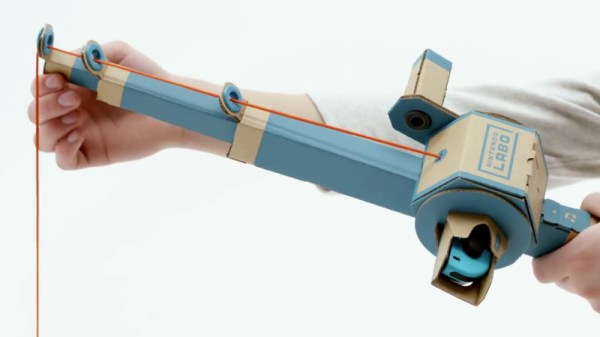
The Labo creations demonstrated in the bombastic announcement video make clever use of the very unique Switch hardware. The removable Joy-Con controllers are generally still used as input devices, albeit in less traditional ways. Twisting and tilting the cardboard creations, which take varied forms such as a fishing rod or motorcycle handlebars, relays input to the appropriate game thanks to the accelerometers and gyroscopes they contain.

Many of the more complex contraptions rely on a less-known feature of the controller: the IR depth camera. By pointing the controller’s camera inside of the devices, the motion of internal components, likely helped along by IR-reflective tape, can be tracked in three dimensions. In the video, the internal construction of some of the devices looks downright intimidating.

Which leads into the natural question: “Who exactly is this for?”

Clearly some of the gadgets, not to mention the folded cardboard construction, are aimed at children, an age group Nintendo has never been ashamed to appeal to. But some of the more advanced devices and overall concept seems like it would play better with creative teens and adults looking to push the Switch in new directions.

Will users be empowered to create their own hardware, and by extension, associated software? Will hackers and makers be able to 3D print new input devices for the Switch using this platform? This is definitely something we’ll be keeping a close eye on as it gets closer to release in April.

The popularity of the Switch has already given rise to a surprising amount of hacking given how new the console is. It will be interesting to see if the introduction of Labo has any effect on the impressive work already being done to bend the console to the owner’s will.

Continue reading “Nintendo Switch Gets Making With Labo”