Great People And Culture At 34th Chaos Communication Congress

If you’ve been to a Chaos Communication Congress, you know the feeling — the strange realization after it’s all over that you’re back in the “real world”. It’s somehow alienating and unfriendly in comparison to being surrounded by computer freaks, artists, hackers, activists, coders, and other like-minded individuals over the four days of the Congress. A hand-written poster by the podcasting center read “Endlich, normale Leute” — “At last, normal people” — which is irony piled on irony but the sentiment is still right for certain strange values of “normal”. Normal hackers? You’d probably fit right in.

We cover a lot of the talks from the Congress, because they’re first-class and because you can play along at home, but the real soul of the Congress is people getting together, making something temporary and crazy, talking over their common plans, learning new things directly from one-another, and simply having fun. Here’s our chance to give you a little of the other side of the Congress.
Continue reading “Great People And Culture At 34th Chaos Communication Congress”

Electronics Workbench Goes Vertical With Pegboard Mounting

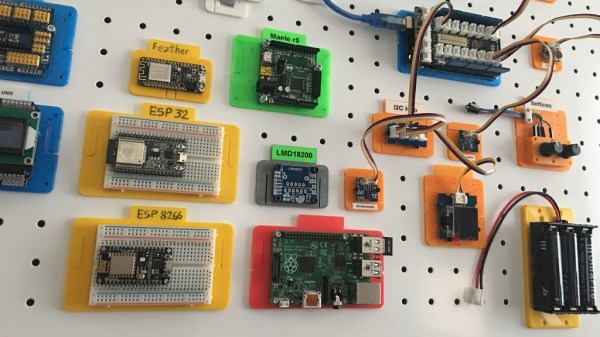
[JesusGomez] has certainly put work into his Vertical Laboratory concept. There’s a bit more to the idea than simply using 3D printed parts to move electronics from the desktop onto a metal pegboard, although that part is certainly nicely done. There are 3D models for securely mounting various hardware such as Raspberry Pi, Beaglebone, ESP32, cable management, breadboards, and other common parts to a metal pegboard. Instead of having parts and wires splayed across a workbench, it can be mounted and organized vertically. Having a project or prototype mounted on pegboard is easier to store, saves room, and frees up desk space in small work areas. It also makes for an organized and visually pleasing layout.

A clever piece of design is in the plastic mounts that he created. He wanted parts to remain securely mounted unless intentionally removed, allow different mounting orientations, and to never require access to the back side of the pegboard. To accomplish this, the parts use a combination of pegs that slide-lock with bendable sections that act as lock tabs. Once mounted, the parts stay put until the lock tabs are released by gently prying them out of position. Since mounting and removal can be done entirely from the front, wall mounted pegboards with inaccessible backs can be used.

Metal pegboard has its uses, even if the more common dead-tree version shows up more often in projects from DIY vacuforming to making a modular work surface for when space is at an absolute premium.

Eat Some Pringles, Feed The Cat

You know the saying: “Dogs have people, cats have servants.” This is especially true when your feline overlord loses track of time and insists on being fed at oh-dark-thirty. You’re tempted to stay in bed feigning death, but that’s a tall order with the cat sitting on your chest and staring into your soul.

An automatic cat feeder would be nice at moments like these, but off-the-shelf units are pricey. [Mom Will Be Proud] decided to roll his own cat feeder, and the results are pretty impressive for what amounts to a trash can build. Two old food cans form the body — a Pringles can on top to hold the food and a nut can below for the servo. The metal ends of the cans nest together nicely, and with a large section removed from each, an aperture opens every time the hopper rotates, dropping food down a chute. A BeagleBone Black controls the servo, but anything with PWM outputs should do the trick. We’d lean toward the ESP8266 ecosystem for WiFi support for remotely controlling feedings, and we’d probably beef up the structure with PVC tube to prevent unauthorized access. But it’s a simple concept, and simple is a good place to start.

You shall not want for pet feeder builds around these parts. Take your pick — snazzy Steampunk, super cheap, or with an Archimedean twist.

Continue reading “Eat Some Pringles, Feed The Cat”

Custom PCB Revives A Vintage Tree Stand

After 56 years, [Jeff Cotten]’s rotating Christmas tree stand had decided enough was enough. While its sturdy cast aluminum frame was ready for another half-century of merriment, the internal mechanism that sent power up through the rotating base had failed and started tripping the circuit breaker. The problem itself seemed easy enough to fix, but the nearly 60 year old failed component was naturally unobtanium.

But with the help of his local makerspace, he was able to manufacture a replacement. It’s not exactly the same as the original part, and he may not get another 56 years out of it, but it worked for this season at least so that’s a win in our books.

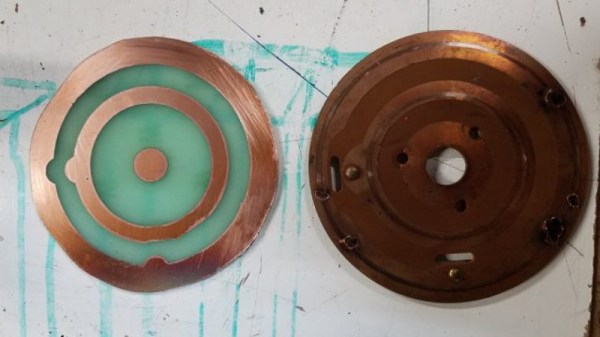
The mechanism inside the stand is fairly simple: two metal “wipes” make contact with concentric circle traces on a round PCB. Unfortunately, over the years the stand warped a bit and the wipe made contact with the PCB where it wasn’t intended do. This caused an arc, destroying the PCB.

The first step in recreating the PCB was measuring the wipes and the distance between them. This allowed [Jeff] to determine how thick the traces needed to be, and how much space should be between them. He was then able to take that data and plug it into Inkscape to come up with a design for his replacement board.

To make the PCB itself, he first coated a piece of copper clad board with black spray paint. Using the laser cutter at the makerspace, he was then able to blast away the paint, leaving behind the two concentric circles. A quick dip in acid, a bit of polishing with toothpaste, and he had a replacement board that was close enough to bolt up in place of the original hardware.

If you’d like to see the kind of hacks that take place above the stand, we’ve got plenty to get you inspired before next Christmas.

34C3: Roll Your Own Network Driver In Four Simple Steps

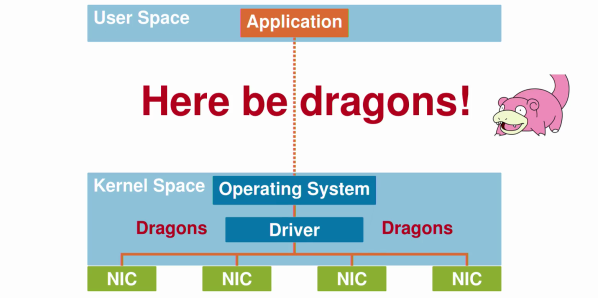
Writing your own drivers is a special discipline. Drivers on the one hand work closely with external hardware and at the same time are deeply ingrained into the operating system. That’s two kinds of specialization in one problem. In recent years a lot of dedicated networking hardware is being replaced by software. [Paul Emmerich] is a researcher who works on improving the performance of these systems.

Making software act like network hardware requires drivers that can swiftly handle a lot of small packets, something that the standard APIs where not designed for. In his talk at this year’s Chaos Commnication Congress [Paul] dissects the different approaches to writing this special flavor of drivers and explains the shortcomings of each.

Continue reading “34C3: Roll Your Own Network Driver In Four Simple Steps”

How The Hero Droid BB-8 Rolls

By now we’ve come to expect a bountiful harvest of licensed merchandise to follow every Star Wars film. This year’s crop included many flavors of BB-8 so every fan can find something to suit their taste. At the top of this food chain is a mobile interactive “Hero Droid BB-8”. For those who want to see how it works, [TheMikeSenna] cracked open his unit to feed our curiosity.

Also called “Spin Master BB-8” for the manufacturer, this toy is impressively sophisticated for its price point. The video surveyed the mechanical components inside the ball. Showing how the droid travels, and how the head articulates.

Continue reading “How The Hero Droid BB-8 Rolls”

Much Assembly Required: Game Your Way To Assembly Guru Status

It can be hard these days to find an excuse to create something for learning purposes. Want a microcontroller board? Why make one when you can buy an Arduino or a Blue Pill for nearly nothing? Want to control a 3D printer? Why write the code when you can just download something that works well like Marlin or Repetier? If you want to learn assembly language, then, it can be hard to figure out something you want to do that isn’t so silly that it demotivates you. If that sounds like you, then you should check out Much Assembly Required.

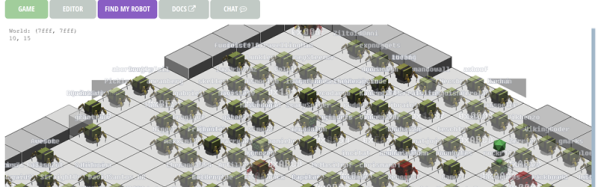
This is a multi-player game that runs in your Web browser. But before you click close, consider this: the game has you control an autonomous robot using an x86-like assembly language. Your robots have to find resources and build structures so it is sort of a mash up of Minecraft and one of the many modern Hammurabi-inspired games like Civilization.

The robots have a variety of peripherals including: drills, lasers, LiDar, legs, a hologram projector, solar-charged batteries, clocks, and more mundane things such as clocks, floppy drives, and a random number generator. The virtual world simulates day and night, so plan your power management accordingly.

You might wonder if you should even bother learning assembly. While it is true it isn’t as necessary as it once was,  understanding what the computer is doing in a very basic way can help form your thinking in surprising ways. There are also those times when you need to optimize something in assembly and that’s the difference between working and not working.

If you want to do something more practical, we’ve looked at options before. Of course, you can always slip your C compiler some assembly, too.