NASA Gemini spacesuit EVA

NASA Wants SpacePoop Hackers

NASA is looking for a few good men and women to solve an upcoming problem. Astronauts will soon be venturing outward beyond Earth orbit. If the spacecraft cabin should depressurize then they’ll have to put on their spacesuits and may have to keep them on for up to six days. During that time something will have to handle the resulting urine, fecal, and menstrual waste, all without the astronauts use of their hands. And that’s where you come in.

NASA is having a space poop challenge. The current system of an adult diaper won’t last six days. Your job, should you choose to accept it, is to design a system that will move the waste away from the skin where it can cause infection. Continue reading for the rather unique requirements.

Continue reading “NASA Wants SpacePoop Hackers”

Repurpose A Classroom Clicker For Great Justice

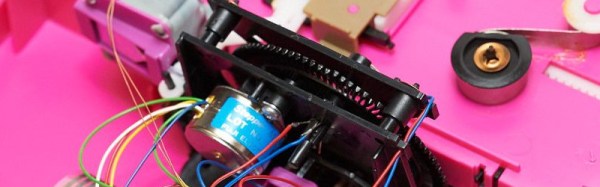
If you’ve been in a university class of a certain size, with a professor who wants to get live feedback from the students, you’ve probably been forced to buy a Turning Point “clicker”. Aside from the ridiculousness of making students pay for their professor’s instructional aides (do the make you pay extra for the chalk too?!?!) these clickers are a gauntlet thrown down to any right-minded hacker because they supposedly contain secrets.

[Nick] had one of these gadgets, and hopped right up on the shoulders of giants to turn it into a remote control that interfaces with his computer and drives a synthesizer, so he can work through the chord changes by clicking. His two references, to [Travis Goodspeed]’s nRF promiscuity hack and to [Taylor Killian]’s Arduino library for the clickers are a testament to why we need both reverse engineers doing the hard work and people who’ll wrap up the hard work in an easy-to-use library.

Continue reading “Repurpose A Classroom Clicker For Great Justice”

Otto Bot Is Bob’s Grandson

The Otto DIY robot has just taken first place in the coveted role as “best robot to 3D print for your (inner) child”. It’s cute, it dances, it doesn’t cost too much, it’s completely open source, and it’s not impossible to write code for. It’s probably the most refined Bob design that we’ve seen yet. Watch it move in the video below.

Continue reading “Otto Bot Is Bob’s Grandson”

Replacing A Failed Ebook Reader Battery

Resurrecting a beloved piece of tech can be a trying process when fighting through the mild heartbreak — doubly so if the product has been discontinued. When their old Sony PRS-T1 e-book reader refused to charge after leaving it on their dashboard during a hot day, [Andrea Gangemi] decided to leverage a little techno-necromancy and hack together a fix.

[Gangemi] found the problem to be a battery failure, but there was nary a replacement to be found. An old Motorola mobile phone battery ended up fitting the purpose nicely. Cracking open the e-book reader, de-soldering the old battery and — after deciphering which pins were which — installing the new one was simply done with a fine, high temperature soldering iron tip and Kapton tape to avoid short-circuiting. But hold on — the new battery wouldn’t charge, and the reader displayed a message saying that the battery was over heating; irony, thou art cruel.

Continue reading “Replacing A Failed Ebook Reader Battery”

NABiRoS sideways walking robot

This Robot Goes Through Life Sideways

We humans walk funny. Pivoting one leg forward at the hip creates an offset that puts us off-balance sideways. We have to compensate for this with each step we take. Many robots handle this by instead taking small, calculated steps. Enter NABiRoS, the Non Anthropomorphic Bipedal Robot System (link to the video below). The ‘Non Anthropomorphic’ means that it doesn’t walk like a human, and yet the ‘Bipedal’ means it still walks on two legs. The difference is that it walks sideways.

NABiRoS leg configuration
NABiRoS leg configuration (from video)

Here’s how the folks from RoMeLa (Robotics & Mechanisms Laboratory) at UCLA did it. Imagine you rotated both your legs 90 degrees such that they were facing in opposite directions. Then you rotate your upper body 90 degrees to face one of your legs. You can now move your legs to walk in the direction you’re facing and there’ll be no more tilting sideways each time you take a step. The joints are also simpler as only a single degree of freedom is needed in each of the knee and hip joints. The ankles and feet are done with a compliant, or an elastic, joint much as you see with a lot of prosthetic legs. As you can see in the video below, in addition to walking, they can do some surprisingly active things such as hopping up and down and what we can only call skipping. In fact, the result is sometimes very human.

Continue reading “This Robot Goes Through Life Sideways”

Fripon Is French For Meteorite Hunting

Just a few weeks ago, we reported on a US NASA project to track the path and estimate the size of meteoroids in the sky using a distributed network of a handful of cameras. It turns out that there’s a similar French effort, and it’s even cooler: the Fireball Recovery and InterPlanetary Observation Network (FRIPON). (The name is cute, if the acronym is contrived: a “fripon” is a trickster in French.)

Continue reading “Fripon Is French For Meteorite Hunting”

Code Like An Egyptian

[Marcelo Maximiano’s] son had a school project. He and a team of students built “The Pyramid’s Secret“–an electronic board game using the Arduino Nano. [Marcelo] helped with the electronics, but the result is impressive and a great example of packaging an Arduino project. You can see a video of the game, below.

In addition to the processor, the game uses a WT5001M02 MP3 player (along with an audio amplifier) to produce music and voices. There’s also a rotary encoder, an LCD, a EEPROM (to hold the quiz questions and answers), and an LED driver. There’s also a bunch of LEDs, switches, and a wire maze that requires the player to navigate without bumping into the wire (think 2D Operation).

Continue reading “Code Like An Egyptian”