Scott Swaaley On High Voltage

If you were to invent a time machine and transport a typical hardware hacker of the 1970s into 2018 and sit them at a bench alongside their modern counterpart, you’d expect them to be faced with a pile of new things, novel experiences, and exciting possibilities. The Internet for all, desktop computing fulfilling its potential, cheap single-board computers, even ubiquitous surface-mount components.

What you might not expect though is that the 2018 hacker might discover a whole field of equivalent unfamiliarity while being very relevant from their grizzled guest. It’s something Scott Swaaley touches upon in his Superconference talk:  “Lessons Learned in Designing High Power Line Voltage Circuits” in which he describes his quest for an electronic motor brake, and how his experiences had left him with a gap in his knowledge when it came to working with AC mains voltage.

When Did You Last Handle AC Line voltages?

If you think about it, the AC supply has become something we rarely encounter for several reasons. Our 1970s hacker would have been used to wiring in mains transformers, to repairing tube-driven equipment or CRT televisions with live chassis’,  and to working with lighting that was almost exclusively provided by mains-driven incandescent bulbs. A common project of the day would have been a lighting dimmer with a triac, by contrast we work in a world of microcontroller-PWM-driven LEDs and off-the-shelf switch-mode power supplies in which we have no need to see the high voltages. It may be no bad thing that we are rarely exposed to high-voltage risk, but along the way we may have lost a part of our collective skillset.

Scott’s path to gaining his mains voltage experience started in a school workshop, with a bandsaw. Inertia in the saw kept the blade moving after the power had been withdrawn, and while that might be something many of us are used to it was inappropriate in that setting as kids are better remaining attached to their fingers. He looked at brakes and electrical loads as the solution to stopping the motor, but finally settled on something far simpler. An induction motor can be stopped very quickly indeed by applying a DC voltage to it, and his quest to achieve this led along the path of working with the AC supply. Eventually he had a working prototype, which he further developed to become the MakeSafe power tool brake.

Get Your AC Switching Right First Time

The full talk is embedded below the break, and gives a very good introduction to the topic of switching AC power. If you’ve never encountered a thryristor, a triac, or even a diac, these once-ubiquitous components make an entrance. We learn about relays and contactors, and how back EMF can destroy them, and about the different strategies to protect them. Our 1970s hacker would recognise some of these, but even here there are components that have reached the market since their time that they would probably give anything to have. We see the genesis of the MakeSafe brake as a panel with a bunch of relays and an electronic fan controller with a rectifier to produce the DC, and we hear about adequate safety precautions. This is music to our ears, as it’s a subject we’ve touched on before both in terms of handling mains on your bench and inside live equipment.

So if you’ve never dealt with AC line voltages, give this talk a look. The days of wiring up transformers to power projects might be largely behind us, but the skills and principles contained within it are still valid.
Continue reading “Scott Swaaley On High Voltage”

Retrotechtacular: Remembering Radio Shack P-Box Kits

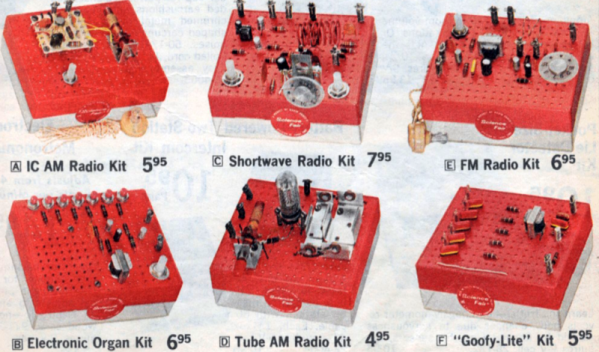
If you are under a certain age, you probably associate Radio Shack with cellphones. While Radio Shack never gave us access to the variety and economy of parts we have today, they did have one thing that I wish we could get again: P-Box kits. The obvious questions are: What’s a P-Box and why do I want one? But the kit wasn’t to make a P-Box. P-Box was the kind of box the kit came in. It was like a piece of perfboard, but made of plastic, built into a plastic box. So you bought the kit — which might be a radio or a metal detector — opened the box and then built the kit using the box as the chassis.

The perfboard was pretty coarse, too, because the components were all big discrete components. There was at least one that had an IC, but that came premounted on a PC board that you treated like a big component. One of my favorites was a three-transistor regenerative shortwave receiver. In those days, you could pick up a lot of stations on shortwave and it was one of the best ways at the time to learn more about the world.

On the left, you can see a picture of the radio from the 1975 catalog. You might think $7.95 is crazy cheap, but that was at least a tank full of gas or four movie tickets in those days, and most of us didn’t have a lot of money as kids, so you probably saved your allowance for a few weeks, did chores, or delivered papers to make $8.

Continue reading “Retrotechtacular: Remembering Radio Shack P-Box Kits”

Jeremy Hong: Weaponizing The Radio Spectrum

Jeremy Hong knows a secret or two about things you shouldn’t do with radio frequency (RF), but he’s not sharing.

That seems an odd foundation upon which to build one’s 2018 Hackaday Superconference talk, but it’s for good reason. Jeremy knows how to do things like build GPS and radar jammers, which are federal crimes. Even he hasn’t put his knowledge to practical use, having built only devices that never actually emitted any RF.

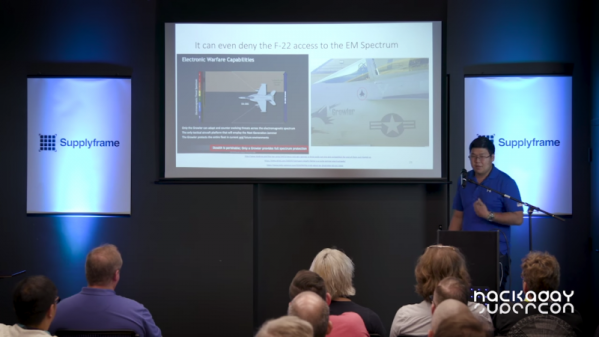
So what does one talk about when circumspection is the order of the day? As it turns out, quite a lot. Jeremy focused on how the military leverages the power of radio frequency jamming to turn the tables on enemies, and how civilian police forces are fielding electronic countermeasures as well. It’s interesting stuff, and Jeremy proved to be an engaging guide on a whirlwind tour into the world of electronic warfare.
Continue reading “Jeremy Hong: Weaponizing The Radio Spectrum”

MakerBot Moves Away From Makers With New Printer

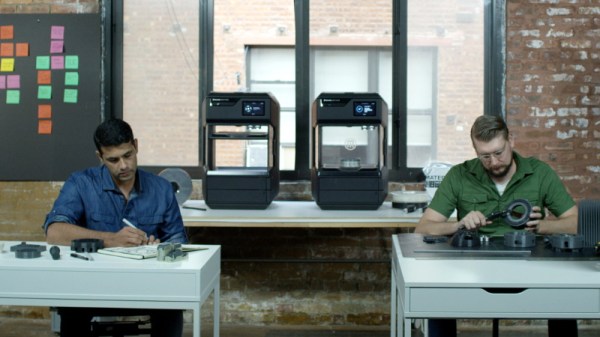
If you’ve been following the desktop 3D printing market for the last couple years, you’re probably aware of the major players right now. Chinese companies like Creality are dominating the entry level market with machines that are priced low enough to border on impulse buys, Prusa Research is iterating on their i3 design and bringing many exciting new features to the mid-range price point, and Ultimaker remains a solid choice for a high-end workhorse if you’ve got the cash. But one name that is conspicuously absent from a “Who’s Who” of 3D printing manufacturers is MakerBot; despite effectively creating the desktop 3D printing market, today they’ve largely slipped into obscurity.

So when a banner popped up on Thingiverse (MakerBot’s 3D print repository) advertising the imminent announcement of a new printer, there was a general feeling of surprise in the community. It had been assumed for some time that MakerBot was being maintained as a zombie company after being bought by industrial 3D printer manufacturer Stratasys in 2013; essentially using the name as a cheap way to maintain a foothold in the consumer 3D printer market. The idea that they would actually release a new consumer 3D printer in a market that’s already saturated with well-known, agile companies seemed difficult to believe.

But now that MakerBot has officially taken the wraps off a printer model they call Method, it all makes sense. Put simply, this isn’t a printer for us. With Method, MakerBot has officially stepped away from the maker community from which it got its name. While it could be argued that their later model Replicator printers were already edging out of the consumer market based on price alone, the Method makes the transition clear not only from its eye watering $6,500 USD price tag, but with its feature set and design.

That said, it’s still an interesting piece of equipment worth taking a closer look at. It borrows concepts from a number of other companies and printers while introducing a few legitimately compelling features of its own. While the Method might not be on any Hackaday reader’s holiday wish list, we can’t help but be intrigued about the machine’s future.

Continue reading “MakerBot Moves Away From Makers With New Printer”

The Space Station Has A Supercomputer Stowaway

The failed launch of Soyuz MS-10 on October 11th, 2018 was a notable event for a number of reasons: it was the first serious incident on a manned Soyuz rocket in 35 years, it was the first time that particular high-altitude abort had ever been attempted, and most importantly it ended with the rescue of both crew members. To say it was a historic event is something of an understatement. As a counterpoint to the Challenger disaster it will be looked back on for decades as proof that robust launch abort systems and rigorous training for all contingencies can save lives.

But even though the loss of MS-10 went as well as possibly could be expected, there’s still far reaching consequences for a missed flight to the International Space Station. The coming and going of visiting vehicles to the Station is a carefully orchestrated ballet, designed to fully utilize the up and down mass that each flight offers. Not only did the failure of MS-10 deprive the Station of two crew members and the experiments and supplies they were bringing with them, but also of a return trip which was to have brought various materials and hardware back to Earth.

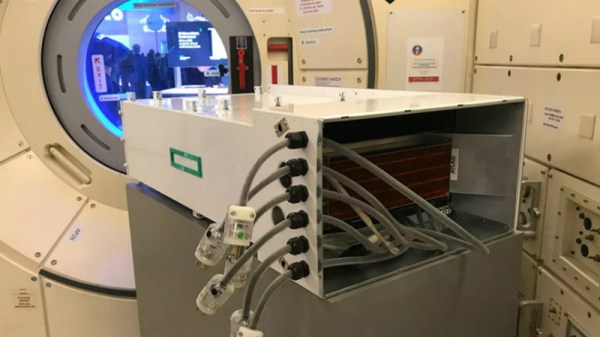
But there’s been at least one positive side effect of the return cargo schedule being pushed back. The “Spaceborne Computer”, developed by Hewlett Packard Enterprise (HPE) and NASA to test high-performance computing hardware in space, is getting an unexpected extension to its time on the Station. Launched in 2017, the diminutive 32 core supercomputer was only meant to perform self-tests and be brought back down for a full examination. But now that its ticket back home has been delayed for the foreseeable future, NASA is opening up the machine for other researchers to utilize, proving there’s no such thing as a free ride on the International Space Station.

Continue reading “The Space Station Has A Supercomputer Stowaway”

Hackaday Links Column Banner

Hackaday Links: December 9, 2018

SpaceX launched a rocket this week, and things did not go as planned. The hydraulics on the grid fins were stuck when the first stage started its atmospheric recovery, and the booster became a fish. The booster landed about a mile or so offshore, which meant we got some great footage of a failed landing, and there are even better shots of the guts of a landed booster. [Scott Manley] whipped out a video showing the ‘new’ discoveries of what’s going on inside a Falcon 9 booster. Interestingly: the weight of the upper stage is carried through the thrust plate of its engine (which makes sense…). There’s a lot of pneumatic stuff going on, and while the composite interstage is very strong along the long axis of the rocket, it doesn’t like being slammed into the ocean.

Winter is coming, and that means you should take your car out during the first snow, drive out to an empty parking lot, and do donuts. I am not kidding this is how you learn to drive in the snow. How do they do it in Russia? They weld 3000 nails to a steel wheel. Does it work? For a while, then the nails bend. We’ve seen this done by drilling screws through a tire, and that works much better; it’s less length for the screws to fulcrum over.

Aaay, we got a date for Sparklecon! It’s February 1-3rd in the endless suburban wastes of Fullerton, California. It’s in an industrial park, there’s a liquor store around the corner, and there’s a remote-controlled couch. Get on it.

Do you wish you had a hassle-free and affordable way to get scorpions delivered straight to your mailbox? Enter Dollar Scorpion Club. Dollar Scorpion Club makes a great gift for all ages. Just enter your friend’s shipping address during checkout, and the extra-special scorpion supply chain management will mean your scorpions are delivered fast to their door.

Regular Car Reviews finally reviewed a Pontiac Aztek. The takeaway is that it’s a bug-out car for Boomers, designed in that episode of The Simpsons where Homer finds out he has a brother.

Want to see something weird? It’s a G3 iMac running Windows 8. This is… weird. Either someone is doing a remote desktop into a Windows 8 machine, someone is just using screenshots, or this machine is way cooler than the craigslist seller is letting on. If you’re in Dallas, it might be worth picking this up.

Magic Wand Learns Spells Through Machine Learning And An IMU

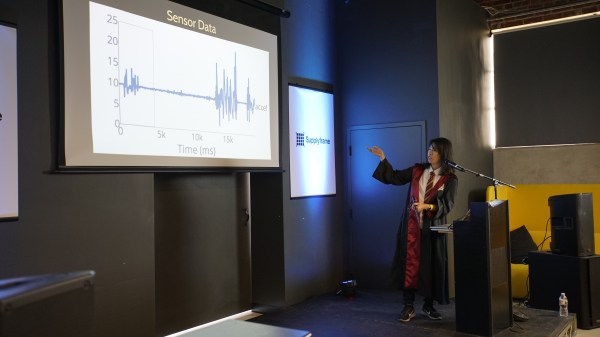
Jennifer Wang likes to dress up for cosplay and she’s a Harry Potter fan. Her wizarding skills are technological rather than magical but to the casual observer she’s managed to blur those lines. Having a lot of experience with different sensors, she decided to fuse all of this together to make a magic wand. The wand contains an inertial measurement unit (IMU) so it can detect gestures. Instead of hardcoding everything [Jennifer] used machine learning and presented her results at the Hackaday Superconference. Didn’t make it to Supercon? No worries, you can watch her talk on building IMU-based gesture recognition below, and grab the code from GitHub.

Naturally, we enjoyed seeing the technology parts of her project, and this is a great primer on applying machine learning to sensor data. But what we thought was really insightful was the discussions about the entire design lifecycle. Asking questions to scope the design space such as how much money can you spend, who will use the device, and where you will use it are often things we subconsciously answer but don’t make explicit. Failing to answer these questions at all increases the risk your project will fail or, at least, not be as successful as it could have been.

Continue reading “Magic Wand Learns Spells Through Machine Learning And An IMU”