Hackaday Prize Needs You: Build For Citizen Scientists

Humanity is better when we work together. Nowhere is this more true than when it comes to Citizen Scientists — the concept that scientific advancement isn’t reserved to the trained professionals, but benefits when a larger population of thinkers collaborates with the community of trained researchers. This is the goal of the Citizen Scientist challenge round for the Hackaday Prize. Let’s build something that enables citizens to be scientists.

We’ll divide $20,000 evenly between twenty projects that target Citizen Scientists. Enter now and build your prototype by July 11th for your chance to win. Even better, if you are selected as one of those 20 finalists you’ll compete for the top prizes, $150k and a residency at the Supplyframe Design Lab in Pasadena. Second through fifth place finishers will get $25k, $10k, $10k, and $5k.
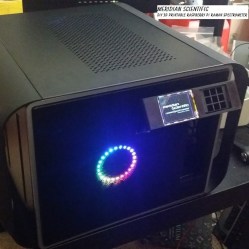
ramanPi You love design challenges and this one has powerful potential. We’ve seen builds like this in the finals during previous years of the Hackaday Prize. In 2014, RamanPi was recognized as the 5th place winner. The project seeks to reduce the expense of acquiring a Raman Spectrometer which is used for analyzing chemical substances. The design used parametric models for the optic jigs used by the machine. The idea is that a university could buy their own optics, adjust the models for the properties of those lenses and mirrors, then 3D print the parts to build the apparatus.
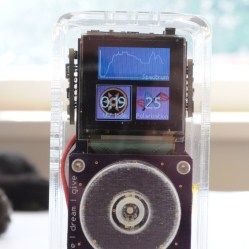
open-science-tricorderAlso a winner in 2014, the Open Science Tricorder was recognized as the fourth place finisher. Based on the form factor and functionality of the iconic Star Trek technology, the Open Science Tricorder combines three or more sensor technologies with a user interface. It provides a hands-on experience for students learning about the properties of the world around them, and a handheld sensor suite to anyone interested in undertaking their own research projects.

The Citizen Scientist challenge round begins right now. Get started on your build today and show us what you can do to solve a technology problem with your prototyping skills. Good luck!


The HackadayPrize2016 is Sponsored by:

Hackaday Links: May 29, 2016

Hackaday has a store‽ Yes, it’s true, and we have a Memorial Day sale going on right now. Get a cool robot had t-shirt, a cool clock, or a GoodFET. Spend money. Consume.

[fbustamante] got his hands on an old GP2X Wiz, one of those ARM-based portable media player/emulator things from a few years ago. This is a complete computer, and like the Pandora, it’ll do everything one of those Raspberry Pi laptops can do. The Wiz doesn’t have a keyboard, so [fbustamante] created his own. He etched his own PC, repurposed a keyboard controller from a USB keyboard, and stole the keycaps from an old Sharp digital organizer.

Speaking of portable consoles, [Element18592] built this incredible Nintendo 64 portable. He’s done an XBox 360 laptop and stuffed a Pi into an old brick Game Boy. This N64 mod is great, uses a 3D printed enclosure, and has truly amazing vinyl graphics.

To the surprise of many, [Photonicinduction] is not dead. The drunk brit with a penchant for high voltage electrics and a very, very confused power company is back making videos again. His latest video is a puzzle. It’s a plastic block with a light bulb socket, a UK power outlet, and a switch. Plug in a light bulb, flip the switch, and it turns on. Plug a blender into the outlet, and that turns on too. No wires, so how is he doing it?

Introduced at CES last January, Monoprice – yes, the same place you get HDMI and Ethernet cables from – has released their $200 3D printer. This one is on our radar and there will be a review, but right away the specs are fantastic for a $200 printer. The build area is 120mm³, it has a heated bed, and appears to be not completely locked down like the DaVinci printers were a few years ago.

Hacklet 109 – Complex 3D Printed Projects

If you can’t tell, we’re on a roll with 3D printers and printed projects this month. So far, we’ve covered printers, and simple functional 3D prints. This week we’re taking a look at some of the awesome complex 3D printed projects on Hackaday.io.

Complex 3D printed projects are things like robots, quadcopters, satellite tracking systems, and more. So let’s jump in and look at some of the best complex 3D printed projects on Hackaday.io!

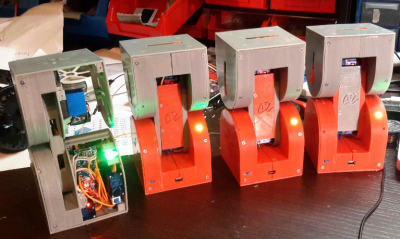
dtto2We start with [Alberto] and Dtto v1.0 Modular Robot. Dtto is [Alberto’s] entry in the 2016 Hackaday Prize. Inspired by Bruce Lee’s famous water quote, Dtto is a modular snake-like robot. Each section of Dtto is a double hinged joint. When two sections come together, magnets help them align. A servo controlled latch solidly docks the sections, which then work in unison. Dtto can connect and separate segments autonomously – no human required. [Alberto] sees applications for a robot like [Dtto] in search and rescue and space operations. Continue reading “Hacklet 109 – Complex 3D Printed Projects”

Minimal MQTT: Control And Clients

So you’ve built a central server and filled your house with WiFi-connected nodes all speaking to each other using the MQTT protocol. In short, you’ve got the machine-to-machine side of things entirely squared away. Now it’s time to bring the humans into the loop! We’re going to explore a couple graphical user interfaces.

You could build a physical knob and/or LED display for every little aspect of your entire system, but honestly, this is where GUIs really shine. In this installment of Minimal MQTT, we’re going to look at human-friendly ways of consuming and producing data to interact with your connected sensors, switches, and displays. There are a ton of frameworks out there that use MQTT to build something like this, but we’re going to cut out the middle-man and go straight for some GUI MQTT clients.

Continue reading “Minimal MQTT: Control And Clients”

Retrotechtacular: Examining Music In 1950’s Russia

If you had told 12-year-old me that one day I would be able to listen to pretty much any song I wanted to on demand and also pull up the lyrics as fast as I could type the artist’s name and part of the title into a text box, I would have a) really hoped you weren’t kidding and b) would have wanted to grow up even faster than I already did.

The availability of music today, especially in any place with first world Internet access is really kind of astounding. While the technology to make this possible has come about only recently, the freedom of music listening has been fairly wide open in the US. The closest we’ve come to governmental censorship is the parental advisory sticker, and those are just warnings. The only thing that really stands between kids’ ears and the music they want to listen to is parental awareness and/or consent.

However, the landscape of musical freedom and discovery has been quite different in other corners of the world, especially during the early years of rock ‘n roll. While American teens roller skated and sock-hopped to the new and feverish sounds of Little Richard and Elvis Presley, the kids in Soviet Russia were stuck in a kind of sonic isolation. Stalin’s government had a choke hold on the influx of culture and greatly restricted the music that went out over the airwaves. They viewed Western and other music as a threat, and considered the musicians to be enemies of the USSR.

Continue reading “Retrotechtacular: Examining Music In 1950’s Russia”

This Is Your Epic Weekend To Hack Together Anything

Wow how the time flies. It seems like only couple of weeks ago we were unveiling the film we shot at Salton Sea to launch this, our third global hacking initiative called The Hackaday Prize. What we want is to see you use those skills of yours to Build Something that Matters. Come up with a way to solve a technology problem and score yourself some sweet prizes. This weekend, anything goes.

The current challenge is called Anything Goes and the deadline to enter your project is Monday at 7am PDT. You need to show off a prototype of your idea, and have at least four (4) build logs about your work on your project page. Use the menu in the left sidebar of your project page to enter it in the Hackaday Prize (or in the Anything Goes round if you entered it during the first challenge).

Are you confused about what is happening here? Let’s hit the high points:

  • Every five weeks we start a new Challenge Round which is basically a whole new contest. You can enter now — it’s not too late. If you entered previously you may enter again.
  • From each challenge round we will select twenty projects to move on to the final round, and award them each $1,000 for their achievement.
  • When all five rounds are complete, those hundred final projects will be viewed by our expert judges who will pick five winners who get the big cash prizes: $150k, $25k, $10k, $10k, and $5k. The Grand Prize winner will also be offered a residency at the Supplyframe Design Lab in Pasadena, CA.
  • The moral of the story is: build something awesome because that’s what you do. But this weekend, make it something that helps people and you just might be one of the twenty moving on for a shot at a much larger purse.

It’s true, we have a lot of projects in the running for this year’s prize; right about 700 entries at the time of writing. But, like I said above, each Challenge is a new contest. We are just about to hit 300 entries for Anything Goes. Twenty will be finalists, which means your entry has about a 1 in 15 chance at this point. Make this weekend your personal hackathon — build it, document it, and don’t forget to submit it.

The HackadayPrize2016 is Sponsored by:
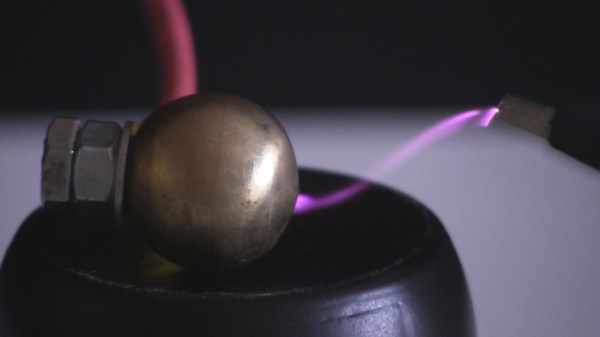
Arc from a flyback transformer power supply

A Cornucopia Of High Voltage Sources

Having hacked away with high voltage for many years I’ve ended up using a large number of very different high voltage sources. I say sources and not power supplies because I’ve even powered a corona motor by rubbing a PVC pipe with a cotton cloth, making use of the triboelectric effect. But while the voltage from that is high, the current is too low for producing the necessary ion wind to make a lifter fly up off a tabletop. For that I use a flyback transformer and Cockcroft-Walton voltage multiplier power supply that’s plugged into a wall socket.

So yes, I have an unorthodox skillset when it comes to sourcing high voltage. It’s time I sat down and listed most of the power sources I’ve used over the years, including a bit about how they work, what their output is like and what they can be used for, as well as some idea of cost or ease of making. The order is from least powerful to most powerful so keep reading for the ones that really bite.

Triboelectric Effect

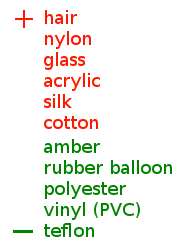
Triboelectric series table

You’ve no doubt encountered this effect. It’s how your body is charged when you rub your feet on carpet and then get a shock from touching a door knob. When you rub two specific materials together there’s a transfer of electrons from one to the other. Not just any two materials will work. To find out which materials are good to use, have a look at a triboelectric series table.

Materials that are on the positive end of the table will become positively charged when rubbed against materials on the negative end of the table. Those materials will become negatively charged. The further apart they are in the table, the stronger the charging.

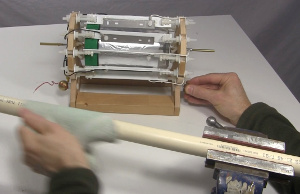
Powering corona motor with triboelectricity

An example of where I’ve used this is to power the corona motor shown here. I vigorously rub a PVC pipe with a cotton cloth, and as the pipe emerges from the cloth, a sharp wire a few millimeters away takes the charge from the pipe. You can see this corona motor being powered by other power sources in the video here.

This would be considered an electrostatic power source because charge is accumulated on surfaces. Being insulating materials, that charge can’t move around.

Continue reading “A Cornucopia Of High Voltage Sources”