Electrostatic Loudspeakers: High End HiFi You Can Build Yourself

If you have an interest in audio there are plenty of opportunities for home construction of hi-fi equipment. You can make yourself an amplifier which will be as good as any available commercially, and plenty of the sources you might plug into it can also come into being on your bench.

There will always be some pieces of hi-fi equipment which while not impossible to make will be very difficult for you to replicate yourself. Either their complexity will render construction too difficult as might be the case with for example a CD player, or as with a moving-coil loudspeaker the quality you could reasonably achieve would struggle match that of the commercial equivalent. It never ceases to astound us what our community of hackers and makers can achieve, but the resources, economies of scale, and engineering expertise available to a large hi-fi manufacturer load the dice in their favour in those cases.

The subject of this article is a piece of extreme high-end esoteric hi-fi that you can replicate yourself, indeed you start on a level playing field with the manufacturers because the engineering challenges involved are the same for them as they are for you. Electrostatic loudspeakers work by the attraction and repulsion of a thin conductive film in an electric field rather than the magnetic attraction and repulsion you’ll find in a moving-coil loudspeaker, and the resulting very low mass driver should be free of undesirable resonances and capable of a significantly lower distortion and flatter frequency response than its magnetic sibling.
Continue reading “Electrostatic Loudspeakers: High End HiFi You Can Build Yourself”

Rocking An Acoustic Guitar By Making It Electric

Brothers [Armand] and [Victor] took their acoustic guitar to the next level, making their own pickups to turn it into an electric guitar. The result is that awesome electric guitar sound.

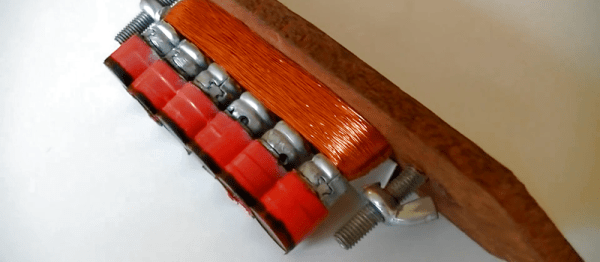
The pickups are homemade magnetic pickups. Each string has a steel bolt behind it with three ceramic magnets on each bolt. A coil is also wrapped around all the pickups. That coil is what’s connected to the wires going to the amplifier. When a string vibrates, it changes the magnetic field in the pickup which induces a current in the coil and that is then sent on to the amplifier to be altered as desired and turned back into sound. Of course that meant the guys had to replace their nylon strings for steel ones.

With just the volume amplified the sound isn’t very different but when the amplifier’s gain is turned up and the volume turned down the sound is undoubtedly electric. As you can hear in the video below, Johnny B. Goode, Paint it Black and Satisfaction take their acoustic guitar’s sound to a whole new level.

Continue reading “Rocking An Acoustic Guitar By Making It Electric”

4-Bit Audio Output Via Voltage Reference

[Bruce Land] switched his microprocessor programming class over from Atmel parts to Microchip’s PIC32 series, and that means that he’s got a slightly different set of peripherals to play with. One thing that both chips lack, however is a digital-to-analog converter (DAC). Or do they? (Dun-dun-dun-duuuuhnnnn!)

The PIC part has a programmable, sixteen-level voltage reference. And what is a Vref if not a calibrated DAC? With that in mind, [Bruce] took to documenting its performance and starting to push it far beyond the manufacturer’s intentions. Turns out that the Vref has around 200 kHz of bandwidth. (Who would update a voltage reference 200,000 times per second?)

Anyway, [Bruce] being [Bruce], he noticed that the bits weren’t changing very often in anything more than the least significant bit: audio waveforms, sampled fast enough, are fairly continuous. This suggests using a differential PCM encoding, which knocks the bitrate down by 50% and saves a lot on storage. (Links to all the code for this experiment is inline with his writeup.)

The audio hacks that come out of [Bruce]’s Cornell ECE classes are always a treat. From the lock that you have to sing to open, to chiptunes programmed into an FPGA, there’s something for music fans of all inclinations.

Onde Magnetique Will Wow And Flutter Your Ears

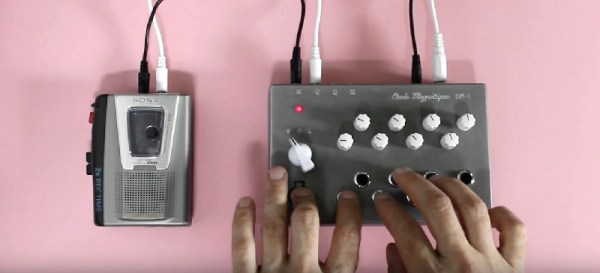
[Scott Campbell] built a cassette-based synthesizer that sounds exactly like everything you’ve heard before. The sound generation comes straight off cassettes, but the brainbox of this synth varies the volume and pitch. It’s called the Onde Magnetique, and it is what you would get if you combined a Mellotron and Ondes Martenot.

The key component for the Onde Magnetique is a Sony cassette recorder that conveniently and inexplicably comes with a ‘tape speed input’ mini jack. By varying the voltage sent to this input jack, the speed of the tape, and thus the pitch of the sound being played, is changed. Build a box with a touch-sensitive button for volume, and a few tact switches for different speeds, and you have an electromechanical bastard child of a Mellotron and an Ondes Martenot.

By itself, the Onde Magnetique produces no sound – it only controls the pitch and volume of whatever is on the cassette. [Scott] produced a few single-note cassettes for his instrument, with ‘voice patches’ including a flute, choir, and a synth. With the CV and Gate input, these sounds can be sequenced with outboard gear, producing the wonderful sounds heard in the video after the break.

Continue reading “Onde Magnetique Will Wow And Flutter Your Ears”

The Music Of A Sunset

What would you do if you suddenly went blind and could never again see the sun set? How would you again experience this often breathtaking phenomenon? One answer is music, orchestrated by the sun and the Weather Warlock.

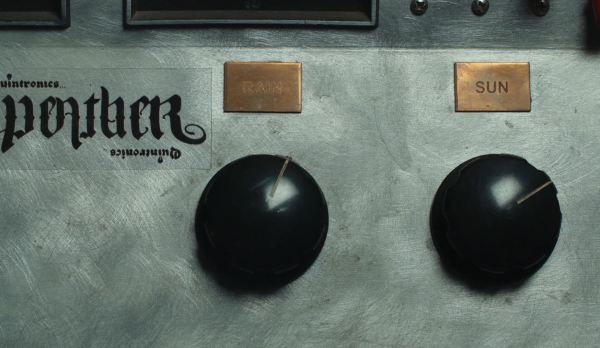
Built by the musician [Quintron] (builder and inventor of insane electronic instruments), the Weather Warlock is an analog synthesizer controlled by — you guessed it — the weather. It translates temperature, moisture, wind and sunlight into tones and harmonics with an E major root chord. UV, light, moisture, and temperature sensors combined with an anemometer set up outside feed the weather data to a synthesizer that has [Quintron] dialing knobs and toggling switches. The Weather Warlock steams 24/7 to the website weatherfortheblind.org so that the visually impaired are able to tune in and experience the joy of sunrise and sunset through music. Continue reading “The Music Of A Sunset”

Ever Buy Music From Apple? Use Linux? You Need This Tool

Sure, you’re a hardcore superuser, but that doesn’t mean you don’t enjoy the finer things in life — like shiny squircles and getting every new app first. But, what’s an OS-indiscriminate person like yourself going to do when it comes time to purchase music? That’s where the recover_itunes tool shines, and if you’re a Linux user with an iPhone, it might just be your new best friend.

Continue reading “Ever Buy Music From Apple? Use Linux? You Need This Tool”

Nirvana Like You’ve Never Heard Them Before

If you were an early 1990s youth, the chances are [Nirvana]’s Smells Like Teen Spirit is one of those pieces of music that transports you straight back to those times. As your writer it evokes a student radio studio and the shelves of its record library, and deafening badly-lit discos with poorly adjusted PA systems and unpleasantly sticky dance floors.

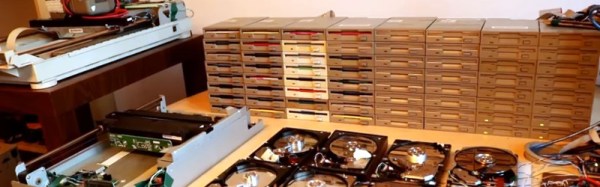
One of our finds this morning therefore comes as an evocative diversion, Smells Like Teen Spirit on [SileNT]’s Floppotron. The Floppotron is a music player composed of a huge array of floppy drives, hard drives, and a couple of flatbed scanners. The scanners are controlled by off-the-shelf Arduino boards and the hard drives have ATMega16s with H-bridge drivers.

This build is the most refined floppy drive organ we’ve seen yet. The floppies are divided into single-voice blocks of eight controlled by an ATMega16, with dynamic volume envelopes mad possible by the number of simultaneously running drives, so the sounds can fade in and out like “natural” musical instruments. The hard drives and scanners are run against their mechanical stops, providing percussion. All the boards are daisychained via SPI to an Arduino that acts as a PC interface, and the PC schedules the performance with a Python script.

He’s provided a couple of pieces as YouTube videos, the floppy motors work particularly well for [Nirvana]’s grunge, but perhaps a bit more mechanical for Hawaii Five-O. This last track will be more evocative than the first if you attended a particular university in the North of England where it was the end-of night record played as the lights came up in one of the discos that had a much better-adjusted PA because the technician knew what she was doing. For those of you with different childhoods, there’s also the Imperial March.

Continue reading “Nirvana Like You’ve Never Heard Them Before”