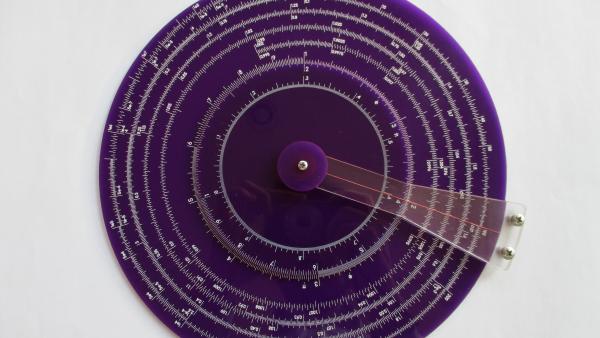
front view of a purple acrylic slide rule with white ink scale markings.

Design And Build Your Own Circular Slide Rule

You have to really like slide rules to build your own, including the necessary artwork. Apparently [Dylan Thinnes] is a big fan, based on this project he began working on a few months back. The result is a set of algorithms that automatically generates most of the scales that were common on slide rules back in the day. For example:

K       Cubic scale, x^3
A,B     Squared scale, x^2
C,D     Basic scale, x
CI,DI   Inverted scale, 1/x
CF,DF   Folded scale, x*pi
LLn     Log-log scales, e^a*x
LL0n    Log-log scales, e^-a*x
L       Log scale, log10(x), linear
S       Sine and cosines scale, sin(x)
T       Tangent scale, tan(x)

If you’ve ever tried to manually draw an axis using a computer program — attempting to automatically set reasonable tick marks, grids, and labels — you can appreciate that this is a non-trivial problem. [Dylan] tackled things from the bottom up, developing several utility functions that work in concert to iteratively build up each scale. One advantage of this approach, he says, is that you can quite easily build almost any scale you want. We’re going to take his word on that, because the project is not easily accessible to the average programmer. As [Dylan] notes:

At the moment it’s still a library w/ no documentation, and written in a relatively obscure language called Haskell, so it’s really only for the particularly determined.

The project is published on his GitHub repository, and sample scales and demo program are available. Without knowledge of obscure languages and being only mildly determined, one can at least generate some sample scales — just downloading the Haskell environment, a few dependencies, and clone [Dylan]’s repository. The output is an SVG file which can be scaled to any desired size. In this follow-up Reddit post he discusses the fabrication techniques used for the acrylic circular slide rule shown in the lead photo.

It’s always been possible to make your own slide rules using pre-generated artwork — for example, the Slide Rule Museum website has a slew of various scales available in graphic format. But if you want to make a custom scale, or make one of that’s meters long, check out [Dylan]’s project and give it a whirl. For another take on making slide rules, check out this project that we covered last year.
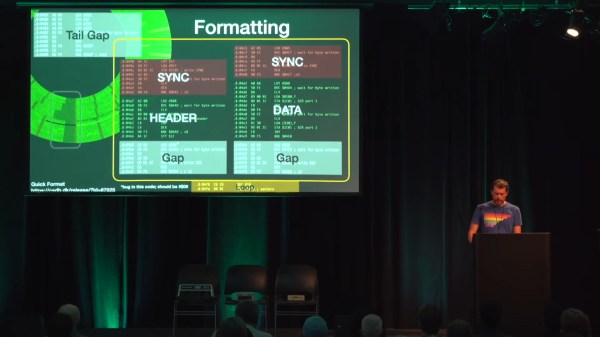
The Ultimate 1541 Talk by Michael Steil, presented at the Vintage Computer Festival West

The Ultimate Commodore 1541 Drive Talk: A Deep Dive Into Disks, Controllers, And Much More

When we think of retrocomputing, it’s very often the computers themselves that get all the glory.  There’s nothing wrong with this of course- the computers of the late 70’s and 80’s were incredible machines that were chock full of hacks in their own right. But some of the most interesting hacks of the day happened not in the computers, but rather in their peripherals. A devotee of such periphery is [Michael Steil], who was driven to compile years of research, knowledge, and hard data into The Ultimate Commodore 1541 Drive Talk which you can view below the break.

In the talk, [Michael] covers the physical disk composition and construction, the disk drives, controller hardware, and the evolution thereof. The bit-by-bit breakdown of the tracks, sectors, and header information on the disks themselves is fascinating, as is the discussion of various copy protection techniques used by vendors to prevent piracy at a time when sneakernet was in full swing.

The descent into the circuitry of the controller reveals a venerable 6502 CPU which powered many vintage computers. Further discussion divulges the secrets for getting higher performance from the 1541 drive using innovations that are as recent as 2013.

A computer historian and archaeologist, [Michael] discusses how using modified vintage hardware is sometimes enough to save your old floppy collection. He also shows how modern interfaces that read disks all the way down to the magnetic flux level can be used to reconstruct missing data.

[Michael] masterfully lays bare the complexity, engineering, and hackery that went into storing less than 200kb of data. Whether you’re a Commodore enthusiast or not, your appreciation for the 32GB USB stick collecting dust on your desk is bound to grow!

We’ve covered [Michael]’s exploits before, and you may wish to check out the Ultimate Apollo Guidance Computer Talk or the Ultimate Gameboy Talk. Do you have your own favorite retrocomputer hacks and insights to share? Be sure to let us know via the Tip Line!

Continue reading “The Ultimate Commodore 1541 Drive Talk: A Deep Dive Into Disks, Controllers, And Much More”

Automatic Microfiche Scanner Digitizes Docs

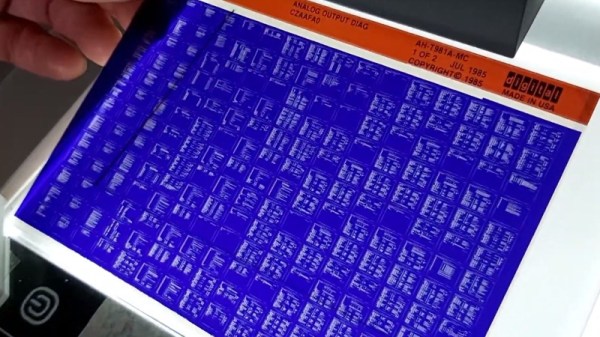
While the concept might seem quaint to us today, microfiche was once a very compelling way to store and distribute documents. By optically shrinking them down to just a few percent of their original size, hundreds of pages could be stored on a piece of high-resolution film. A box of said films could store the equivalent of several gigabytes of text and images, and reading them back only required a relatively simple projection machine.

As [Joerg Hoppe] explains in the write-up for his automatic microfiche scanner, companies such as Digital Equipment Corporation (DEC) made extensive use of this technology to distribute manuals, schematics, and even source code to their service departments in the 70s and 80s. Luckily, that means hard copies of all this valuable information still exist in excellent condition decades after DEC published it. The downside, of course, is that microfiche viewers aren’t exactly something you can pick up at the local Big Box electronics store these days. To make this information accessible to current and future generations, it needs to be digitized.

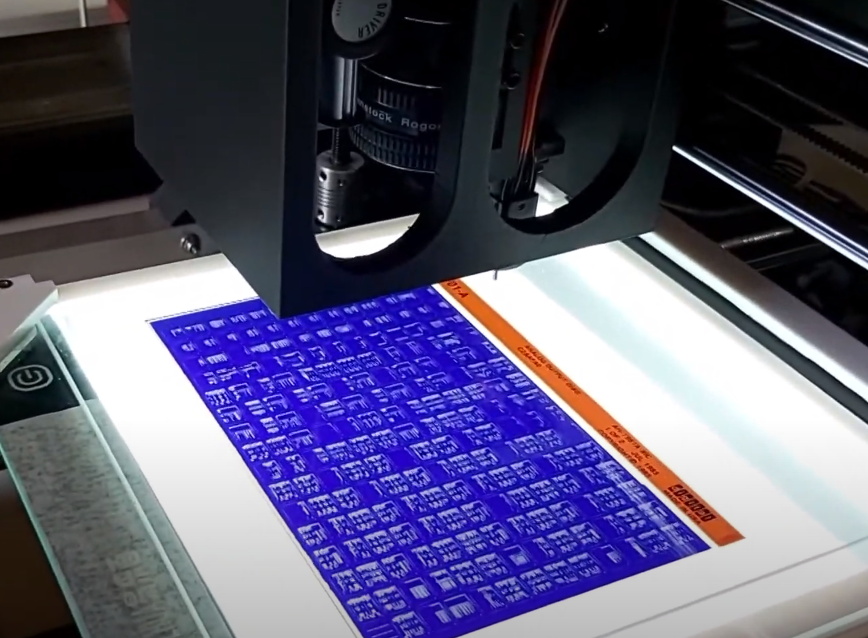
The camera panning over a full DEC microfiche sheet.

[Joerg] notes there are commercial services that would do this for you, but the prices are just too high to be practical for the hobbyist. The same for turn-key microfiche scanners. Which is why he’s developed this hardware and software system specifically to digitize DEC documents. The user enters in the information written on the top of the microfiche into the software, and then places it onto the machine itself which is based on a cheap 3D printer.

The device moves a Canon DSLR camera and appropriate magnifying optics in two dimensions over the film, using the Z axis to fine-tune the focus, and then commands the camera to take an image of each page. These are then passed through various filters to clean up the image, and compiled into PDFs that can be easily viewed on modern hardware. The digital documents can be further run though optical character recognition (OCR) so the text can be easily searched and manipulated. In the video after the break you can see that the whole process is rather involved, but once the settled into the workflow, [Joerg] says his scanner can digitize 100 pages in around 10 minutes.

A machine like this is invaluable if you’ve got a trove of microfiche documents to get through, but if you’ve just got a sheet or two you’d like to take a peek at, [CuriousMarc] put together a simple rig using a digital microscope and a salvaged light box that should work in a pinch.

Continue reading “Automatic Microfiche Scanner Digitizes Docs”

A CRT Monitor Restoration

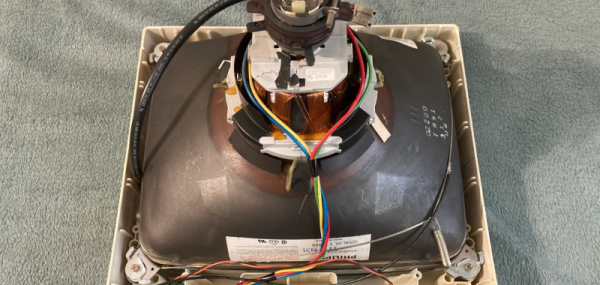
Nothing quite says vintage computer like a dedicated glass terminal. We enjoyed [Adam]’s restoration of an Acorn CRT monitor. The 14 inch display had a common problem: a defective power switch. Replacing a switch shouldn’t be a big deal, of course, but these old CRT monitors have exciting voltages inside and require special care.

One common issue, for example, is the fact that the old CRTs are really large capacitors and can hold a dangerous charge for some time. The easiest way to handle the potential problem is to make sure the device is unplugged, ground a screwdriver blade, and push the blade under the second anode cap. Most of the time, nothing happens. Once in a while, though, you’ll hear a loud pop and you just saved yourself a nasty shock.

Even though the actual repair was pretty mundane, the teardown was a great nostalgia trip and while we don’t want to give up our LCD, we do like the old glass. CRTs have a long history and came a long way before their last gasps. They even took a turn as mass storage devices.

Farewell Sir Clive Sinclair; Inspired A Generation Of Engineers

It is with sadness that we note the passing of the British writer, engineer, home computer pioneer, and entrepreneur, Sir Clive Sinclair, who died this morning at the age of 81 after a long illness. He is perhaps best known among Hackaday readers for his ZX series of home computers from the 1980s, but over a lifetime in the technology industry there are few corners of consumer electronics that he did not touch in some way.

Sinclair’s first career in the 1950s was as a technical journalist and writer, before founding the electronics company Sinclair Radionics in the 1960s. His output in those early years was a mixture of miniature transistor radios and Hi-Fi components, setting the tone for decades of further tiny devices including an early LED digital watch at the beginning of the 1970s, miniature CRT TVs in the ’70s and ’80s, and another tiny in-ear FM radio which went on sale in the ’90s.

Continue reading “Farewell Sir Clive Sinclair; Inspired A Generation Of Engineers”

Ferranti’s Ghost Tours The Chip Factory That Made The ULA

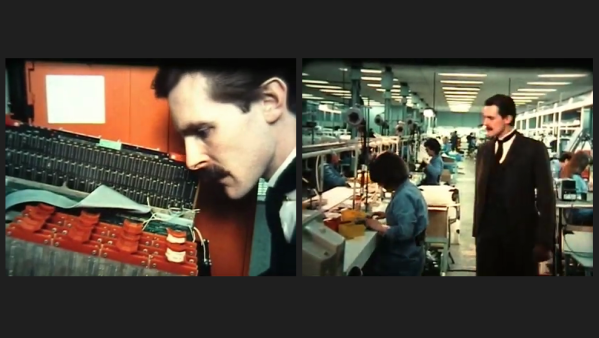
Former Ferranti Electric engineer [Martin Mallinson] recently posted a 1980s documentary on YouTube (see the video below the break). It shows in some detail the semiconductor plant at Gem Mill outside of Manchester UK, as seen through the eyes of the ghost of founder Dr. Sebastian Ferranti. This dramatic device seems a little silly at times, but the documentary still provides a very interesting look at the industry at the time.

The Gem Mill plant was one of the first semiconductor facilities, having begun operations in the 1950s by Ferranti. In 1959 they made the first European silicon diode, and went on to commercialize Uncommitted Logic Arrays (ULA) in the early 1980s. Most famously, Ferranti ULAs were used in many home computers of the day, such as the Sinclair ZX81 and ZX Spectrum, Acorn Electron, and the BBC Micro. Much of the factory tour in this documentary is depicting the ULA process, and they hint at an even more advanced technology being developed by the (unnamed) competition — an FPGA? CPLD?

In a series of events worthy of a mystery novel, Ferranti finally closed its doors in 1993 after acquiring a company that was involved with clandestine agencies and illegal arms sales (see Ferranti on Wikipedia). But through a series of acquisitions over the years, many of their products outlived the company and were available under the labels of future owners Plessey, Zetex, and finally Diodes, Inc. The Gem Mill facility was decommissioned in 2004 and in 2008 it was demolished and replaced by a housing estate.

Thanks to [Cogidubnus Rex] for bringing this video to our attention. A couple of other Ferranti documentaries of the same era are also included down below the break.

Continue reading “Ferranti’s Ghost Tours The Chip Factory That Made The ULA”

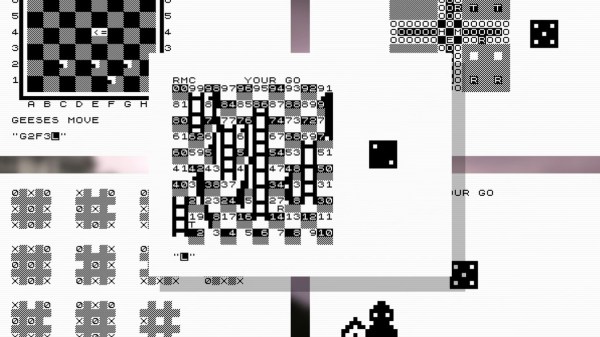
Examples of ZX81 computer game screens

The Labor Of Love That Is Recovering Lost Software

At the beginning of the home computer revolution, the humble compact cassette was far and away the most popular choice for microcomputer data storage, especially on the European continent. As a volunteer at the Museum of Computing, [Keith] was instrumental in recovering and archiving the early works of Roger Dymond, a pioneering developer of early computer software in the United Kingdom.

In his video, [Keith] goes to great lengths detailing the impact that Roger Dymond had on the early home computing scene. After being let go from his council apprenticeship, Roger turned his attention to developing games for the ZX81, and later the ZX Spectrum. With the help of his family, he went on to run a moderately successful mail-order games publishing venture for several years. Increasing advertising costs and a crowded development scene saw Roger’s business become nonviable by 1983, but not before developing several gambling-style games and a standout Space Invaders clone.

Fast forward to 2021, and while some of Roger’s Spectrum software had been archived, much had been marked as ‘missing’ by online archivists. After further research, [Keith] realized that another potentially important tape had been forgotten about. ‘Games Compendium’ for the ZX81 had been completely lost to time, with the only evidence that it had ever existed coming from a 1983 advert in ‘Sinclair User’ magazine. Being written for the earlier model ZX81, the compendium would undoubtedly be of interest to software archivists and game historians.

Continue reading “The Labor Of Love That Is Recovering Lost Software”