The MiniITX Retro System

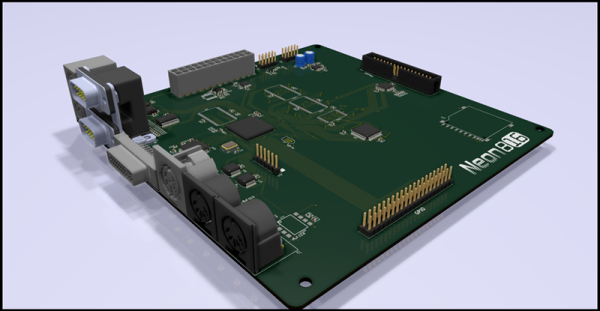
There are hundreds of modern, retrocomputing projects out there that put ancient CPUs and chips in a modern context. The Neon816 from [Lenore] is perhaps one of the most impressive projects like this we’ve seen. It’s a classic system in a modern form factor, with modern video output, mashed together into a MiniITX motherboard.

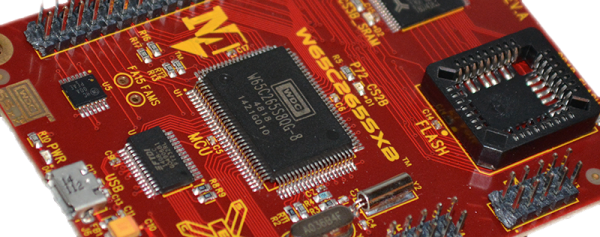
The powerhouse of this computer is the Western Design Center W65C816 CPU. This is the second generation of the venerable 6502 CPU, the same chip found in everything from the Commodore 64 to the Apple II to the Nintendo Entertainment System. The 65816 is a 6502 at start-up until you flip a bit in a register, at which time the signalling on the address bus becomes much weirder. We’ve seen some single board computers based on the 65816 before and The 8-Bit Guy has a few ideas to build a computer around this CPU, but for the foreseeable future work on that will be trapped in development hell.

Of note, the Neon816 will feature DVI output (I guess technically you can just run the analog signals through the connector), a PS/2 Joystick input, two Atari / Sega joystick ports, MIDI in and out, a PC-style floppy disc connector, and a Commodore serial bus. It’s a hodge-podge of classic retrotainment, all in a single MiniITX motherboard.

The key other feature of the Neon816 is an FPGA, specifically a Lattice XP2 8000 LUT chip that is used for video and audio. This is combined with 1MB of main RAM (looks like a simple SRAM) and 128k of Flash storage for the ROM. There’s also an SD card in there for storage.

Right now, [Lenore] is populating the first prototype board, and we can’t wait to see some video generated with this impressive little system.
3D-Printed Rotary Dial Keypad Is Wonderfully Useless

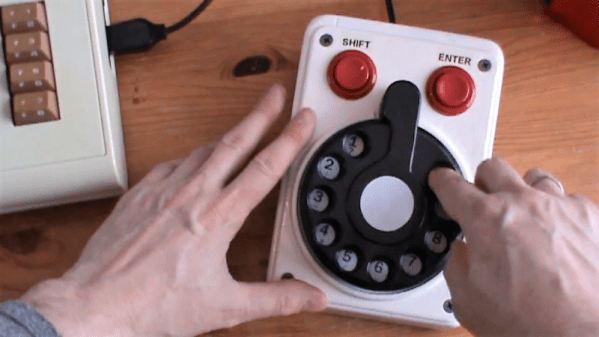
Right up front, let us stipulate that we are not making fun of this project. Even its maker admits that it has no practical purpose. But this 3D-printed Commodore-style rotary dial keypad fails to be practical on so many levels that it’s worth celebrating.

And indeed, celebrating deprecated technology appears to be what [Jan Derogee] had in mind with this build. Rotary dials were not long ago the only way to place a call, and the last time we checked, pulse dialing was still supported by some telephone central office switchgear. Which brings us to the first failure: with millions of rotary dial phones available, why build one from scratch? [Jan] chalks it up to respect for the old tech, but in any case, the 3D-printed dial is a pretty good replica of the real thing. Granted, no real dial used a servo motor to return the dial to the resting state, but the 3D-printed springs [Jan] tried all returned the dial instantly, instead of the stately spin back that resulted in 10 pulses per second. And why this has been done up VIC-20 style and used as a keypad for Commodore computers? Beats us. It had to be used for something. That the software for the C-64  generates DTMF tones corresponding to the number dialed only adds to the wonderful weirdness of this. Check out the video below.

We’ll hand it to [Jan], he has a unique way of looking at the world, especially when it comes to clocks. We really enjoyed his persistence of phosphorescence clock, and his screw-driven linear clock turns the standard timekeeping UI on its head.

Continue reading “3D-Printed Rotary Dial Keypad Is Wonderfully Useless”

It’s Raining Brand-new Commodore 64s

There’s never been a better time to build your own Commodore 64, apparently. Within a day of each other, we got tipped off on three (3!) separate C64 builds from two different hackers.

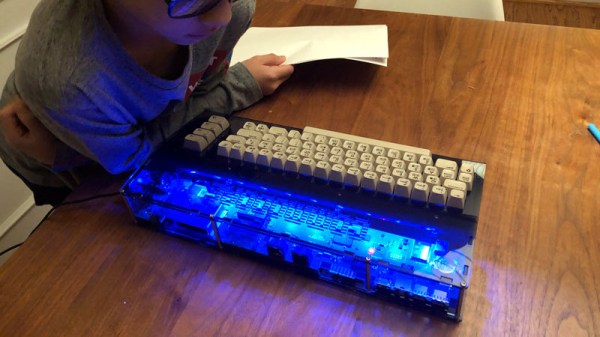
This has been made possible by a series of disparate projects that have individually recreated a piece of the full machine. Replacement motherboards exist, like the Ultimate 64 and the C64 Reloaded Mk2. New cases can be had courtesy of Pixelwizard. Even new keyboard bases can be had thanks to the Mechboard 64 project.

[Eric Hill] took all these parts and built his own C64 from scratch. And not content with one, he repeated the process and built another.

These two machines serve as demos for the two different motherboard options. Taken together, they serve to demonstrate how many of the vintage Commodore components have been remanufactured by the fan community: with the exception of the keycaps and possibly some of the silicon, all the parts in both machines are new.

Did we just say “keycaps?” This became the pet project of [Perifractic], who discovered that certain Lego Technic pieces had the same cross-shaped slot as the original Commodore 64 keys. After some experimentation, a full set of Lego keycaps was produced. (YouTube, embedded below.) Far from a thrown-together set of random pieces, the sets are available for order with printed tiles with recreation graphics. And this lets you build a C64 using precisely zero parts that came out of a Commodore factory. It’s a testament to the popularity of the world’s best selling computer that it is now once again possible to build one with brand new parts.

If you want to replicate this feat, [Perifractic]’s website is set up to make ordering everything you need easy. Things have certainly come a long way from the first reproduction cases launched on Kickstarter a few years ago.

[Thanks to Keith O for the tip!]

Continue reading “It’s Raining Brand-new Commodore 64s”

SVG Rendering Comes To 8-bit Atari Computers

Bringing modern protocols and techniques to vintage computers is a favorite pastime for hackers, and over the years we’ve seen some absolutely incredible hardware and software projects designed specifically to do what most people would consider impossible. They’re very rarely practical projects, of course. But that’s never really the point.

The product of 45 minutes of work.

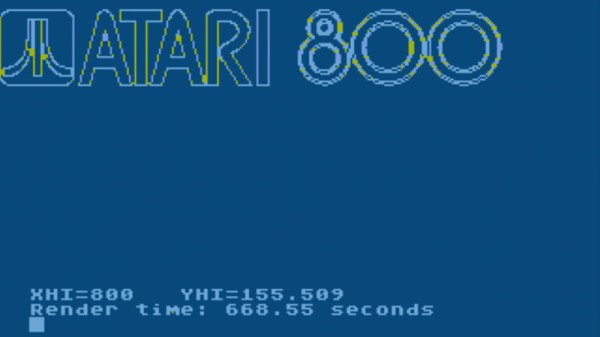
Today we present another excellent entry into this niche avenue of hacking: Renderific, a tool to render SVGs on 8-bit Atari computers by [Kevin Savetz]. The MIT licensed program is written in Turbo-BASIC XL and allows computers such the 1200XL and 800XL to not only render the image on screen but output it to an attached plotter. There are a few niggling issues with some files, and apparently the plotter draws the image upside-down for some reason, but on the whole we can now add “SVG Rendering” to the list of things you can do with a nearly 40-year-old computer.

Of course, those who are familiar with these 1980’s machines might wonder how their limited CPUs can possibly cope with such a task. Well, that’s where the impracticality comes in. According to [Kevin], you can be in for quite a wait depending on the complexity of the image. In his tests, some SVGs took up to 45 minutes to fully render on the screen, so you might want to have a snack handy.

If you’re interested in lending a hand with the project, it sounds as though [Kevin] could use some assistance in figuring out why the Atari 1020 plotter doesn’t like the output of his program. There’s also a few SVG functions and forms of Bézier curves that need some work if you’ve got your Turbo-BASIC XL programming books handy.

Will you ever have a need to view SVG files on an Atari 1200XL? No, probably not. You might not have a desire to play Spotify on the Macintosh SE/30 either, but that hasn’t stopped hackers from figuring out how you can do it. As long as these old machines are still up and running, we’re confident that the community will continue to teach them new tricks.

The Primordial Sinclair ZX Spectrum Emerges From The Cupboard

The Centre for Computing History in Cambridge, UK, receive many donations from which they can enrich their collection and museum displays. Many are interesting but mundane, but the subject of their latest video is far from that. The wire-wrapped prototype board they reveal with a flourish from beneath a folded antistatic mat is no ordinary computer, because it is the prototype Sinclair ZX Spectrum.

It came to the museum from Nine Tiles, a local consultancy firm that had been contracted by Sinclair Research in the early 1980s to produce the BASIC ROM that would run on the replacement for their popular ZX81 home microcomputer. The write-up and the video we’ve placed below the break give some detail on the history of the ROM project, the pressures from Sinclair’s legendary cost-cutting, and the decision to ship with an unfinished ROM version meaning that later peripherals had to carry shadow ROMs with updated routines.

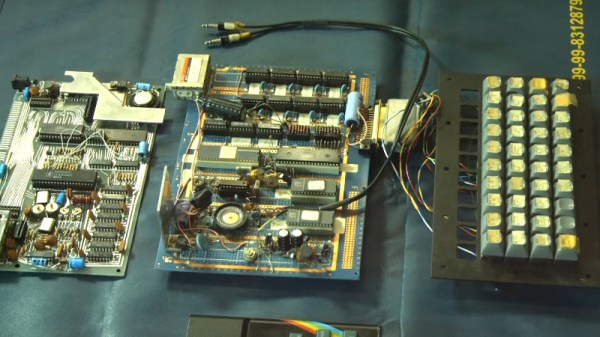
The board itself is a standard wire-wrap protoboard with all the major Spectrum components there in some form.  This is a 16k model, there is no expansion connector, and the layout is back-to-front to that of the final machine. The ULA chip is a pre-production item in a ceramic package, and the keyboard is attached through a D connector. Decent quality key switches make a stark contrast to the rubber keys and membrane that Spectrum owners would later mash to pieces playing Daley Thompson’s Decathlon.

This machine is a remarkable artifact, and we should all be indebted to Nine Tiles for ensuring that it is preserved for those with an interest in computing to study and enjoy. It may not look like much, but that protoboard had a hand in launching a huge number of people’s careers in technology, and we suspect that some of those people will be Hackaday readers. We’ll certainly be dropping in to see it next time we’re in Cambridge.

If you haven’t been to the Centre for Computing History yet, we suggest you take a look at our review from a couple of years ago. And if prototype home computers are your thing, this certainly isn’t the first to grace these pages.

Continue reading “The Primordial Sinclair ZX Spectrum Emerges From The Cupboard”

Programmable Ruler Keeps 1970’s Computing Alive

A ruler seems like a pretty simple device; just a nice straight piece of material with some marks on it. There are some improvements out there to the basic design, like making it out of something flexible or printing a few useful crib notes and formulas on it so you have a handy reference. But for the most part, we can all agree that ruler technology has pretty much plateaued.

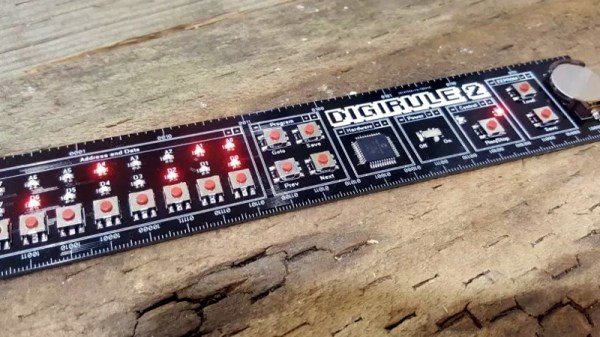
Well, not if [Brad] has anything to say about it. His latest creation, the Digirule2, is essentially an 8-bit computer like those of the 1970’s that just so happens to be a functional ruler as well. Forget lugging out the Altair 8800 next time you’re in the mood for some old school software development, now you can get the same experience with a piece of hardware that lives in your pencil cup.

Even if you’ve never commanded one of the blinkenlight behemoths that inspired the Digirule2, this is an excellent way to get some hands-on experience with early computer technology. Available for about the cost of a large pizza on Tindie, it represents one of the easiest and most cost-effective ways to tell your friends that as a matter of fact you have programmed a computer in binary.

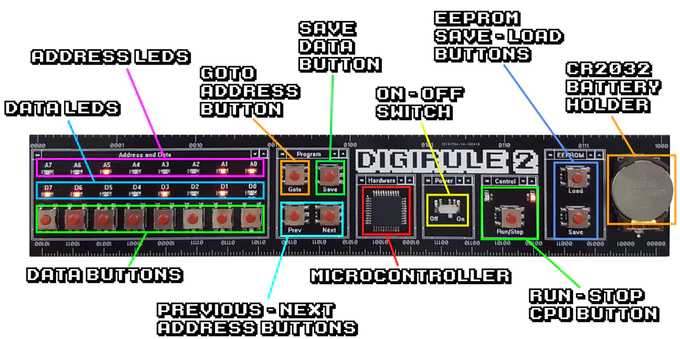
The Digirule2 is powered by a Microchip PIC18F43K20, and is programmed by punching binary in one byte at a time with a bank of eight tactile switches. To make things a little easier, programs can be saved to the internal EEPROM and loaded back up just as easily thanks to the handy buttons next to the power switch. Now all you’ve got to do is figure out what all those blinking LEDs mean, and you’ll be in business.

The original Digirule was a logic gate simulator that we first covered back in 2015. We’re always happy to see projects grow and evolve over time, and think this new retro-computer themed variant is going to be quite popular with those who still love toggle switches and blinking lights.

Continue reading “Programmable Ruler Keeps 1970’s Computing Alive”

The 8-Bit Guy Builds A 16-Bit Computer

One of the better retro historians out there on YouTube is the 8-Bit Guy, and after years of wanting to do something like this, it’s finally happening. The 8-Bit Guy is building his dream computer, heavily inspired by the Commodore 64.

Before we go into what this computer will do and what capabilities it will have, it’s important to note the 8-Bit Guy is actually doing a bit of market and user research before dedicating a year or more to this project. He’s asked other famous retrocomputing YouTubers for their input on what their ‘dream’ retrocomputer should do, and they’ve come up with a basic list of requirements. The Dream Computer will be like working on a 1957 Chevy, in that all the registers are immediately available for peeking and poking. The computer will be completely comprehensible, in so far that one person can completely understand everything, from the individual logic gates inside the CPU to the architecture of the kernel. It’ll run BASIC.

In the age of the Raspberry Pi, one might ask, ‘why not go with a Raspberry Pi?’. To the 8-Bit Guy, the Pi is just a Linux computer. Other retrocomputing projects of a similar scope to this dream computer also fail: The Mega65, a project to resurrect the Commodore 65, will be too expensive. The BASIC Engine fails because it only does composite out, and it runs on an ESP anyway, so you’re shielded from the real hardware. The same problem exists with the Maximite in that the hardware is one layer of abstraction away from the interface. The C256 Foenix is probably the closest to meeting the design goals, but it’s far too expensive, and even without the MIDI ports, SID chips, and other interesting hardware, it would still be above the desired price point.

The ‘requirement’ for this dream computer is to use only modern parts, have VGA or HDMI video out, a real CPU, preferably a 6502, use no FPGA or microcontrollers, and can run Commodore Basic. Also, this computer would cost about $50, with $100 as the absolute, maximum limit (implying a BOM cost of around $15-$25). This is absolutely, completely, astonishingly impossible. I would be deceiving you if I did not mention the impossibility of this project happening with the stated goals. This project will not meet the goal of selling for less than one hundred dollars.

That said, there’s no harm in trying, so The 8-Bit Guy is currently working with a few dev boards, specifically one designed around the 65816 CPU. The 65816 is an interesting chip, in that it is a 6502 until you flip a bit in a register. It has a larger address space than the 6502, and everything from the World of Commodore should be (relatively) easily ported to the 65816. Why was this CPU never used in Commodore hardware? Because a Western Design Center sales guy told a Commodore engineer that Apple was using it in their next computer (the Apple IIgs). The option of Commodore ever using the ‘816 died then and there.

If you’d like to help out on this computer, there is a Facebook group for organizing the build. This Facebook group is a closed group, meaning you need a Facebook account to login. Unfortunate, but we’re looking forward to a year of updates around this dream computer. Building a computer that meets the specs is impossible, but we’re more than eager to see the community try.

Continue reading “The 8-Bit Guy Builds A 16-Bit Computer”