If you were given the task of designing a computer at a time when computers weren’t really even a thing, how would you start? How would you take a collection of vacuum tubes, passive components, and a precious few germanium diodes and engineer something to sell to customers looking for an “electronic brain”?
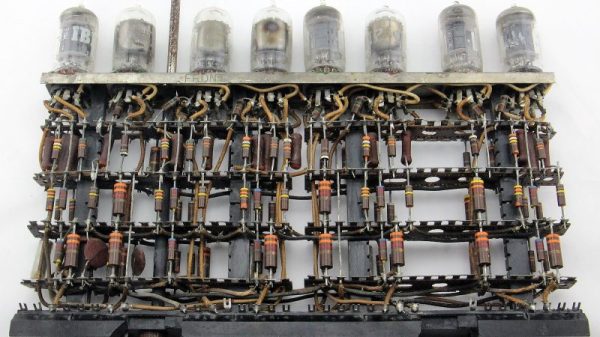
Where there’s a paycheck, there’s a way, and computer archeologist [Ken Shirriff] laid his hands on some old IBM hardware that tells us a lot about how engineers thought in the earliest days of the computer industry. The gear is a pluggable module from IBM, one of hundreds that once went into their Model 705 computer from the mid-1950s. The particular module [Ken] has is a 5-channel contact debouncer, or in Big Blue’s mid-century parlance, a “Contact-Operated Trigger.” It was used to debounce five of the many, many mechanical contacts in the machine, both buttons and relays, and used eight dual triode tubes to do it. Other modules with the exact same footprint formed the flip-flops, inverters, buffers and clocks needed to build a computer.
[Ken]’s analysis of the debouncer is a fascinating look at what was possible with the technology of the day, and the fact that it led to a standardized framework for generic modules that were actually hot-swappable with what essentially was a zero insertion force plug was quite a feat of engineering. And as a bonus, [Ken] and friends actually got the module up in running in the video after the break.
What’s the first thing you do when a new set of boards from the fab house hits the doorstep? Apply solder paste, populate the components, and stick it in the reflow oven? That’s one way to do it. But a lot of non-obvious things can go wrong at the fab house, like shorts and undrilled vias. One tiny mistake can mean hours of frustration and sanity questioning as you troubleshoot some problem that’s now buried under solder paste and 0603s.
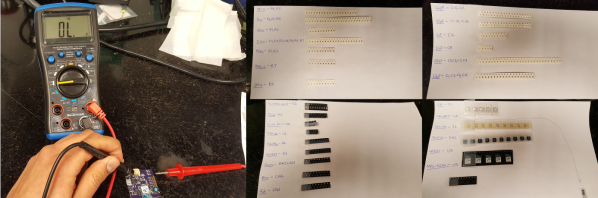
Over on IO, [Bhavesh] tries to nip these problems in the bud with a comprehensive and explanatory guide to properly bringing up a PCB. Though it’s based on fab house boards, this soup-to-nuts plan is good for any project from kit building to custom stripboard circuits. When new boards arrive, [Bhavesh] does several continuity checks and visually inspects them with a microscope. In the case of a stripboard layout, it’s a good idea to verify there’s no continuity across cut traces. He goes on to cover solder paste, touching on proper handling and storage, application, and problem correction.
Our favorite part of this guide is the component sheets. Making these is a great preventive measure, like lining up all your ingredients on the counter before you bake a cake. If you know what you need, why not have it all ready? [Bhavesh] uses a sheet for each component type, lists all the relevant values in ascending order, and lays out component reels next to them.
The guide covers solder paste, too—his stencils were late to arrive, so the guide deals with applying paste by hand. He suggests a plan for populating the board by starting in one corner and working in circle, placing small components first. Then it’s on to reflow and those all-important post-reflow checks for bridges and bad joints before letting the magic smoke out.
Our better-traveled colleagues having provided ample coverage of the 34C3 event in Leipzig just after Christmas, it is left to the rest of us to pick over the carcass as though it was the last remnant of a once-magnificent Christmas turkey. There are plenty of talks to sit and watch online, and of course the odd gem that passed the others by.
It probably doesn’t get much worse than nuclear conflagration, when it comes to risks facing the planet. Countries nervously peering at each other, each jealously guarding their stocks of warheads. It seems an unlikely place to find a 34C3 talk about 6502 microprocessors, but that’s what [Moritz Kütt] and [Alex Glaser] managed to deliver.
Policing any peace treaty is a tricky business, and one involving nuclear disarmament is especially so. There is a problem of trust, with so much at stake no party is anxious to reveal all but the most basic information about their arsenals and neither do they trust verification instruments manufactured by a state agency from another player. Thus the instruments used by the inspectors are unable to harvest too much information on what they are inspecting and can only store something analogous to a hash of the data they do acquire, and they must be of a design open enough to be verified. This last point becomes especially difficult when the hardware in question is a modern high-performance microprocessor board, an object of such complexity could easily have been compromised by a nuclear player attempting to game the system.
We are taken through the design of a nuclear weapon verification instrument in detail, with some examples and the design problems they highlight. Something as innocuous as an ATtiny microcontroller seeing to the timing of an analogue board takes on a sinister possibility, as it becomes evident that with compromised code it could store unauthorised information or try to fool the inspectors. They show us their first model of detector using a Red Pitaya FPGA board, but make the point that this has a level of complexity that makes it unverifiable.
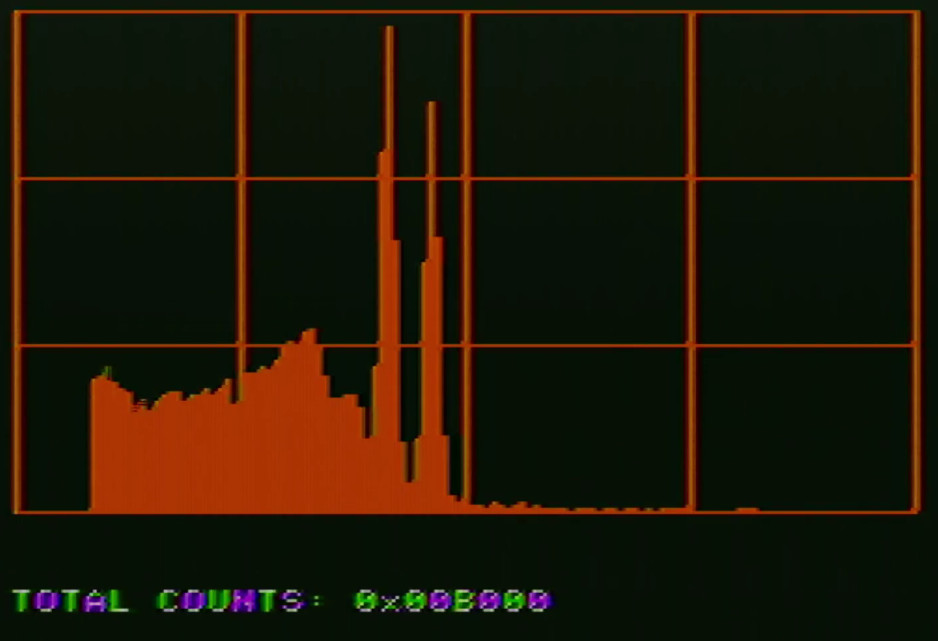
The gamma ray energy spectrum of a cobalt-60 source as seen from an Apple II.
Then comes the radical idea, if the technology used in this field is too complex for its integrity to be verified, what technology exists at a level that can be verified? Their answer brings us to the 6502, a processor in continuous production for over 40 years and whose internal structures are so well understood as to be de facto in the public domain. In particular they settle upon the Apple II home computer as a 6502 platform, because of its ready availability and the expandability of [Steve Wozniak]’s original design. All parties can both source and inspect the instruments involved.
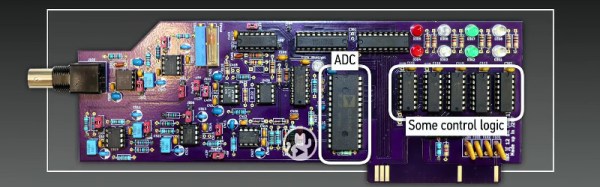
If you’ve never examined a nuclear warhead verification device, the details of the system are fascinating. We’re shown the scintillation detector for measuring the energies present in the incident radiation, and the custom Apple II ADC board which uses only op-amps, an Analog Devices flash ADC chip, and easily verifiable 74-series logic. It’s not intentional but pleasing from a retro computing perspective that everything except perhaps the blue LED indicator could well have been bought for an Apple II peripheral back in the 1980s. They then wrap up the talk with an examination of ways a genuine 6502 system could be made verifiable through non-destructive means.
It is not likely that nuclear inspectors will turn up to the silos with an Apple II in hand, but this does show a solution to some of the problems facing them in their work and might provide pointers towards future instruments. You can read more about their work on their web site.
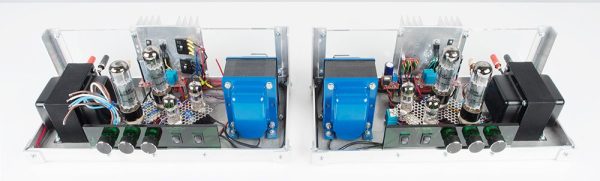
Our friend [Pete] was reminiscing over the golden days with his old and broken antique Grundig Majestic console when he realized it deserved proper refurbishing. Now, any generic stereo record player might not be worth the time and effort to fix, but this was not any generic stereo record player. [Pete’s] inherited Grundig Majestic was his childhood favorite due to the distinct sound it had from the tubes that were used as the active elements. So he set out to fix both tube amps inside of the system.
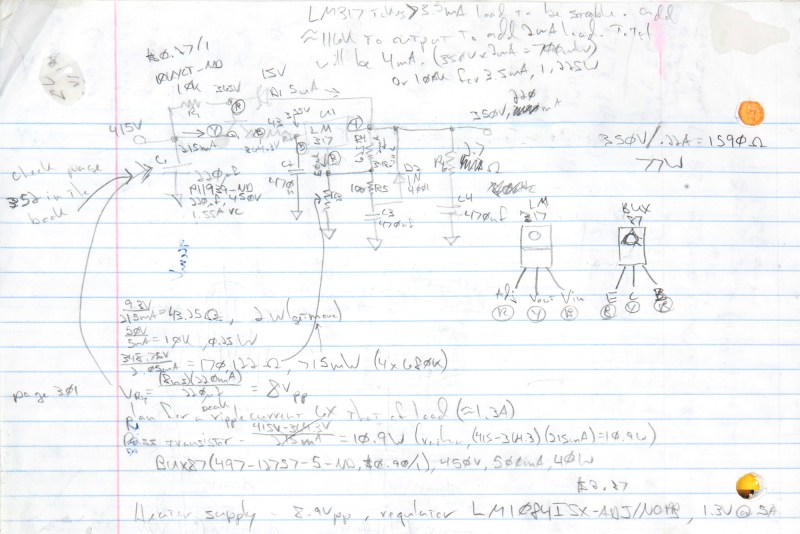
[Pete] has had some experience working with audio equipment in the past. He did what we all aspire to, and got paid for doing what he loves by creating tube amps as a side gig. When he had finally had enough of the sub-par quality of bluetooth speakers that we all put up with for convenience sake, he decided to finally fix his favorite radio that had been lying around for far too long. He got to work immediately in his notebook finding what parts would be necessary for the reboot. The build ended up consisting of a HT supply regulated at 350V, an LT supply half DC-regulated at 6.3V, a 12AX7 input/bass/treble section, 6922 concertina tubes, and an EL34 ultra-linear output section. The end results yielded one amp that sounded just like it did in his youth, and one that isn’t quite there yet.
The Grundig Majestic is not done with just yet though. [Pete] plans to add a couple of additional modifications to his beauty when he’s not too busy with the kids. Firstly, perfecting the second amp is a top priority. After that, installing red LEDs that illuminate underneath the tubes would indicate low voltage presence, whereas blue illumination would indicate HT was locked and loaded. Bias monitoring to keep him informed on the status of the circuit conditions would insure smooth sailing down the road. Adding a relay connection of the speakers to the output transformer would minimize a popping sound that is currently being made in the speakers when the HT is initially turned on. These small improvements are just that — small — but that is part of what makes home projects so rewarding. The more you use something at home, the more you realize what needs to be refined further, so you are constantly learning more. It is a gratifying experience that I hope all of our readers have the chance to come across.
[Yeo Kheng Meng] had a question: what is the oldest x86 processor that is still supported by a modern Linux kernel? Furthermore, is it actually possible to use modern software with this processor? It’s a question that surely involves experimentation, staring into the bluescreen abyss of BIOS configurations, and compiling your own kernel. Considering Linux dropped support for the 386 in 2012, the obvious answer is a 486. This supposition was tested, and the results are fantastic. You can, indeed, install a modern Linux on an ancient desktop.
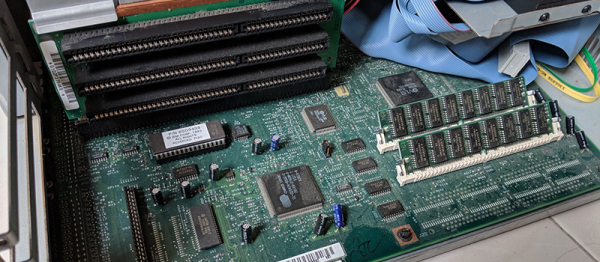
This project got its start last month at a Super Silly Hackathon where [Yeo] and [Hui Jing] installed Damn Small Linux on an ancient IBM PS/1 desktop of 1993 vintage. The hardware consists of an AMD 486 clone running at 133MHz, 64 MB of RAM, a 48x IDE CDROM drive (wow!), a floppy emulator, a Sound Blaster, 10Mbps Ethernet card, and a CompactFlash to IDE adapter. By any account, this is a pimped-out rig for 1993 that would have cost more than a car at the time. The hardware works, but can you run a modern Linux kernel on it?
[Yeo] decided to install the Gentoo x86 minimal installation, but sanity and time constraints meant compiling a kernel on a 486 wasn’t happening. That was done on a modern Thinkpad after partitioning all the drives, verifying all the compilation parameters, and configuring the kernel itself. The bootloader is LILO (Grub2 didn’t work), but for the most part, this is entirely modern software running on a 25-year-old machine. The step-by-step instructions for becoming a /g/entooman on a 486 are available on GitHub.
The entire (boring) boot process can be seen in the video below. One interesting application of this build is that the 486 does not support out-of-order execution, making this completely safe from Meltdown and Spectre attacks. It’s an impressive retrocomputing achievement that right now could not be more timely.
With the holidays over, many of us are braving the elements to take down all those holiday lights. LED lights have largely taken over the market, but in some places, you can still get classic incandescent bulbs. There are some effects that LEDs can’t quite mimic yet. One of those is the magic of “twinkling” light sets, which [Alec Watson] explains in a Technology Connections video. Everyone has seen bulbs that flash, and strings that dim. But the twinkle effect until recently has been hard to describe.
Typical flashing bulbs use a bimetallic strip. As the filament of the bulb heats up, the strip bends, opening the circuit. Then the strip cools and closes the circuit again. Twinkling lights do exactly the opposite. The bimetallic strip shorts the bulb out rather than open the circuit. Twinkling sets also use a lot of bimetallic strip bulbs – typically every fifth bulb has a strip. The result of the bulbs being shorted out is that all be the bulbs in set see a higher voltage. This makes the entire strip shimmer in time with the flashing. That’s where the twinkling magic comes from.
It occurs to us that the voltage on the strip would be a great source of random seeds. Sure, you’d have to replace bulbs now and again, but how many people can say they get their random numbers from a set of Christmas lights?
If your goal is to harvest unique parts from defunct devices, the further back in time you go, the better the pickings stand to be. At least that’s what [Kerry Wong] discovered during his tear-down of a darkroom color analyzer from the early 1980s.
For readers whose experience with photography has been solely digital, you need to understand that there once was a time when images were made with real cameras on real film, and serious amateurs and pros had darkrooms to process the film. Black and white processing was pretty straightforward in terms of chemistry — it was just developer, stop, and fixing. Color processes were much trickier, and when it came to enlarging your film onto color photo paper, things could get really complicated. [Kerry]’s eBay find, a Besler PM1A color analyzer, was intended to help out in the color lab by balancing the mix of cyan, blue, and yellow components in the enlarger.
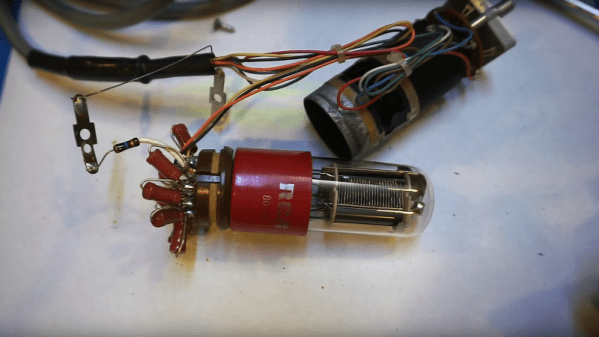
The instrument, which no doubt demanded a princely sum back in the day, is actually really simple, with the object of [Kerry]’s desire, a PM1A photomultiplier tube and its driver, being the only real find. Still, it’s an interesting teardown, and we’re eager to see what [Kerry] makes of the gem. A muon detector, perhaps? An X-ray backscatter machine? Or perhaps repeating his old speed of light experiments is on the docket.