Ooops, Did We Just Close An Airport Over A UFO Sighting?

Picture this: it’s late in the evening on a freezing cold, dark, and windy December night in southern England, and an airport worker at Gatwick — London’s second international airport — sees something fly past in the gloom above the floodlights. The weather and darkness makes it difficult to see what the object was, but the report is phoned in to security. What was it? A flock of birds? A piece of plastic litter caught by the wind and blown through the night? In this case, the call is recorded as a drone. Because the magic D-word has been uttered, a security plan swings into action, the airport is put on a high state of readiness, and flights are suspended.

Gatwick by night, on an evening far less inclement than last week. News Oresund [CC BY 2.0].
Thousands of people across the site are put on alert, watching for the drone. And of course, the drone reports roll in, and the story takes on a life of its own. People who have no idea what a drone looks like in the air are now expecting to see one, so of course when a flock of birds or a plastic bag caught by the wind crosses their peripheral vision they too are convinced that it is the drone. Night turns into day, there is a lull in the reports so the airport re-opens, only to be closed again following a fresh spate of sightings. Flights are diverted all across the country, and tens of thousands of passengers are stranded in the terminals.

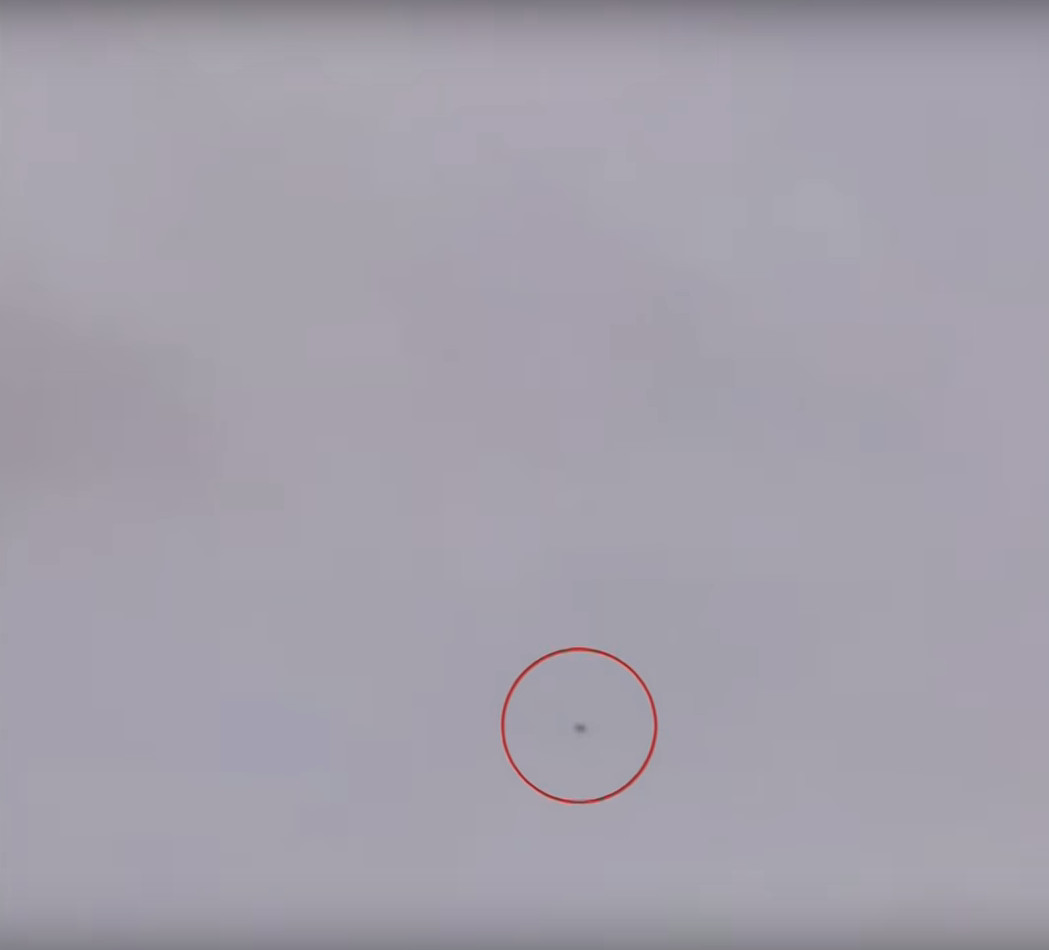
No, it's not a speck of dirt on your screen, it's a drone! BBC (Fair use)
No, it’s not a speck of dirt on your screen, it’s a drone! BBC (Fair use)

There follows three days of airport closure drama. No photos emerge despite almost every one of the many thousands of people on the site having a camera phone from which they are Tweeting about the queues in the terminal. There is a grainy video, but it is indistinct, and crucially it doesn’t have anything in it that is identifiable as Gatwick. Meanwhile the police are frustrated in their search for the drone operators, who like their drone, prove difficult to pinpoint

During the third night a pair of arrests are announced, a local couple. The police have saved the day, the culprits are under lock and key. Everyone breathes a sigh of relief, the airport re-opens, and that’s the end of that. Except of course it isn’t, because inconveniently the pair are found to be blameless and released. When pressed during an interview, a police spokesman then makes the embarrassing admission that there is a possibility that there may never have been a drone at all.

You Couldn’t Make It Up

If these are the drone parts they've found, they're doing it wrong. Francis Wood [CC BY-SA 3.0]
If these are the drone parts they’ve found, they’re doing it wrong. Francis Wood [CC BY-SA 3.0]
You might imagine that this was the fictional plot of a thriller novel, but sadly not. All of the above is a tale of the last few days of events in the British news, save for most of the first paragraph which is our guess at how the first drone sightings may have happened. At the time of writing there remains the possibility that there could have been a drone over Gatwick, but given the current dearth of evidence it is one that seems tenuous. There are reports of drone wreckage, but since readers with long memories will recall UK police once identified RepRap parts as a 3D printed gun we’ll wait until we see it before we call it that.

If there was indeed a drone then of course we would like to see its operators brought to justice forthwith. But what concerns us at Hackaday are the implications the episode could still have for those of our community with an interest in multirotors. The usual clamour was made for Government to do something about it, and we know that would have meant a fresh set of onerous regulations for responsible multirotor owners while doing nothing about the criminals, because of course criminals have little regard for laws.

So if we are to glean anything from this sorry mess, we must examine it from several angles. Why is there a lack of drone detection technology in place? How should drone reports initially be treated and investigated on the ground? How should they be dealt with in official inquiries, and how then should lawmakers see them? This will inevitably have a British flavour to it because of the incident in question, but the points are just as valid worldwide.

When a Drone Report Comes In, We Need a Reliable Way to Evaluate It

An oft-shared drone identification guide for airline pilots, of uncertain provenance (phantompilots.com).

When we are told something new, it passes a process of evaluation in our minds. We look at the source, and weigh up the story itself. If a guy with crazy hair in the street tells us that the aliens have landed and are controlling the Prime Minister with a ray gun, it will probably be discounted. But if Hackaday tells us that someone has hacked a VGA chipset to work as a software-defined radio we’re guessing most of you would be very interested indeed.

When a fresh drone incident is reported it appears that this evaluation process has historically been defective. We have previously discussed official incident reports that come with no physical evidence of a drone, but contain descriptions of drones with capabilities unmatched even by jet fighter aircraft. It seems like any eyewitness report in which the culprit is named as a drone is automatically taken at face value no matter how unlikely it may be. The fact that a report may have come from a pilot is sometimes mentioned as a boost to its credibility, but that is a false assumption. A pilot who is not familiar with either how drones appear from a distance or what the capabilities of a drone are in the air can only be considered an unreliable witness, because while they may know a lot about aircraft they lack the required expertise for this judgement. So what can be done to help boost the quality of reporting and to immediately highlight credible reports while requiring more for dubious ones?

In the case of a near miss in open airspace there may be little effect on ground-based facilities, but at an airport such as Gatwick there can be no chances taken by the authorities. A drone collision on an aircraft on final approach could cause hundreds of fatalities, so upon receipt of a report they must have had little choice but to close the runways. There appears to have been a lack of drone detection technologies in place at Gatwick which means that the only source available to the airport would have been the eyewitnesses themselves, and since we have amply demonstrated the potential for eyewitness reports being unreliable then the current confusion becomes an inevitability. It is imperative that more reliable detection technologies be fitted or developed if necessary. This is especially true when precautionary shut-downs stretch past minutes or hours into world-news-making delays as happened in this instance.

Competent Police Investigations and Responsible Journalism on Drone Reports

The mass media tech story cycle. Our apologies to Gartner. Curve image: Jeremykemp [ CC BY-SA 3.0 ]
Once an incident has started and news of it emerges there is a consequent effect upon members of our community. Legitimate drone fliers away from the airport will find themselves under more scrutiny, and since it is already a common tale to hear of police being called when flying is under way that means they could face harassment and wrongful arrest. Indeed though we do not know all the details of the pair arrested near Gatwick it smacks of their being arrested in a round-up of convenient local drone enthusiasts rather than as a result of meaningful investigation. That the names of the pair were leaked and they became the subject of a media frenzy further shows the danger in which they were placed, as well as the irresponsibility of the reporters who covered their plight.

Perhaps Most Importantly: We Need Accurate Official Incident Reports

Whatever happens in a drone report, whether it be an arrest or an embarrassing debacle, there will inevitably be an official incident report from the Civil Aviation Authority, the regulator of British civilian airspace. This will form the official record of the event, and thus should strive to be as accurate as possible, but here the process falls short for the final time. There appears to be no evaluation step performed on the available evidence and no requirement for physical proof. So if an eyewitness reports behaviors about the drone that no drone ever built could possibly be capable of, it is solemnly recorded as fact. Our previous article on this subject highlights multiple such accounts, and this is an important point because as the official record these reports are what informs legislators. When they make laws pertaining to drones it is imperative that their decisions are based upon accurate evidence, and it is clear that this is not the case. Given that they will no doubt be reviewing drone legislation in the wake of this fiasco it is particularly important that the investigators consult people with specialist knowledge in the field, demand physical proof rather than heresay, and most importantly question accounts that stretch credibility.

It seems obvious that the multirotor hobbyist is caught in a perfect storm of incompetent authorities, deeply flawed investigations, shoddy journalism, and clueless legislators. This incident has laid bare some of the shortcomings, and it is to be hoped that a few lessons might be learned to produce less of a debacle surrounding future drone incidents. It is still a developing story so there may be a breakthrough and the whole narrative will change, and if that turns out to be the case then we hope they find the correct perpetrator this time and send them away at Her Majesty’s pleasure for a very long time. We’re guessing though that every effort will be made to push it as far under the carpet as possible to save red faces among officialdom. As multirotor enthusiasts we must keep the issue of poor investigation alive though, for if we let it be buried once more it will come back to trouble us again.


GoPro Factory Goes Nomad To Dodge Tariff Threat

Despite the fact that the United States and China are currently in the middle of a 90-day “cease fire” in their ongoing trade war, with new tariffs on hold until March 2019 while the two countries try to reach agreement, not everyone is waiting around to see who comes out on top. In a recent press release, action camera manufacturer GoPro has announced their intention to move some production out of China in the face of potential tariff expansions; which many analysts fear will be the result of the current stalemate. That’s right, only some of their production is moving.

“We’re proactively addressing tariff concerns by moving most of our US-bound camera production out of China,” says GoPro CFO Brian McGee. “We believe this diversified approach to production can benefit our business regardless of tariff implications.” Reading his words carefully, the key phrase here is “diversified approach”. GoPro doesn’t intend to move their entire production capability out of China, but only the production of the cameras which are designated for importation into the United States. GoPro models which are to be sold to other parts of the world will still be made in China.

This might seem an extravagant move just to avoid US tariffs, but with better than 40% of GoPro’s revenue for the third quarter of 2018 coming from the Americas, the company stands to be hit hard by the proposed 25% tax. Combined with the fact they shuttered their drone division last year citing “an extremely competitive aerial market”, and the proliferation of “GoPro clones” available for pennies on the dollar, it seems pretty clear that belt-tightening is the name of the game for the company that was once synonymous with action cameras.

Continue reading “GoPro Factory Goes Nomad To Dodge Tariff Threat”

GPS III Launching Today But You Can’t Use It Until 2022

Imagine if you bought a new car but they keys were not going to be shipped to you until a few years later. That’s analogous to the situation the U.S. Air Force finds itself in. The first GPS III satellite is finally ready to launch today, December 18, 2018 — a little over 2 years beyond the original schedule. However, most of the unique GPS III features won’t be available until at least 2022, according to a 2017 Government Accounting Office (GAO) report to Congress.

GPS III is a project to launch 32 new satellites that will — for military users — be more difficult to jam. For civilian users, the new GPS satellites will be compatible with other systems, including the EU’s Galileo system. But the big draw? About three times the accuracy of the current system. For civilian use, that means 3 to 10 feet under good conditions as opposed to the current systems’ 10- to 33-foot resolution.

Continue reading “GPS III Launching Today But You Can’t Use It Until 2022”

Welcome To The Slow Death Of Satellite TV In America

During an earnings call on November 29th, CEO of AT&T Communications John Donovan effectively signed the death warrant for satellite television in the United States. Just three years after spending $67 billion purchasing the nations’s largest satellite TV provider, DirecTV, he made a comment which left little doubt about the telecom giant’s plan for the service’s roughly 20 million subscribers: “We’ve launched our last satellite.

The news might come as a surprise if you’re a DirecTV customer, but the writing has been on the wall for years. When the deal that brought DirectTV into the AT&T family was inked, they didn’t hide the fact that the actual satellite content delivery infrastructure was the least of their concerns. What they really wanted was the installed userbase of millions of subscribers, as well as the lucrative content deals that DirecTV had already made. The plan was always to ween DirecTV customers off of their satellite dishes, the only question was how long it would take and ultimately what technology they would end up using.

Now that John Donovan has made it clear their fleet of satellites won’t be getting refreshed going forward, the clock has officially started ticking. It won’t happen this year, or even the year after that. But eventually each one of the satellites currently beaming DirecTV’s content down to Earth will cease to function, and with each silent bird, satellite television (at least in the United States) will inch closer to becoming history.

Continue reading “Welcome To The Slow Death Of Satellite TV In America”

MakerBot Moves Away From Makers With New Printer

If you’ve been following the desktop 3D printing market for the last couple years, you’re probably aware of the major players right now. Chinese companies like Creality are dominating the entry level market with machines that are priced low enough to border on impulse buys, Prusa Research is iterating on their i3 design and bringing many exciting new features to the mid-range price point, and Ultimaker remains a solid choice for a high-end workhorse if you’ve got the cash. But one name that is conspicuously absent from a “Who’s Who” of 3D printing manufacturers is MakerBot; despite effectively creating the desktop 3D printing market, today they’ve largely slipped into obscurity.

So when a banner popped up on Thingiverse (MakerBot’s 3D print repository) advertising the imminent announcement of a new printer, there was a general feeling of surprise in the community. It had been assumed for some time that MakerBot was being maintained as a zombie company after being bought by industrial 3D printer manufacturer Stratasys in 2013; essentially using the name as a cheap way to maintain a foothold in the consumer 3D printer market. The idea that they would actually release a new consumer 3D printer in a market that’s already saturated with well-known, agile companies seemed difficult to believe.

But now that MakerBot has officially taken the wraps off a printer model they call Method, it all makes sense. Put simply, this isn’t a printer for us. With Method, MakerBot has officially stepped away from the maker community from which it got its name. While it could be argued that their later model Replicator printers were already edging out of the consumer market based on price alone, the Method makes the transition clear not only from its eye watering $6,500 USD price tag, but with its feature set and design.

That said, it’s still an interesting piece of equipment worth taking a closer look at. It borrows concepts from a number of other companies and printers while introducing a few legitimately compelling features of its own. While the Method might not be on any Hackaday reader’s holiday wish list, we can’t help but be intrigued about the machine’s future.

Continue reading “MakerBot Moves Away From Makers With New Printer”

The Space Station Has A Supercomputer Stowaway

The failed launch of Soyuz MS-10 on October 11th, 2018 was a notable event for a number of reasons: it was the first serious incident on a manned Soyuz rocket in 35 years, it was the first time that particular high-altitude abort had ever been attempted, and most importantly it ended with the rescue of both crew members. To say it was a historic event is something of an understatement. As a counterpoint to the Challenger disaster it will be looked back on for decades as proof that robust launch abort systems and rigorous training for all contingencies can save lives.

But even though the loss of MS-10 went as well as possibly could be expected, there’s still far reaching consequences for a missed flight to the International Space Station. The coming and going of visiting vehicles to the Station is a carefully orchestrated ballet, designed to fully utilize the up and down mass that each flight offers. Not only did the failure of MS-10 deprive the Station of two crew members and the experiments and supplies they were bringing with them, but also of a return trip which was to have brought various materials and hardware back to Earth.

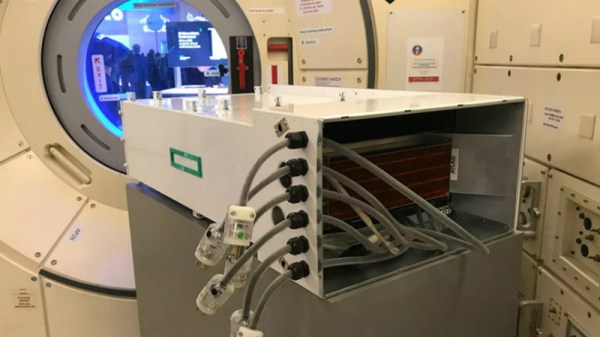
But there’s been at least one positive side effect of the return cargo schedule being pushed back. The “Spaceborne Computer”, developed by Hewlett Packard Enterprise (HPE) and NASA to test high-performance computing hardware in space, is getting an unexpected extension to its time on the Station. Launched in 2017, the diminutive 32 core supercomputer was only meant to perform self-tests and be brought back down for a full examination. But now that its ticket back home has been delayed for the foreseeable future, NASA is opening up the machine for other researchers to utilize, proving there’s no such thing as a free ride on the International Space Station.

Continue reading “The Space Station Has A Supercomputer Stowaway”

Weaponized Networked Printing Is Now A Thing

It’s a fairly safe bet that a Venn diagram of Hackaday readers and those who closely follow the careers of YouTube megastars doesn’t have a whole lot of overlap, so you’re perhaps blissfully unaware of the man who calls himself [PewDiePie]. As such, you might not know that a battle between himself and another YouTube channel which uploads Bollywood music videos has reached such a fever pitch that his fans have resorted to guerrilla hacking to try to sway public opinion towards their side. It’s perhaps not the dystopian future we imagined, but it just might be the one we deserve.

To briefly summarize the situation, a hacker known only by the handle [TheHackerGiraffe] decided to help out Dear Leader by launching an automated attack against 50,000 Internet connected printers. When the hack was successful, the printer would spit out a page of digital propaganda, complete with fist ASCII art, that urged the recipient to go on YouTube and pledge their support for [PewDiePie]. There’s some debate about how many of the printers [TheHackerGiraffe] targeted actually delivered their payload, but judging by reactions throughout social media, it was enough to get the message out.

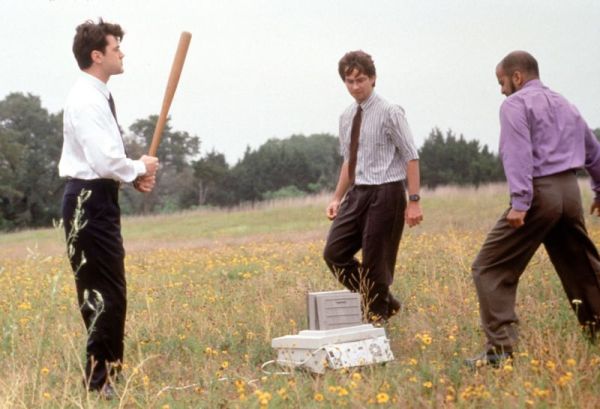
While the stunt itself may have come as a surprise, the methodology wasn’t. In fact, the only surprising element to the security researchers who’ve weighed in on the situation is that this hasn’t happened more often. It certainly isn’t the first time somebody’s done it, but the fact that this time its been connected to such a high profile Internet celebrity is putting more eyes on the problem then there have been in the past. Now that the proverbial cat is out of the bag, there are even websites springing up which claim to be purveyors of “Printer Advertising”. Odds are good this won’t be the last time somebody’s printer starts running off more than TPS reports.

We here at Hackaday don’t have much interest in the battle for YouTube supremacy. We’re just pulling for Dave Jones’s EEVBlog channel to join [AvE] in breaking a million subscribers. But we’re very interested in the technology which made this attack possible, how likely it is we’re going to see more people exploit it, and what are we supposed to do now that even our own printers can be turned against us?

Continue reading “Weaponized Networked Printing Is Now A Thing”