Chuck peddle father of 6502

Honoring Chuck Peddle; Father Of The 6502 And The Chips That Went With It

Chuck Peddle, the patriarch of the 6502 microprocessor, died recently. Most people don’t know the effect that he and his team of engineers had on their lives. We often take the world of microprocessor for granted as a commonplace component in computation device, yet there was a time when there were just processors, and they were the size of whole printed circuit boards.

Chuck had the wild idea while working at Motorola that they could shrink the expensive processor board down to an integrated circuit, a chip, and that it would cost much less, tens of dollars instead of ten thousand plus. To hear Chuck talk about it, he got a cease-and-desist letter from the part of Motorola that made their living selling $14,000 processor boards and to knock off all of the noise about a $25 alternative.

In Chuck’s mind this was permission to take his idea, and the engineering team, elsewhere. Chuck and his team started MOS Technologies in the 1970’s in Norristown PA, and re-purposed their work on the Motorola 6800 to become the MOS 6502. Lawsuits followed.

Continue reading “Honoring Chuck Peddle; Father Of The 6502 And The Chips That Went With It”

See You On The Dark Side Of The Moon: China’s Lunar Radio Observatory

For nearly as long as there has been radio, there have been antennas trained on the sky, looking at the universe in a different light than traditional astronomy. Radio astronomers have used their sensitive equipment to study the Sun, the planets, distant galaxies, and strange objects from the very edge of the universe, like pulsars and quasars. Even the earliest moments of the universe have been explored, a portrait in microwave radiation of the remnants of the Big Bang.

And yet with all these observations, there’s a substantial slice of the radio spectrum that remains largely a mystery to radio astronomers. Thanks to our planet’s ionosphere, most of the signals below 30 MHz aren’t observable by ground-based radio telescopes. But now, thanks to an opportunity afforded by China’s ambitious lunar exploration program, humanity is now listening to more of what the universe is saying, and it’s doing so from a new vantage point: the far side of the moon.

Continue reading “See You On The Dark Side Of The Moon: China’s Lunar Radio Observatory”

The Birth Of The Modern Robot

When Isaac Asmiov was writing I, Robot, the field of robotics was still in its infancy. As he notes in The Complete Robot, as the field began to mature, it started showing signs of conforming to the popular ideas held by science fiction writers about what robotics ought to be. Notions of humanoid robots, the functions that robots would have in domestic settings, even the ethical quandaries that AI ethicists face today were all themes of early sci-fi writers.

The idea of a robot – at least of automata – predates the field of robotics. The idea of an independent automata may have existed as early as the ancient Egyptians Chinese, and Greeks, who attempted to build self-operated machines that resembled animals and humans. Myths of clay golems in Jewish legends and clay giants in Norse legends perpetuated the idea of an artificial being that could mimic the actions of living creatures. A 400 BC myth from Crete spoke of a man of bronze who guarded their island from pirates.

Continue reading “The Birth Of The Modern Robot”

Wonder Woman And The Real Lasso Of Truth

You might think it is strange that a story about technology would start off talking about Wonder Woman. When you realize the technology in question is a lie detector, you might think, “Oh, that’s right. Wonder Woman had the lasso of truth, so this is just a lame association.” You might think that, but you’d be wrong. Turns out, Wonder Woman and real life polygraphs have a much deeper connection; both the polygraph and Wonder Woman share a common creator.

It makes a good story to say that William Marston — an internationally famous psychologist — created the polygraph, but as you might expect it wasn’t the result of a single person’s effort. However, Marston played a key role and also was behind promoting the technology. So, too, even though he is credited as Wonder Woman’s sole creator, the truth is probably a bit more complex.

Continue reading “Wonder Woman And The Real Lasso Of Truth”

Linux Fu: Stupid SSH Tricks

If you connect to remote computers over the Internet, it is a pretty good chance you use some form of SSH or secure shell. On Linux or Unix you’ll use the ssh command. Same goes for Linux-like environments on Windows like Cygwin or WSL. For native Windows, you might be using Putty. In its simplest form, ssh is just a terminal program that talks to a server using an encrypted connection. We think it is very hard to eavesdrop on anyone communicating with a remote computer via ssh.

There are several tricks for using ssh — some are pretty straightforward and some are things you might not think of as being in the domain of a terminal program. You probably know that ssh can copy files securely, and there are easy and hard ways to set up logging in with no password.

However, you can also mount a remote filesystem via ssh (actually, there are several ways to do that). You can use ssh to securely browse the web in your favorite browser, or even use it to tunnel specific traffic by port or even use it as a makeshift VPN. In fact, there’s so much ground to cover that this won’t be the last Linux Fu to talk about ssh. But enough setup, let’s get to the tricks.

Continue reading “Linux Fu: Stupid SSH Tricks”

Prusa Dares You To Break Their Latest Printer

Two months after its surprise reveal at the 2019 East Coast RepRap Festival, the Prusa Mini has started shipping out to the first wave of early adopters. True to form, with the hardware now officially released to the public, the company has begun the process of releasing the design as open source. In their GitHub repository, owners can already find the KiCad files for the new “Buddy” control board and STLs for the machine’s printable parts.

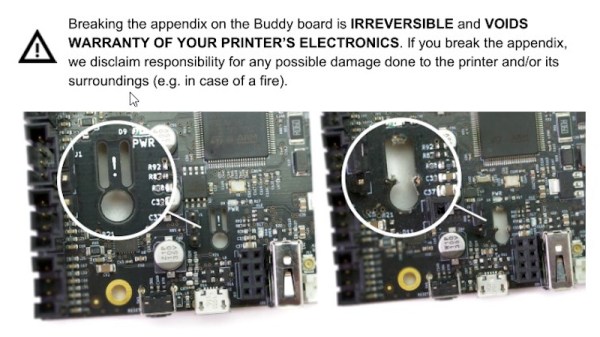
But even so, not everyone feels that Prusa Research has made the Mini as “open” as its predecessors. Some concerned owners have pointed out that according to the documentation for the Buddy board, they’ll need to physically snap off a section of the PCB so they can flash custom firmware images via Device Firmware Upgrade (DFU) mode. Once this piece of the board has been broken off, which the documentation refers to as the Appendix, Prusa Research will no longer honor any warranty claims for the electronic components of the printer.
For the hardcore tinkerers out there, this news may come as something of a shock. Previous Prusa printers have enjoyed a fairly active firmware development community, and indeed, features that started out as user-developed modifications eventually made their way into the official upstream firmware. What’s more, certain hardware modifications require firmware tweaks to complete.

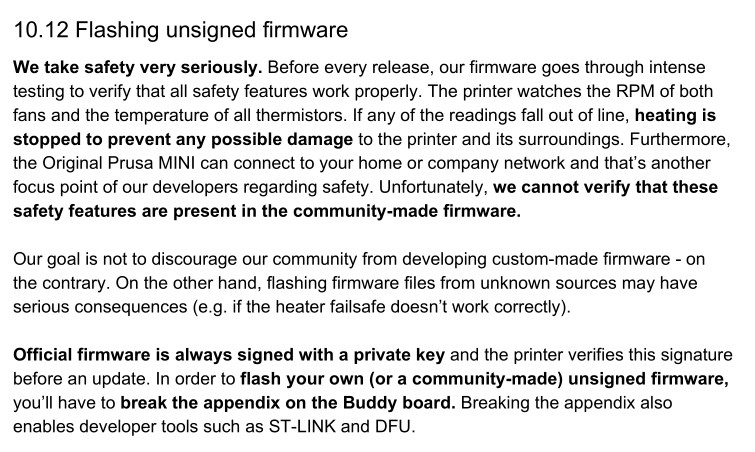
Prusa Research explains their stance by saying that there’s no way the company can verify the safety of community developed firmware builds. If thermal runaway protections have been disabled or otherwise compromised, the results could be disastrous. We’ve already seen it happen with other printers, so it’s hard to fault them for being cautious here. The company is also quick to point out that the installation of an unofficial firmware has always invalidated the printer’s warranty; physically breaking the board on the Mini is simply meant as a way to ensure the user understands they’re about to leave the beaten path.

How much support is a manufacturer obligated to provide to a user who’s modified their hardware? It’s of course an issue we’ve covered many times before. But here the situation is rather unique, as the user is being told they have to literally break a piece off of their device to unlock certain advanced functionality. If Prusa wanted to prevent users from running alternate firmware entirely they could have done so (or at least tried to), but instead they’ve created a scenario that forces the prospective tinkerer to either back down or fully commit.

So how did Prusa integrate this unusual feature into their brand new 32-bit control board? Perhaps more importantly, how is this going to impact those who want to hack their printers? Let’s find out.

Continue reading “Prusa Dares You To Break Their Latest Printer”

The Hornsdale Power Reserve And What It Means For Grid Battery Storage

Renewable energy has long been touted as a major requirement in the fight to stave off the world’s growing climate emergency. Governments have been slow to act, but prices continue to come down and the case for renewables grows stronger by the day.

However, renewables have always struggled around the issue of availability. Solar power only works when the sun is shining, and wind generators only when the wind is blowing. The obvious solution is to create some kind of large, grid-connected battery to store excess energy in off-peak periods, and use it to prop up the grid when renewable outputs are low. These days, that’s actually a viable idea, as South Australia proved in 2017.

Continue reading “The Hornsdale Power Reserve And What It Means For Grid Battery Storage”