During an earnings call on November 29th, CEO of AT&T Communications John Donovan effectively signed the death warrant for satellite television in the United States. Just three years after spending $67 billion purchasing the nations’s largest satellite TV provider, DirecTV, he made a comment which left little doubt about the telecom giant’s plan for the service’s roughly 20 million subscribers: “We’ve launched our last satellite.”
The news might come as a surprise if you’re a DirecTV customer, but the writing has been on the wall for years. When the deal that brought DirectTV into the AT&T family was inked, they didn’t hide the fact that the actual satellite content delivery infrastructure was the least of their concerns. What they really wanted was the installed userbase of millions of subscribers, as well as the lucrative content deals that DirecTV had already made. The plan was always to ween DirecTV customers off of their satellite dishes, the only question was how long it would take and ultimately what technology they would end up using.
Now that John Donovan has made it clear their fleet of satellites won’t be getting refreshed going forward, the clock has officially started ticking. It won’t happen this year, or even the year after that. But eventually each one of the satellites currently beaming DirecTV’s content down to Earth will cease to function, and with each silent bird, satellite television (at least in the United States) will inch closer to becoming history.
The greatest hardware hacks of all time were simply the result of finding software keys in memory. The AACS encryption debacle — the 09 F9 key that allowed us to decrypt HD DVDs — was the result of encryption keys just sitting in main memory, where it could be read by any other program. DeCSS, the hack that gave us all access to DVDs was again the result of encryption keys sitting out in the open.
Because encryption doesn’t work if your keys are just sitting out in the open, system designers have come up with ingenious solutions to prevent evil hackers form accessing these keys. One of the best solutions is the hardware enclave, a tiny bit of silicon that protects keys and other bits of information. Apple has an entire line of chips, Intel has hardware extensions, and all of these are black box solutions. They do work, but we have no idea if there are any vulnerabilities. If you can’t study it, it’s just an article of faith that these hardware enclaves will keep working.
Now, there might be another option. RISC-V researchers are busy creating an Open Source hardware enclave. This is an Open Source project to build secure hardware enclaves to store cryptographic keys and other secret information, and they’re doing it in a way that can be accessed and studied. Trust but verify, yes, and that’s why this is the most innovative hardware development in the last decade.
If you’ve been following the desktop 3D printing market for the last couple years, you’re probably aware of the major players right now. Chinese companies like Creality are dominating the entry level market with machines that are priced low enough to border on impulse buys, Prusa Research is iterating on their i3 design and bringing many exciting new features to the mid-range price point, and Ultimaker remains a solid choice for a high-end workhorse if you’ve got the cash. But one name that is conspicuously absent from a “Who’s Who” of 3D printing manufacturers is MakerBot; despite effectively creating the desktop 3D printing market, today they’ve largely slipped into obscurity.
So when a banner popped up on Thingiverse (MakerBot’s 3D print repository) advertising the imminent announcement of a new printer, there was a general feeling of surprise in the community. It had been assumed for some time that MakerBot was being maintained as a zombie company after being bought by industrial 3D printer manufacturer Stratasys in 2013; essentially using the name as a cheap way to maintain a foothold in the consumer 3D printer market. The idea that they would actually release a new consumer 3D printer in a market that’s already saturated with well-known, agile companies seemed difficult to believe.
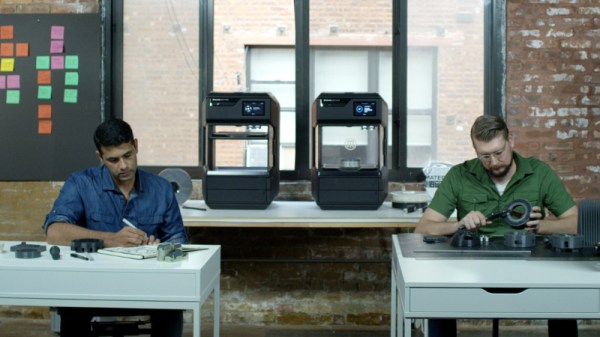
But now that MakerBot has officially taken the wraps off a printer model they call Method, it all makes sense. Put simply, this isn’t a printer for us. With Method, MakerBot has officially stepped away from the maker community from which it got its name. While it could be argued that their later model Replicator printers were already edging out of the consumer market based on price alone, the Method makes the transition clear not only from its eye watering $6,500 USD price tag, but with its feature set and design.
That said, it’s still an interesting piece of equipment worth taking a closer look at. It borrows concepts from a number of other companies and printers while introducing a few legitimately compelling features of its own. While the Method might not be on any Hackaday reader’s holiday wish list, we can’t help but be intrigued about the machine’s future.
Here’s a fun exercise: take a list of the 20th century’s inventions and innovations in electronics, communications, and computing. Make sure you include everything, especially the stuff we take for granted. Now, cross off everything that can’t trace its roots back to the AT&T Corporation’s research arm, the Bell Laboratories. We’d wager heavily that the list would still contain almost everything that built the electronics age: microwave communications, data networks, cellular telephone, solar cells, Unix, and, of course, the transistor.
But is that last one really true? We all know the story of Bardeen, Brattain, and Shockley, the brilliant team laboring through a blizzard in 1947 to breathe life into a scrap of germanium and wires, finally unleashing the transistor upon the world for Christmas, a gift to usher us into the age of solid state electronics. It’s not so simple, though. The quest for a replacement for the vacuum tube for switching and amplification goes back to the lab of Julius Lilienfeld, the man who conceived the first field-effect transistor in the mid-1920s.
It would be really hard to go through a typical day in the developed world without running across something made from ABS plastic. It’s literally all over the place, from toothbrush handles to refrigerator interiors to car dashboards to computer keyboards. Many houses are plumbed with pipes extruded from ABS, and it lives in rolls next to millions of 3D-printers, loved and hated by those who use and misuse it. And in the form of LEGO bricks, it lurks on carpets in the dark rooms of children around the world, ready to puncture the bare feet of their parents.
ABS is so ubiquitous that it makes sense to take a look at this material in terms of its chemistry and its properties. As we’ll see, ABS isn’t just a single plastic, but a mixture that takes the best properties of its components to create one of the most versatile plastics in the world.
The failed launch of Soyuz MS-10 on October 11th, 2018 was a notable event for a number of reasons: it was the first serious incident on a manned Soyuz rocket in 35 years, it was the first time that particular high-altitude abort had ever been attempted, and most importantly it ended with the rescue of both crew members. To say it was a historic event is something of an understatement. As a counterpoint to the Challenger disaster it will be looked back on for decades as proof that robust launch abort systems and rigorous training for all contingencies can save lives.
But even though the loss of MS-10 went as well as possibly could be expected, there’s still far reaching consequences for a missed flight to the International Space Station. The coming and going of visiting vehicles to the Station is a carefully orchestrated ballet, designed to fully utilize the up and down mass that each flight offers. Not only did the failure of MS-10 deprive the Station of two crew members and the experiments and supplies they were bringing with them, but also of a return trip which was to have brought various materials and hardware back to Earth.
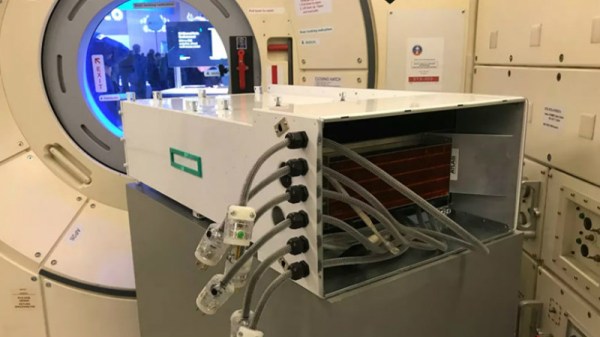
But there’s been at least one positive side effect of the return cargo schedule being pushed back. The “Spaceborne Computer”, developed by Hewlett Packard Enterprise (HPE) and NASA to test high-performance computing hardware in space, is getting an unexpected extension to its time on the Station. Launched in 2017, the diminutive 32 core supercomputer was only meant to perform self-tests and be brought back down for a full examination. But now that its ticket back home has been delayed for the foreseeable future, NASA is opening up the machine for other researchers to utilize, proving there’s no such thing as a free ride on the International Space Station.
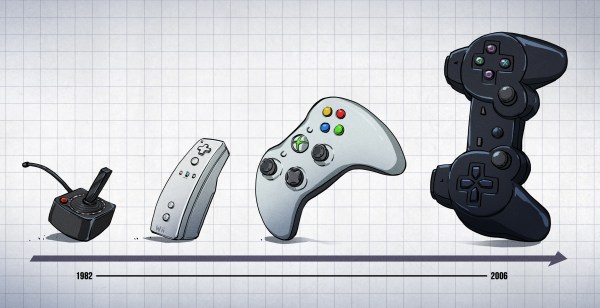
The story goes that Atari was developing a premium model of their popular home video game console, the Atari 2600, for the 1981 fiscal year. Internally known as the Stella RC, this model revision promised touch sensitive game selection toggles, LED indicators, and onboard storage for the controllers. The focus of the project, however, was the “RC” in Stella RC which stood for remote control. Atari engineers wanted to free players from the constraints of the wires that fettered them to their televisions.
Problem with the prototypes was that the RF transmitters in the controllers were powerful enough to send a signal over a 1000 ft. radius, and they interfered with a number of the remote garage door openers on the market. Not to mention that if there were another Stella RC console on the same channel in an apartment building, or simply across the street, you could be playing somebody else’s Pitfall run. The mounting tower of challenges to making a product that the FCC would stamp their approval on were too great. So Atari decided to abandon the pioneering Stella RC project. Physical proof of the first wireless game controllers would have been eliminated at that point if it were created by any other company… but prototypes mysteriously left the office in some peculiar ways.
“Atari had abandoned the project at the time…[an Atari engineer] thought it would be a great idea to give his girlfriend’s son a videogame system to play with…I can’t [comment] about the relationship itself or what happened after 1981, but that’s how this system left Atari…and why it still exists today.”
– Joe Cody, Atari2600.com
Atari did eventually get around to releasing some wireless RF 2600 joysticks that the FCC would approve. A couple years after abandoning the Stella RC project they released the Atari 2600 Remote Control Joysticks at a $69.95 MSRP (roughly $180 adjusted for inflation). The gigantic price tag mixed with the video game market “dropping off the cliff” in 1983 saw few ever getting to know the bliss of wire-free video game action. It was obvious that RF game controllers were simply ahead of their time, but there had to be cheaper alternatives on the horizon.
Out of Sight, Out of Control with IR Schemes
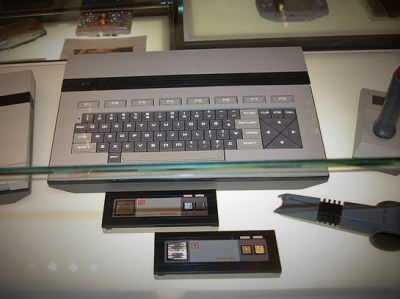
Nintendo AVS console deck and IR controller on display.
Video games were a dirty word in America in 1985. While games themselves were still happening on the microcomputer platforms, the home console business was virtually non-existent. Over in Japan, Nintendo was raking in money hand over fist selling video games on their Famicom console. They sought to replicate that success in North America by introducing a revised model of the Famicom, but it had to impress the tech journos that would be attending its reveal at the Consumer Electronics Show (CES).
The prototype system was called the Nintendo Advanced Video System (AVS). It would feature a keyboard, a cassette tape drive, and most importantly two wireless controllers. The controllers used infrared (IR) communication and the receiver was built-into the console deck itself. Each controller featured a square metallic directional pad and four action buttons that gave the impression of brushed aluminum. The advancement in video game controller technology was too good to be true though, because the entire system received a makeover before releasing as the Nintendo Entertainment System (NES) that Christmas. The NES lacked the keyboard, the tape drive, and the IR controllers and its change in materials hardly captured the high-end flash of the AVS. The removal of IR meant the device was cheaper to manufacture. A decision that ultimately helped the NES to become a breakout success that in turn brought back dedicated video game consoles single-handedly.


 The news might come as a surprise if you’re a DirecTV customer, but the writing has been on the wall for years. When the deal that brought DirectTV into the AT&T family was inked, they didn’t hide the fact that the actual satellite content delivery infrastructure was the least of their concerns. What they really wanted was the installed userbase of millions of subscribers, as well as the lucrative content deals that DirecTV had already made. The plan was always to ween DirecTV customers off of their satellite dishes, the only question was how long it would take and ultimately what technology they would end up using.