The BNC Connector And How It Got That Way

When I started working in a video production house in the early 1980s, it quickly became apparent that there was a lot of snobbery in terms of equipment. These were the days when the home video market was taking off; the Format War had been fought and won by VHS, and consumer-grade VCRs were flying off the shelves and into living rooms. Most of that gear was cheap stuff, built to a price point and destined to fail sooner rather than later, like most consumer gear. In our shop, surrounded by our Ikegami cameras and Sony 3/4″ tape decks, we derided this equipment as “ReggieVision” gear. We were young.

For me, one thing that set pro gear apart from the consumer stuff was the type of connectors it had on the back panel. If a VCR had only the bog-standard F-connectors like those found on cable TV boxes along with RCA jacks for video in and out, I knew it was junk. To impress me, it had to have BNC connectors; that was the hallmark of pro-grade gear.

I may have been snooty, but I wasn’t really wrong. A look at coaxial connectors in general and the design decisions that went into the now-familiar BNC connector offers some insight into why my snobbery was at least partially justified.

Continue reading “The BNC Connector And How It Got That Way” →

Ask Hackaday: Why Aren’t We Hacking Cellphones?

When a project has outgrown using a small microcontroller, almost everyone reaches for a single-board computer — with the Raspberry Pi being the poster child. But doing so leaves you stuck with essentially a headless Linux server: a brain in a jar when what you want is a Swiss Army knife.

It would be a lot more fun if it had a screen attached, and of course the market is filled with options on that front. Then there’s the issue of designing a human interface: touch screens are all the rage these days, so why not buy a screen with a touch interface too? Audio in and out would be great, as would other random peripherals like accelerometers, WiFi, and maybe even a cellular radio when out of WiFi range. Maybe Bluetooth? Oh heck, let’s throw in a video camera and high-powered LED just for fun. Sounds like a Raspberry Pi killer!

And this development platform should be cheap, or better yet, free. Free like any one of the old cell phones that sit piled up in my “hack me” box in the closet, instead of getting put to work in projects. While I cobble together projects out of Pi Zeros and lame TFT LCD screens, the advanced functionality of these phones sits gathering dust. And I’m not alone.

Why is this? Why don’t we see a lot more projects based around the use of old cellphones? They’re abundant, cheap, feature-rich, and powerful. For me, there’s two giant hurdles to overcome: the hardware and the software. I’m going to run down what I see as the problems with using cell phones as hacker tools, but I’d love to be proven wrong. Hence the “Ask Hackaday”: why don’t we see more projects that re-use smartphones?

Continue reading “Ask Hackaday: Why Aren’t We Hacking Cellphones?” →

ILLIAC Was HAL 9000’s Granddaddy

Science fiction is usually couched in fact, and it’s fun to look at an iconic computer like HAL 9000 and trace the origins of this artificial intelligence gone wrong. You might be surprised to find that you can trace HAL’s origins to a computer built for the US Army in 1952.

If you are a fan of the novel and movie 2001: A Space Oddessy, you may recall that the HAL 9000 computer was “born” in Urbana, Illinois. Why pick such an odd location? Urbana is hardly a household name unless you know the Chicago area well. But Urbana has a place in real-life computer history. As the home of the University of Illinois at Urbana–Champaign, Urbana was known for producing a line of computers known as ILLIAC, several of which had historical significance. In particular, the ILLIAC IV was a dream of a supercomputer that — while not entirely successful — pointed the way for later supercomputers. Sometimes you learn more from failure than you do successes and at least one of the ILLIAC series is the poster child for that.

The Urbana story starts in the early 1950s. This was a time when the 1945 book “First Draft of a Report on the EDVAC” was sweeping through the country from its Princeton origins. This book outlined the design and construction of the Army computer that succeeded ENIAC. In it, Von Neumann proposed changes to EDVAC that would make it a stored program computer — that is, a computer that treats data and instructions the same.

Continue reading “ILLIAC Was HAL 9000’s Granddaddy” →

Hacking When It Counts: Setting Sail In A Submarine

By the early 20th century, naval warfare was undergoing drastic technological changes. Ships were getting better and faster engines and were being outfitted with wireless communications, while naval aviation was coming into its own. The most dramatic changes were taking place below the surface of the ocean, though, as brave men stuffed themselves into steel tubes designed to sink and, usually, surface, and to attack by stealth and cunning rather than brute force. The submarine was becoming a major part of the world’s navies, albeit a feared and hated one.

For as much animosity as there was between sailors of surface vessels and those that chose the life of a submariner, and for as vastly different as a battleship or cruiser seems from a submarine, they all had one thing in common: the battle against the sea. Sailors and their ships are always on their own dealing with forces that can swat them out of existence in an instant. As a result, mariners have a long history of doing whatever it takes to get back to shore safely — even if that means turning a submarine into a sailboat.

Continue reading “Hacking When It Counts: Setting Sail In A Submarine” →

The Science Of Landing On An Asteroid

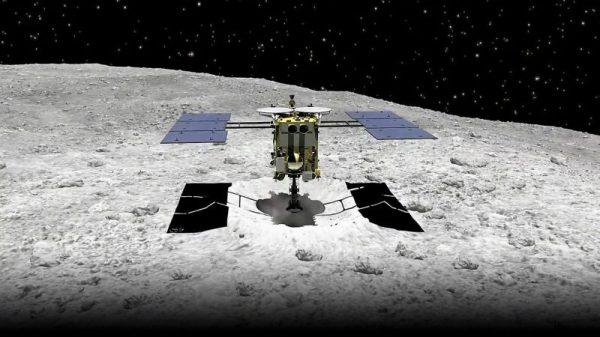
Exploiting the resources of the rock-strewn expanse of space between Mars and the outer planets has been the stuff of science fiction for ages. There’s gold in them ‘thar space rocks, or diamonds, or platinum, or something that makes them attractive targets for capitalists and scientists alike. But before actually extracting the riches of the asteroid belt, stuck here as we are at the bottom of a very deep gravity well that’s very expensive to climb out of, we have to answer a few questions. Like, how does one rendezvous with an asteroid? What’s involved with maneuvering near a comparatively tiny celestial body? And most importantly, how exactly does one land on an asteroid and do any useful work?

Back in June, a spacecraft launched by the Japanese Aerospace Exploration Agency (JAXA) finally caught up to an asteroid named Ryugu after having chased it for the better part of four years. The Hayabusa2 was equipped to answer all those questions and more, and as it settled in close to the asteroid with a small fleet of robotic rovers on board, it was about to make history. Here’s how they managed to not only land on an asteroid, but how the rovers move around on the surface, and how they’ll return samples of the asteroid to Earth for study.

Continue reading “The Science Of Landing On An Asteroid” →

Teardown: D50761 Aircraft Quick Access Recorder

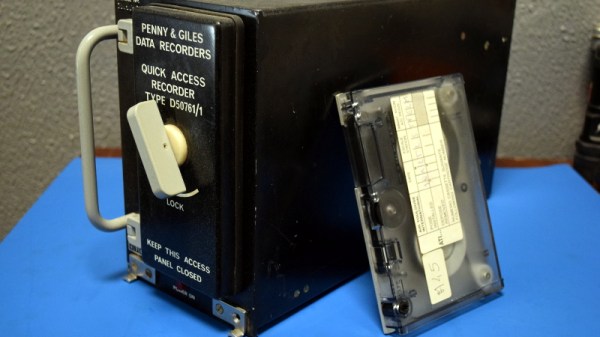
Everyone’s heard of the “black box”. Officially known as the Flight Data Recorder (FDR), it’s a mandatory piece of equipment on commercial aircraft. The FDR is instrumental in investigating incidents or crashes, and is specifically designed to survive should the aircraft be destroyed. The search for the so-called “black box” often dominates the news cycle after the loss of a commercial aircraft; as finding it will almost certainly be necessary to determine the true cause of the accident. What you probably haven’t heard of is a Quick Access Recorder (QAR).

While it’s the best known, the FDR is not the only type of recording device used in aviation. The QAR could be thought of as the non-emergency alternative to the FDR. While retrieving data from the FDR usually means the worst has happened, the QAR is specifically designed to facilitate easy and regular access to flight data for research and maintenance purposes. Its data is stored on removable media and since the QAR is not expected to survive the loss of the aircraft it isn’t physically hardened. In fact, modern aircraft often use consumer-grade technology such as Compact Flash cards and USB flash drives as storage media in their QAR.

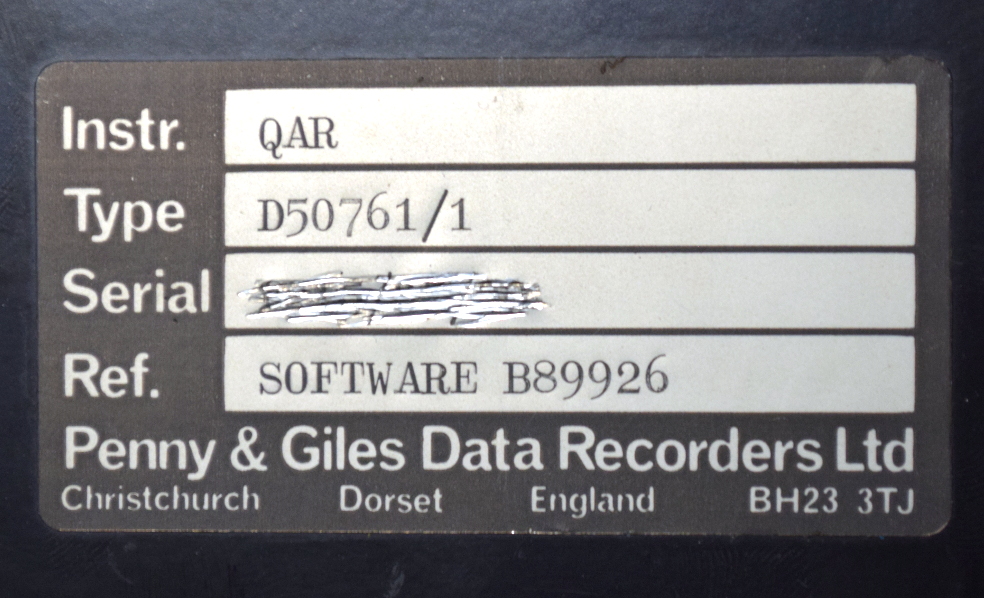
Through the wonders of eBay, I recently acquired a vintage Penny & Giles D50761 Quick Access Recorder. This was pulled out of an aircraft which had been in service with the now defunct airline, Air Toulouse International. Let’s crack open this relatively obscure piece of equipment and see just what goes into the hardware that airlines trust to help ensure their multi-million dollar aircraft are operating in peak condition.

Continue reading “Teardown: D50761 Aircraft Quick Access Recorder” →

Construction Cranes Versus Hurricanes

When engineers are designing buildings, bridges, or other large construction projects, a lot of thought is given to the environment. Some of these considerations might seem obvious, like designing a skyscraper in San Francisco to tolerate earthquakes, building a stadium in New York City to hold up not only its own weight but the weight of several feet of snow on the roof, or constructing bridges in any coastal area to be able to tolerate salt spray. Not everything is this straightforward, though. Not only do the structures themselves have to tolerate the environmental conditions they are in, but the equipment that is used to build them must tolerate these conditions as well, specifically the large cranes that are often semi-permanently attached to their construction sites.

Perhaps the most extreme example of this in recent memory was during Typhoon Manghut as it hit Hong Kong. There were several large construction cranes that didn’t fare too well with the high winds. At least one toppled as a result and catching the free-spinning of another on video is more than enough to make you gasp. Other videos of construction cranes surfaced from this typhoon showing some concerning, but surprisingly well-designed, emergency operation of the same type of crane.

Continue reading “Construction Cranes Versus Hurricanes” →