The King Of Machine Tools

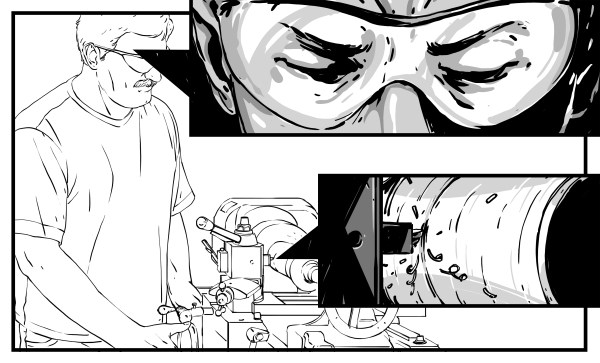
The lathe is known as the King of Machine Tools for a reason. There are very few things that you can’t make with one. In fact, people love to utter the old saw that the lathe is the only machine tool that can make itself. While catchy, I think that’s a bit disingenuous. It’s more accurate to say that there are parts in all machine tools that (arguably) only a lathe can make. In that sense, the lathe is the most “fundamental” machine tool. Before you harbor dreams of self-replication, however, know that most of an early lathe would be made by hand scraping the required flat surfaces. So no, a lathe can’t make itself really, but a lathe and a skilled craftsperson with a hand-scraper sure can. In fact, if you’ve read the The Metal Lathe by David J. Gingery, you know that a lathe is instrumental in building itself while you’re still working on it.

We’re taking trip through the machining world with this series of articles. In the previous article we went over the history of machine tools. Let’s cut to the modern chase now and help some interested folks get into the world of hobby machining, shall we? As we saw last time, the first machine tools were lathes, and that’s also where you should start.

Continue reading “The King Of Machine Tools”

How the 555 timer IC works

Learning The 555 From The Inside

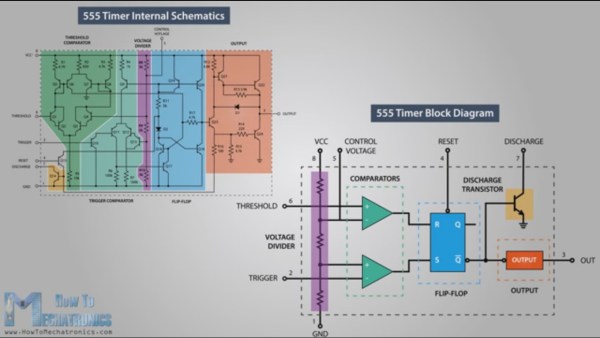
One way to understand how the 555 timer works and how to use it is by learning what the pins mean and what to connect to them. A far more enjoyable, and arguably a more useful way to learn is by looking at what’s going on inside during each of its modes of operation. [Dejan Nedelkovski] has put together just such a video where he walks through how the 555 timer IC works from the inside.

We especially like how he immediately removes the fear factor by first showing a schematic with all the individual components but then grouping them into what they make up: two comparators, a voltage divider, a flip-flop, a discharge transistor, and an output stage. Having lifted the internals to a higher level, he then walks through examples, with external components attached, for each of the three operating modes: bistable, monostable and astable. If you’re already familiar with the 555 then you’ll enjoy the trip down memory lane. If you’re not familiar with it, then you soon will be. Check out his video below.

Continue reading “Learning The 555 From The Inside”

Vera Rubin: Shedding Light On Dark Matter

Vera sat hunched in the alcove at Kitt Peak observatory, poring over punch cards. The data was the same as it had been at Lowell, at Palomar, and every other telescope she’d peered through in her feverish race to collect the orbital velocities of stars in Andromeda. Although the data was perfectly clear, the problem it posed was puzzling. If the stars at the edges of spiral galaxy were moving as fast as the ones in the center, but the pull of gravity was weaker, how did they keep from flying off? The only possible answer was that Andromeda contained some kind of unseen matter and this invisible stuff was keeping the galaxy together.

Though the idea seemed radical, it wasn’t an entirely new one. In 1933, Swiss astronomer Fritz Zwicky made an amazing discovery that was bound to bring him fame and fortune. While trying to calculate the total mass of the galaxies that make up the Coma Cluster, he found that the mass calculation based on galaxy speed was about ten times higher than the one based on total light output. With this data as proof, he proposed that much of the universe is made of something undetectable, but undeniably real. He dubbed it Dunkle Materie: Dark Matter.

But Zwicky was known to regularly bad mouth his colleagues and other astronomers in general. As a result, his wild theory was poorly received and subsequently shelved until the 1970s, when astronomer Vera Rubin made the same discovery using a high-powered spectrograph. Her findings seemed to provide solid evidence of the controversial theory Zwicky had offered forty years earlier.

Continue reading “Vera Rubin: Shedding Light On Dark Matter”

You All Know Reginald Fessenden. Who?

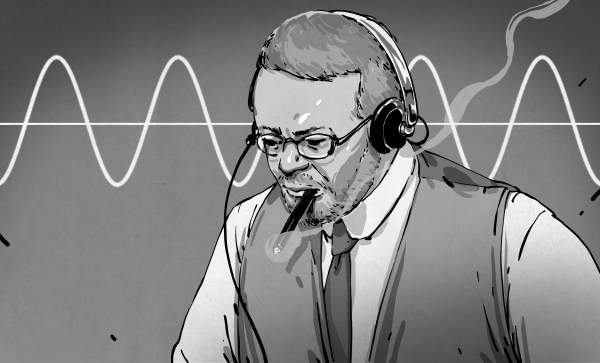
Quick, name someone influential in the history of radio. Who do did you think of? Marconi? Tesla? Armstrong? Hertz? Perhaps Sarnoff? We bet only a handful would have said Reginald Fessenden. That’s a shame because he was the first to do something that most of us do every day.

Few know this Canadian inventor’s name even though he developed quite a few innovations. Unlike Colpitts and Hartley we don’t have anything named after him. However, Fessenden was the first man to make a two-way transatlantic radio contact (Marconi’s was one way) and he was a pioneer in using voice over the radio.

He did even more than that. He patented transmitting with a continuous wave instead of a spark, which made modern radio practical. This was unpopular at the time because most thought the spark was necessary to generate enough energy. In 1906, John Fleming (who gave us tubes that are sometimes still called Fleming valves) wrote that “a simple sine-curve would not be likely to produce the required effect.” That was in 1906, five years after Fessenden’s patent.

Continue reading “You All Know Reginald Fessenden. Who?”

Retrotechtacular: AM Radios, Core Memory, And Color TV, What Was Hot In Chips In ’73

As part of writing tech stories such as those we feature here at Hackaday, there is a huge amount of research to be done.  We trawl through pages and pages of obscure blogs, videos, and data sheets. Sometimes we turn up resources interesting enough that we file them away, convinced that they contain the nucleus of another story at some point in the future.

Today’s topic of entertainment is just such a resource, courtesy of the Internet Archive. It’s not a video as we’d often provide you in a Retrotechtacular piece, instead it’s the February 1973 edition of the Fairchild Semiconductor Linear Integrated Circuits Catalog. Books like this one that could be had from company sales representatives were highly prized in the days before universal Internet access to data sheets, and the ink-on-paper datasheets within it provide a fascinating snapshot of the integrated electronics industry as it was 45 years ago.

The first obvious difference between then and now is one of scale, this is a single volume containing Fairchild’s entire range. At 548 pages it wouldn’t have been a slim volume by any means, but given that Fairchild were at the time one of the big players in the field it is unimaginable that the entire range of a 2018 equivalent manufacturer could be contained in the same way. Given that the integrated circuit was at the time an invention barely 15 years old, we are looking at an industry still in relative infancy.

The catalog has a series of sections with familiar headings: Operational amplifiers, comparators, voltage regulators, computer/interface, consumer, and transistor/diode arrays with analog switches. Any modern catalog will have similar headings, and there are even a few devices you will find have survived the decades. The μA741 op-amp (page 64) from its original manufacturer has not yet become a commodity product here, and it sits alongside familiar devices such as the μA7800 series (page 201) or μA723 (page 194) regulators.

Continue reading “Retrotechtacular: AM Radios, Core Memory, And Color TV, What Was Hot In Chips In ’73”

Whatever Happened To The Desktop Computer?

If you buy a computer today, you’re probably going to end up with a laptop. Corporate drones have towers stuffed under their desks. The cool creative types have iMacs littering their open-plan offices. Look around on the online catalogs of any computer manufacturer, and you’ll see there are exactly three styles of computer: laptops, towers, and all-in-ones. A quick perusal of Newegg reveals an immense variety of towers; you can buy an ATX full tower, an ATX mid-tower, micro-ATX towers, and even Mini-ITX towers.

It wasn’t always this way. Nerds of a sufficient vintage will remember the desktop computer. This was, effectively, a tower tilted on its side. You could put your monitor on top, negating the need for a stack of textbooks bringing your desktop up to eye level. The ports, your CD drive, and even your fancy Zip drive were right there in front of you. Now, those days of desktop computers are long gone, and the desktop computer is relegated to history. What happened to the desktop computer, and why is a case specifically designed for a horizontal orientation so hard to find?

Continue reading “Whatever Happened To The Desktop Computer?”

Learn About Waveforms Interactively

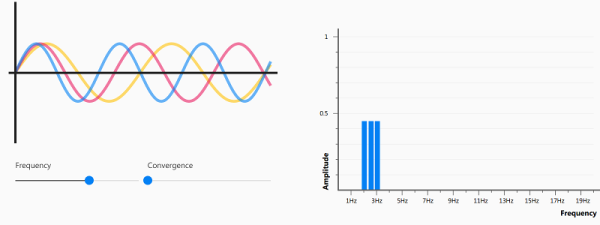
We’ll be honest: If you are a regular Hackaday reader, you probably won’t learn much new information about waveforms from this website. However, the presentation is a great example of using React on a webpage and — who knows — you might just pick up something interesting. At the very least, it’ll be a great resource the next time you try to help someone starting out.

The animated waveform is cool enough. It is also interesting that it changes based on where you are in the text. The really interesting part though is that you can press the M key to unmute your audio and hear what the wave sounds like. You can also use adjustments to control the frequency and amplitude of the wave.

Continue reading “Learn About Waveforms Interactively”