Conventional Current Vs. Electron Current

Electric current comes in many forms: current in a wire, flow of ions between the plates of a battery and between plates during electrolysis, as arcs, sparks, and so on. However, here on Hackaday we mostly deal with the current in a wire. But which way does that current flow in that wire? There are two possibilities depending on whether you’re thinking in terms of electron current or conventional current.

Electron current vs. conventional current

In a circuit connected to a battery, the electrons are the charge carrier and flow from the battery’s negative terminal, around the circuit and back to the positive terminal.

Conventional current takes just the opposite direction, from the positive terminal, around the circuit and back to the negative terminal. In that case there’s no charge carrier moving in that direction. Conventional current is a story we tell ourselves.

But since there is such a variety of forms that current comes in, the charge carrier sometimes does move from the positive to the negative, and sometimes movement is in both directions. When a lead acid battery is in use, positive hydrogen ions move in one direction while negative sulfate ions move in the other. So if the direction doesn’t matter then having a convention that ignores the charge carrier makes life easier.

Saying that we need a convention that’s independent of the charge carrier is all very nice, but that seems to be a side effect rather than the reason we have the convention. The convention was established long before there was a known variety of forms that current comes in — back even before the electron, or even the atom, was discovered. Why do we have the convention? As you’ll read below, it started with Benjamin Franklin.

Continue reading “Conventional Current Vs. Electron Current”

Fabricate Your Own Tabletop Gaming Props

Delve into the mysterious world of tabletop roleplaying games. Warhammer Fantasy Roleplay, Shadowrun, Pathfinder, Ars Magica, Vampire, whatever gets your dice rollin’ — metaphorically in the case of a diceless system. This might very well be your daddy’s D&D. If you’re not a gamer, you’re certainly familiar with the concept. People sit around a table pretending to have an epic adventure, often adding a random element with the help of dice. A map is often displayed on the table, sized for figures that show the various heroes and villains.

As a person with access to a variety of CNC machines I find myself wanting to create things to make gameplay more fun. I want to build a scale castle and have a siege. I want to conduct a ship-to-ship battle with wooden ships built to scale. But I also think smaller. What is something I could make that would help us every day? Say, a box for dice. Not every project needs to be the dragon’s lair.

It turns out a lot of other folks have been thinking about the same thing.

Continue reading “Fabricate Your Own Tabletop Gaming Props”

Books You Should Read: The Bridge

A few weeks ago, Amazon’s crack marketing AI decided to recommend a few books for me. That AI must be getting better because instead of the latest special-edition Twilight books, I was greeted with this:

“The asteroid was called the Hand of God when it hit.”

That’s the first sentence of The Bridge, a new Sci-Fi book by Leonard Petracci. If you think that line sucks you in, wait until you read the whole first chapter.

The Bridge is solidly in the generation ship trope. A voyage hundreds or even thousands of years long, with no sleep or stasis pods. The original crew knows they have no hope of seeing their destination, nor will their children and grandchildren. Heinlein delved into it with Orphans of the Sky. Even Robert Goddard himself discussed generation ships in The Last Migration.

I wouldn’t call The Bridge hard Sci-Fi — and that’s perfectly fine. Leonard isn’t going for scientific accuracy. It’s a great character driven story. If you enjoyed a book like Ready Player One, you’ll probably enjoy this.

The Bridge Is the story of Dandelion 14, a ship carrying people of Earth to a new planet. At some point during the journey, Dandelion 14 was struck by an asteroid, which split the ship in two. Only a few wires and cables keep the halves of the ship together. The crew on both sides of the ship survived, but they had no way to communicate. They do catch glimpses of each other in the windows though.

Much of the story is told in the first person by Horatius, a young man born hundreds of years after the asteroid strike. Horatius’ side of the ship has a population of one thousand, carefully measured at each census. They’ve lost knowledge of how to operate the ship’s systems, but they are surviving. Most of the population are gardeners, but there are doctors, cooks, porters, and a few historians. At four years old, Horatius is selected to become a gardener, like his father was before him. But Horatius has higher aspirations. He longs to become a historian to learn the secrets of the generations that came before him and to write his own story down for those who will come after.

Horatius sees the faces of the people on the other side of the ship as well. Gaunt, hungry, often fighting with knives or other weapons. A stark contrast to the well-fed people on his side of the vessel. The exception is one red-haired girl about his age. He often finds her staring back at him, watching him.

Horatius might have been chosen as a gardener, but he’s clever — a fact that sometimes gets him in trouble. His life takes an abrupt turn when the sleeping ship awakens with an announcement blaring “Systems Rebooting, Ship damage assessed. Reuniting the two halves of the ship and restoring airlock, approximately twenty-four hours until complete.”

The hardest part of writing a book review is not giving too much away. While I won’t tell you much more about the plot for The Bridge, I can tell a bit about how the book came about. You might call this book a hack of the publishing system. Leonard Petracci is also known as leoduhvinci on Reddit. The Bridge started life as Leonard’s response to a post on /r/writingprompts. The prompt went like this:

After almost 1,000 years the population of a generation ship has lost the ability to understand most technology and now lives at a pre-industrial level. Today the ship reaches its destination and the automated systems come back online.

Leonard ’s response to the prompt shot straight to the top, and became the first chapter of The Bridge. Chapter 2 followed soon after. In only a few months, the book was complete. Available on Reddit, and on Leonard’s website. The Bridge is also available on Amazon for Kindle, and on paper from Amazon’s CreateSpace.

The only real criticism I have about The Bridge is the ending. The book’s resolution felt a bit rushed. It would have been nice to have a few more pages telling us what happened to the characters after the major events of the book. Leonard is planning a sequel though, and he teases this in the final pages.

You can start reading The Bridge right now on Leonard’s website. He has the entire book online for free for a few more weeks. If you’ve missed the free period, the Kindle edition is currently $2.99.

Automate The Freight: The Robotic Garbage Man

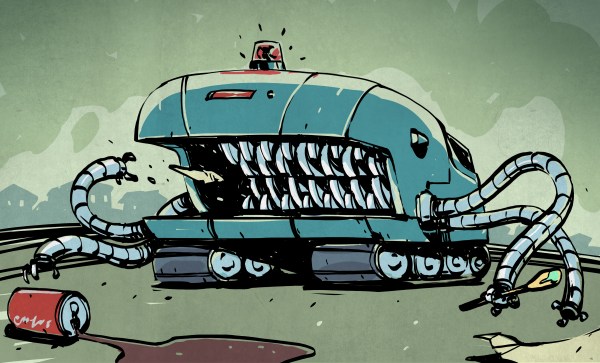
When I started the Automate the Freight series, my argument was that long before the vaunted day when we’ll be able to kick back and read the news or play a video game while our fully autonomous car whisks us to work, economic forces will dictate that automation will have already penetrated the supply chain. There’s much more money to be saved by carriers like FedEx and UPS cutting humans out of the loop while delivering parcels to homes and businesses than there is for car companies to make by peddling the comfort and convenience of driverless commuting.

But the other end of the supply chain is ripe for automation, too. For every smile-adorned Amazon package delivered, a whole bunch of waste needs to be toted away. Bag after bag of garbage needs to go somewhere else, and at least in the USA, municipalities are usually on the hook for the often nasty job, sometimes maintaining fleets of purpose-built trucks and employing squads of workers to make weekly pickups, or perhaps farming the work out to local contractors.

Either way you slice it, the costs for trash removal fall on the taxpayers, and as cities and towns look for ways to stretch those levies even further, there’s little doubt that automation of the waste stream will start to become more and more attractive. But what will it take to fully automate the waste removal process? And how long before the “garbage man” becomes the “garbage ‘bot”?

Continue reading “Automate The Freight: The Robotic Garbage Man”

Flying Defibrillators

It’s a sad reality that, by and large, cardiopulmonary resuscitation (CPR) doesn’t save lives. Despite all the “you could save a life” marketing aimed at getting people certified in CPR, the instances where even the prompt application of the correct technique results in a save are vanishingly rare, and limited mostly to witnessed arrests in a hospital. Speaking from personal experience, few things are sadder than arriving on-scene as a first responder to see CPR being performed by a husband on his wife and knowing that no matter what we do, it’s not going to end well.

The problem is one of time. Hearts only rarely just stop beating outright; usually some kind of arrhythmia first causes the heart to beat ineffectively, leading to hypoxia and loss of consciousness. From there it’s about a four-minute trip to brain death, but in that brief window chances are pretty good that the heart can be restarted. That’s why witnessed cardiac arrests in a hospital have better survival rates — the needed electric reboot of the heart with a defibrillator is only as far away as the nearest crash cart.

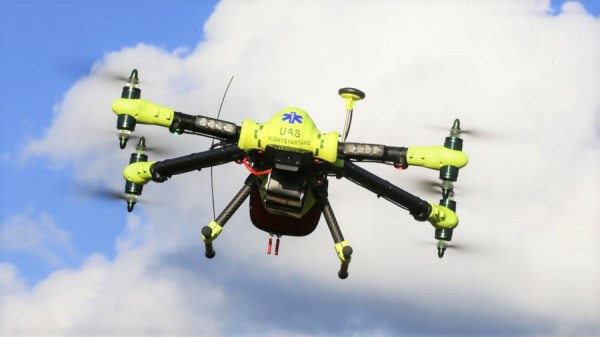
The advent of the automatic external defibrillator (AED) has increased the odds for survival of out-of-hospital cardiac arrest (OHCA), but the penetration of AEDs into public settings is far from complete enough to put one within a few minutes reach of everyone who might need one. So it’s only natural that thoughts would turn to delivering AEDs to cardiac incidents by drones. It seems like a great idea, but will it work? Continue reading “Flying Defibrillators”

Bicycle Racing In Space Could Be A Thing

It’s 2100 AD, and hackers and normals live together in mile-long habitats in the Earth-Moon system. The habitat is spun up so that the gravity inside is that of Earth, and for exercise, the normals cycle around on bike paths. But the hackers do their cycling outside, in the vacuum of space.

How so? With ion thrusters, rocketing out xenon gas as the propellant. And the source of power? Ultimately that’s the hackers’ legs, pedaling away at a drive system that turns two large Wimshurst machines.

Those Wimshurst machines then produce the high voltage needed for the thruster’s ionization as well as the charge flow. They’re also what gives the space bike it’s distinctly bicycle-like appearance. And based on the calculations below, this may someday work!

Continue reading “Bicycle Racing In Space Could Be A Thing”

Horns Across America: The AT&T Long Lines Network

A bewildering amount of engineering was thrown at the various challenges presented to the United States by the end of World War II and the beginning of the Cold War. From the Interstate Highway System to the population shift from cities to suburbs, infrastructure of all types was being constructed at a rapid pace, fueled by reasonable assessments of extant and future threats seasoned with a dash of paranoia, and funded by bulging federal coffers due to post-war prosperity and booming populations. No project seemed too big, and each pushed the bleeding edge of technology at the time.

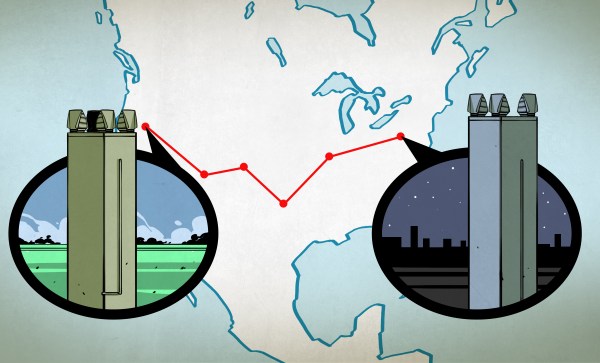
Some of these critical infrastructure projects have gone the way of the dodo, supplanted by newer technologies that rendered them obsolete. Relics of these projects still dot the American landscape today, and are easy to find if you know where to look. One that always fascinated me was the network of microwave radio relay stations that once stitched the country together. From mountaintop to mountaintop, they stand silent and largely unattended, but they once buzzed with the business of a nation. Here’s how they came to be, and how they eventually made themselves relics.

Continue reading “Horns Across America: The AT&T Long Lines Network”