Negative Resistance: It Shouldn’t Make Sense!

When you leaf through a basic electronics textbook, you’ll find chapters describing in detail the operation of the various components. Resistors, capacitors, inductors, and semiconductors. The latter chapter will talk about P and N type regions, introduce us to the diode, and then deal with the transistor: its basic operation, how to bias it, and the like.
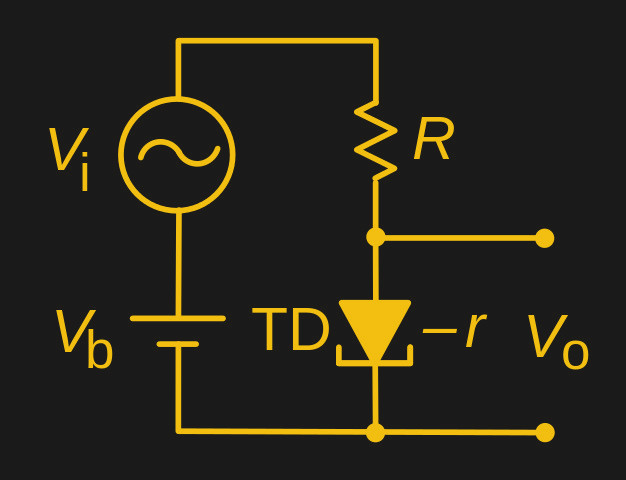
A tunnel diode amplifier circuit. Chetvorno [CC0]
Particularly if your textbook is a little older, you may find a short section talking about the tunnel diode. There will be an odd-looking circuit that seems to make no sense at all, an amplifier formed from just a forward-biased diode and a couple of resistors. This logic-defying circuit you are told works due to the tunnel diode being of a class of devices having a negative resistance, though in the absence of readily available devices for experimentation it can be difficult to wrap your head around.

We’re all used to conventional resistors, devices that follow Ohm’s Law. When you apply a voltage to a resistor, a current flows through it, and when the voltage is increased, so does the current. Thus if you use a positive resistance device, say a normal resistor, in both the top and the bottom halves of a potential divider, varying the voltage fed into the top of the divider results in the resistor behaving as you’d expect, and the voltage across it increases.
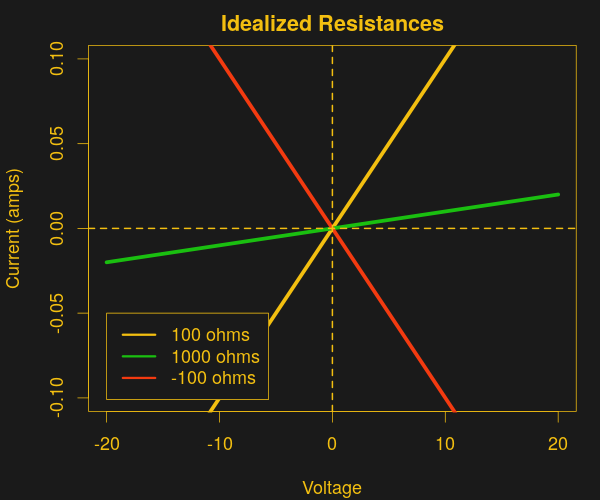
In a negative resistance device the opposite is the case: increasing the voltage across it results in decreasing current flowing through it. When a large enough negative resistance device is used in the lower half of a resistive divider, it reduces the overall current flowing through the divider when the input voltage increases. With less current flowing across the top resistor, more voltage is present at the output. This makes the negative resistor divider into an amplifier.

The tunnel diodes we mentioned above are probably the best known devices that exhibit negative resistance, and there was a time in the early 1960s before transistors gained extra performance that they seemed to represent the future in electronics. But they aren’t the only devices with a negative resistance curve, indeed aside from other semiconductors such as Gunn diodes you can find negative resistance in some surprising places. Electrical arcs, for example, or fluorescent lighting tubes.
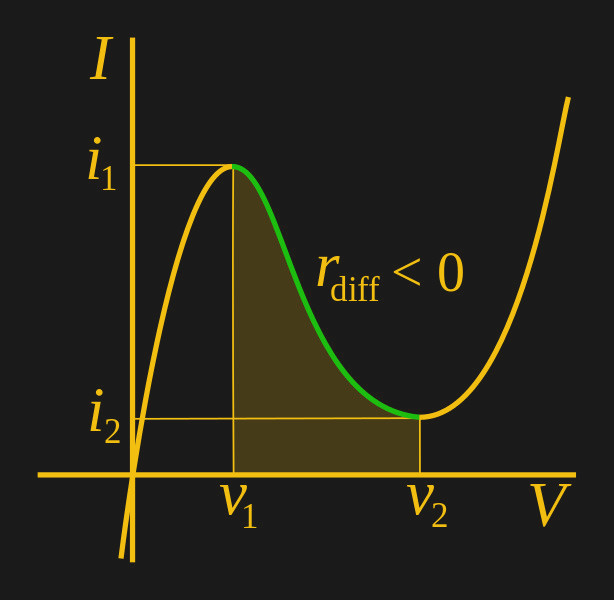
A typical negative resistance I-V curve. Chetvorno [CC0]
The negative resistance property of electric arcs in particular produced a fascinating device from the early twentieth century. The first radio transmitters used an electric arc to generate their RF, but were extremely inefficient and wideband, causing interference. A refinement treated the spark not as the source of the RF but as the negative resistance element alongside a tuned circuit in an oscillator, These devices could generate single frequencies at extremely high power, and thus became popular as high-powered transmitters alongside those using high-frequency alternators until the advent of higher powered tube-based transmitters around the First World War.

It’s unlikely that you will encounter a tunnel diode or other similar electronic component outside the realm of very specialist surplus parts suppliers. We’ve featured them only rarely, and then they are usually surplus devices from the 1960s. But understanding something of how they operate in a circuit should be part of the general knowledge of anyone with an interest in electronics, and is thus worth taking a moment to look at.

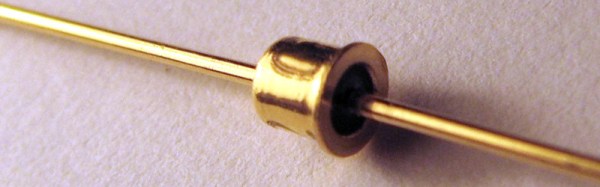
1N3716 tunnel diode header image: Caliston [Public domain].

Fix-a-Brick: Fighting The Nexus 5X Bootloop

Oh Nexus 5X, how could you? I found my beloved device was holding my files hostage having succumbed to the dreaded bootloop. But hey, we’re hackers, right? I’ve got this.

It was a long, quiet Friday afternoon when I noticed my Nexus 5X was asking to install yet another update. Usually I leave these things for a few days before eventually giving in, but at some point I must have accidentally clicked to accept the update. Later that day I found my phone mid-way through the update and figured I’d just wait it out. No dice — an hour later, my phone was off. Powering up led to it repeatedly falling back to the “Google” screen; the dreaded bootloop.

Stages of Grief

I kept my phone on me for the rest of the night’s jubilant activities, playing with it from time to time, but alas, nothing would make it budge. The problem was, my Nexus still had a full day’s video shoot locked away on its internal flash that I needed rather badly. I had to fix the phone, at least long enough to recover my files. This is the story of my attempt to debrick my Nexus 5X.

Continue reading “Fix-a-Brick: Fighting The Nexus 5X Bootloop”

How Many Inventors Does It Take To Invent A Light Bulb

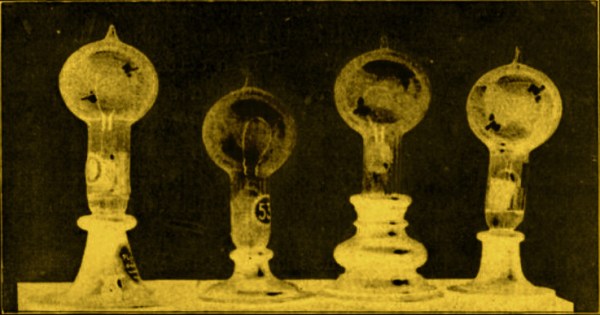
Many credit the invention of the incandescent light bulb with Edison or Swan but its development actually took place over two centuries and by the time Edison and Swan got involved, the tech was down to the details. Those details, however, meant the difference between a laboratory curiosity that lasted minutes before burning out, and something that could be sold to consumers and last for months. Here then is the story of how the incandescent light bulb was invented.

Continue reading “How Many Inventors Does It Take To Invent A Light Bulb”

How To Use A Photo Tachometer

If you’re into anything even vaguely mechanical on the broad hacking spectrum, you’ve come into contact with things that spin. Sometimes, it’s important to know precisely how fast they are spinning! When you’ve got the need to know angular speed, you need a device to measure it. That device is a tachometer. And the most useful tachometer is the non-contact photo-tachometer.

Continue reading “How To Use A Photo Tachometer”

Are You Down With MPPT? (Yeah, You Know Me.)

Solar cells have gotten cheaper and cheaper, and are becoming an economically viable source of renewable energy in many parts of the world. Capturing the optimal amount of energy from a solar panel is a tricky business, however. First there are a raft of physical prerequisites to operating efficiently: the panel needs to be kept clean so the sun can reach the cells, the panel needs to point at the sun, and it’s best if they’re kept from getting too hot.

Along with these physical demands, solar panels are electrically finicky as well. In particular, the amount of power they produce is strongly dependent on the electrical load that they’re presented, and this optimal load varies depending on how much illumination the panel receives. Maximum power-point trackers (MPPT) ideally keep the panel electrically in the zone even as little fluffy clouds roam the skies or the sun sinks in the west. Using MPPT can pull 20-30% more power out of a given cell, and the techniques are eminently hacker-friendly. If you’ve never played around with solar panels before, you should. Read on to see how!

Continue reading “Are You Down With MPPT? (Yeah, You Know Me.)”

Retrotechtacular: How Old Is The Remote?

A few weeks ago we covered a (probably) bogus post about controlling a TV with the IR from a flame. That got us thinking about what the real origin of the remote control was. We knew a story about the 38 kHz frequency commonly used to modulate the IR. We’ve heard that it was from sonar crystals used in earlier sonic versions of remotes. Was that true? Or just an urban myth? We set out to find out.

Surprise! Remotes are Old!

If you are a younger reader, you might assume TVs have always had remotes. But for many of us, remotes seem like a new invention. If you grew up in the middle part of the last century it is a good bet you were your dad’s idea of a remote control: “Get up and turn the channel!” Turns out remotes have been around for a long time, though. They just weren’t common for a long time.

If you really want to stretch back, [Oliver Lodge] used a radio to move a beam of light in 1894. In 1896, [Marconi] and some others made a bell ring by remote control. [Tesla] famously showed a radio-controlled boat in 1898. But none of these were really remote controls like we think of for a television.

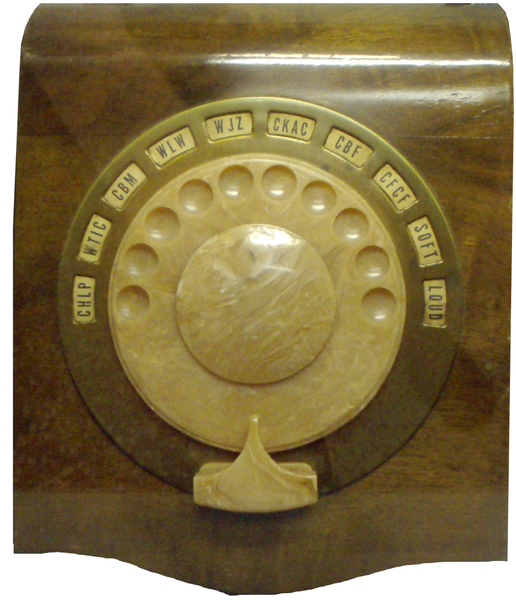
mysteryOf course, TV wouldn’t be around for a while, but by the 1930’s many radio manufacturers had wired remotes for radios. People didn’t like the wires, so Philco introduced the Mystery Control in 1939. This used digital pulse coding and a radio transmitter. That’s a fancy way of saying it had a dial like an old telephone. As far as we can tell, this was the first wireless remote for a piece of consumer equipment.

Continue reading “Retrotechtacular: How Old Is The Remote?”

Two Bits A Gander: Of Premature Babies, Incubators, And Coney Island Sideshows

Newborn humans are both amazingly resilient and frighteningly fragile creatures. A child born with 40 full weeks of gestation has pretty good odds of surviving the neonatal period these days, and even if he or she comes along a few weeks early, things usually go smoothly. But those babies that can’t wait to get out and meet the world can run into trouble, and the earlier they’re born, the greater the intervention needed to save them.

We’ve all seen pictures of remarkably tiny babies in incubators, seemingly dwarfed by the gloved hands of an anxious parent who just wants that first magical touch of their baby’s skin. As common as such an intervention is now and as technologically advanced as neonatology is, care for premature infants as a medical discipline has a long and interesting history of technical and social hacks that’s worth looking at.

Continue reading “Two Bits A Gander: Of Premature Babies, Incubators, And Coney Island Sideshows”