PCB Design Guidelines To Minimize RF Transmissions

There are certain design guidelines for PCBs that don’t make a lot of sense, and practices that seem excessive and unnecessary. Often these are motivated by the black magic that is RF transmission. This is either an unfortunate and unintended consequence of electronic circuits, or a magical and useful feature of them, and a lot of design time goes into reducing or removing these effects or tuning them.

You’re wondering how important this is for your projects and whether you should worry about unintentional radiated emissions. On the Baddeley scale of importance:

  • Pffffft – You’re building a one-off project that uses battery power and a single microcontroller with a few GPIO. Basically all your Arduino projects and around-the-house fun.
  • Meh – You’re building a one-off that plugs into a wall or has an intentional radio on board — a run-of-the-mill IoT thingamajig. Or you’re selling a product that is battery powered but doesn’t intentionally transmit anything.
  • Yeeeaaaaahhhhhhh – You’re selling a product that is wall powered.
  • YES – You’re selling a product that is an intentional transmitter, or has a lot of fast signals, or is manufactured in large volumes.
  • SMH – You’re the manufacturer of a neon sign that is taking out all wireless signals within a few blocks.

Continue reading “PCB Design Guidelines To Minimize RF Transmissions”
The Zimmermann Telegram

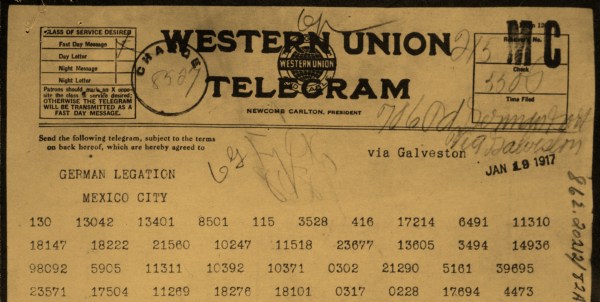
World War I began in 1914 as a fight among several European nations, while the United States pursued a policy of non-intervention. In fact, Woodrow Wilson was reelected President largely because “He kept us out of war”. But as the war unfolded in Europe, an intercepted telegram sent by the German Foreign Secretary, Arthur Zimmermann, to the Mexican government inflamed the U.S. public opinion and was one of the main reasons for the entry of the U.S. into WWI. This is the story of the encrypted telegram that changed the last century.

Continue reading “The Zimmermann Telegram”

Fifty Shades Of Gray Code

Some years back, a museum asked me to help them with an exhibit a contractor had built for them. It was a wheel like the one on Wheel of Fortune, but smaller and mounted on the wall instead of the floor. You would spin the wheel, it would stop on some item, and a computer would play a short video about the item. Physically and mechanically, it was a beautifully built exhibit. The electronics, though, left something to be desired.

In principle, this is pretty simple computer task. Measure the position of the wheel, and when it stops moving, play a video based on the position. The problem was the folks who created the artistic mechanics didn’t think hard about the electronics behind it. Sometimes–but not often–the wheel would play the wrong video. Sometimes it wouldn’t play at all.

The Prime Suspect

My immediate suspicion turned out to be correct. I took the wheel off its mount to discover copper foil tape on the back of it. Each pie wedge had foil in different areas and there were two brushes in each area. When the wheel stopped, two of the brushes would be shorted together and the rest were open. The way they detected that was bizarre, but that wasn’t the problem. (It involved a cannibalized PS/2 keyboard.)
Continue reading “Fifty Shades Of Gray Code”

Tesla Vs. Edison

The phrase “Tesla vs. Edison” conjures up images of battling titans, mad scientists, from a bygone age. We can easily picture the two of them facing off, backed by glowing corona with lightning bolts emitting from their hands. The reality is a little different though. Their main point of contention was Tesla’s passion for AC vs. Edison’s drive to create DC power systems to power his lights. Their personalities also differed in many ways, the most relevant one here being their vastly different approaches to research. Here, then, is the story of their rivalry.

Continue reading “Tesla Vs. Edison”

The Birth Of Quantum Electrodynamics

The start of World War II threw quantum theory research into disarray. Many of the European physicists left Europe all together, and research moved across the ocean to the shores of the United States. The advent of the atomic bomb thrust American physicists into the spotlight, and physicists began to meet on Shelter Island to discuss the future of quantum theory. By this time one thing was certain: the Copenhagen interpretation of quantum theory had triumphed and challenges to it had mostly died off.

This allowed physicists to focus on a different kind of problem. At this point in time quantum theory was not able to deal with transitional states of particles when they are created and destroyed. It was well known that when an electron came into contact with a positron, the two particles were destroyed and formed at least two photons with a very high energy, known as gamma rays. On the flip side, gamma ray photons could spontaneously turn into positron-electron pairs.

No one could explain why this occurred. It had become obvious to the physicists of the day that a quantum version of Maxwell’s electromagnetic field theory was needed to explain the phenomenon. This would eventually give rise to QED, short for quantum electrodynamics. This is a severely condensed  story of how that happened.

Continue reading “The Birth Of Quantum Electrodynamics”

Woodworking Basics For The Hardware Hacker

Hackaday is primarily a place for electronics hackers, but that’s not to say that we don’t see a fair number of projects where woodworking plays a key role. Magic mirror builds come to mind, as do restorations of antique radios, arcade machines built into coffee tables, and small cases for all manner of electronic and mechanical gadgets. In some of these projects, the woodworking really shines and makes the finished project pop. In others — well, let’s just say that some woodwork looks good from far, but is far from good.

Continue reading “Woodworking Basics For The Hardware Hacker”

Owning Hacker As A Word

To a casual observer it might seem as though our community is in the news rather a lot at the moment. It’s all about hacks on our TV screens in the soap opera of Washington politics, who hacked this, whether those people over there helped that lot hack the other lot, or even whether that person’s emails could have been hacked on that server. Keeping up with it as an outsider can become a full-time job.

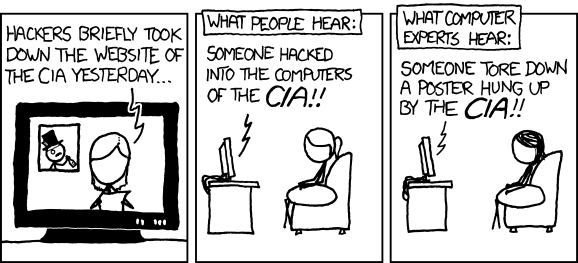
XKCD 932 says it all. (CC BY-NC 2.5)

Of course, as we all know even if the mainstream journalists (or should I refer to them colloquially as “hacks”?) don’t, it’s not us they’re talking about. Their hackers are computer criminals, while we are people with some of the hardware and software skills to bend technology to our will, even beyond what its designers might have intended. And that divergence between the way we use the word in a sense of reappropriation and they use it in disapprobation sometimes puts us in an odd position. Explaining to a sober-suited businessman as the director of a hackspace, that no, we’re not *those*hackers can sometimes  feel like skating on thin ice.

Continue reading “Owning Hacker As A Word”