
Hackspace U

No Timmy, we're not preparing you for a life of mindless drudgery! PD, via Wikimedia Commons.
No Timmy, we’re not preparing you for a life of mindless drudgery! PD, via Wikimedia Commons.

It’s funny, how obsessed we are with qualifications these days. Kids go to school and are immediately thrust into a relentless machine of tests, league tables, and exams. They are ruthlessly judged on grades, yet both the knowledge and qualifications those grades represent so often boil down to relatively useless pieces of paper. It doesn’t even end for the poor youngsters when they leave school, for we are now in an age in which when on moving on from school a greater number of them than ever before are expected to go to university. They emerge three years later carrying a student debt and a freshly-printed degree certificate, only to find that all this education hasn’t really taught them the stuff they really need to do whatever job they land.

A gold standard of education is revealed as an expensive piece of paper with a networking opportunity if you are lucky. You need it to get the job, but in most cases the job overestimates the requirement for it. When a prospective employer ignores twenty years of industry experience to ask you what class of degree you got twenty years ago you begin to see the farcical nature of the situation.

In our hackspaces, we see plenty of people engaged in this educational treadmill. From high schoolers desperately seeking to learn something other than simply how to regurgitate the textbook, through university students seeking an environment closer to an industrial lab or workshop, to perhaps most interestingly those young people who have eschewed university and gone straight from school into their own startups.
Continue reading “Hackspace U”

Creating A PCB In Everything: KiCad, Part 3

This is the third and final installment of a series of posts on how to create a PCB in KiCad, and part of an overarching series where I make the same schematic and board in dozens of different software tools. A few weeks ago, we took a look at making a schematic in KiCad, and more recently turned that schematic into a board ready for fabrication.

For our KiCad tutorials, we’ve already done the basics. We know how to create a PCB, make a part from scratch, and turn that into a board. This is the bare minimum to be considered competent with KiCad, but there’s so much more this amazing tool has to offer.

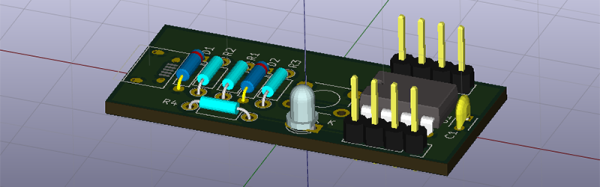
In part three of this KiCad tutorial, we’re going to take a look at turning our board into Gerbers. This will allow us to send the board off to any fab house. We’re going to take a look at DRC, so we can make sure the board will work once we receive it from the fab. We’re also going to take a look at some of the cooler features KiCad has to offer, including push and shove routing (as best as we can with our very minimalist board) and 3D rendering.

Continue reading “Creating A PCB In Everything: KiCad, Part 3”

Disassembly Required

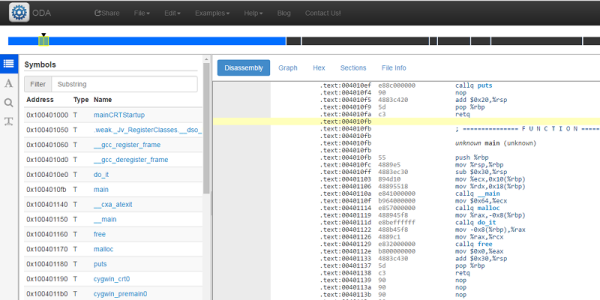
If you really want to hack software, you are going to face a time when you have to take apart someone’s machine code. If you aren’t very organized, it might even be your own — source code does get lost. If you want to impress everyone, you’ll just read through the hex code (well, the really tough old birds will read it in binary). That was hard to do even when CPUs only had a handful of instructions.

A more practical approach is to use a tool called a disassembler. This is nothing more than a program that converts numeric machine code into symbolic instructions. The devil, of course, is in the details. Real programs are messy. The disassembler can’t always figure out the difference between code and data, for example. The transition points between data and code can also be tricky.

When Not to Use

If you are coding your own program in assembly,  a disassembler isn’t usually necessary. The disassembly can’t recover things like variable names, some function names, and — of course — comments. If you use a high-level language and you want to check your compiler output, you can easily have the compiler provide assembly language output (see below).

The real value of a disassembler is when you don’t have the source code. But it isn’t easy, especially for anything nontrivial. Be prepared to do a lot of detective work in most cases.

Continue reading “Disassembly Required”

Tools Of The Trade – Thermoforming

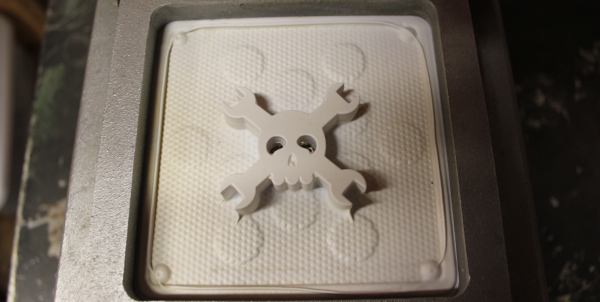
Chances are good that you’ve already lost some blood to thermoforming, the plastics manufacturing process that turns a flat sheet of material into an unopenable clamshell package, tray inside a box, plastic cup, or leftover food container.  Besides being a source of unboxing danger, it’s actually a useful technique to have in your fabrication toolchest. In this issue of Tools of the Trade, we look at how thermoforming is used in products, and how you can hack it yourself.

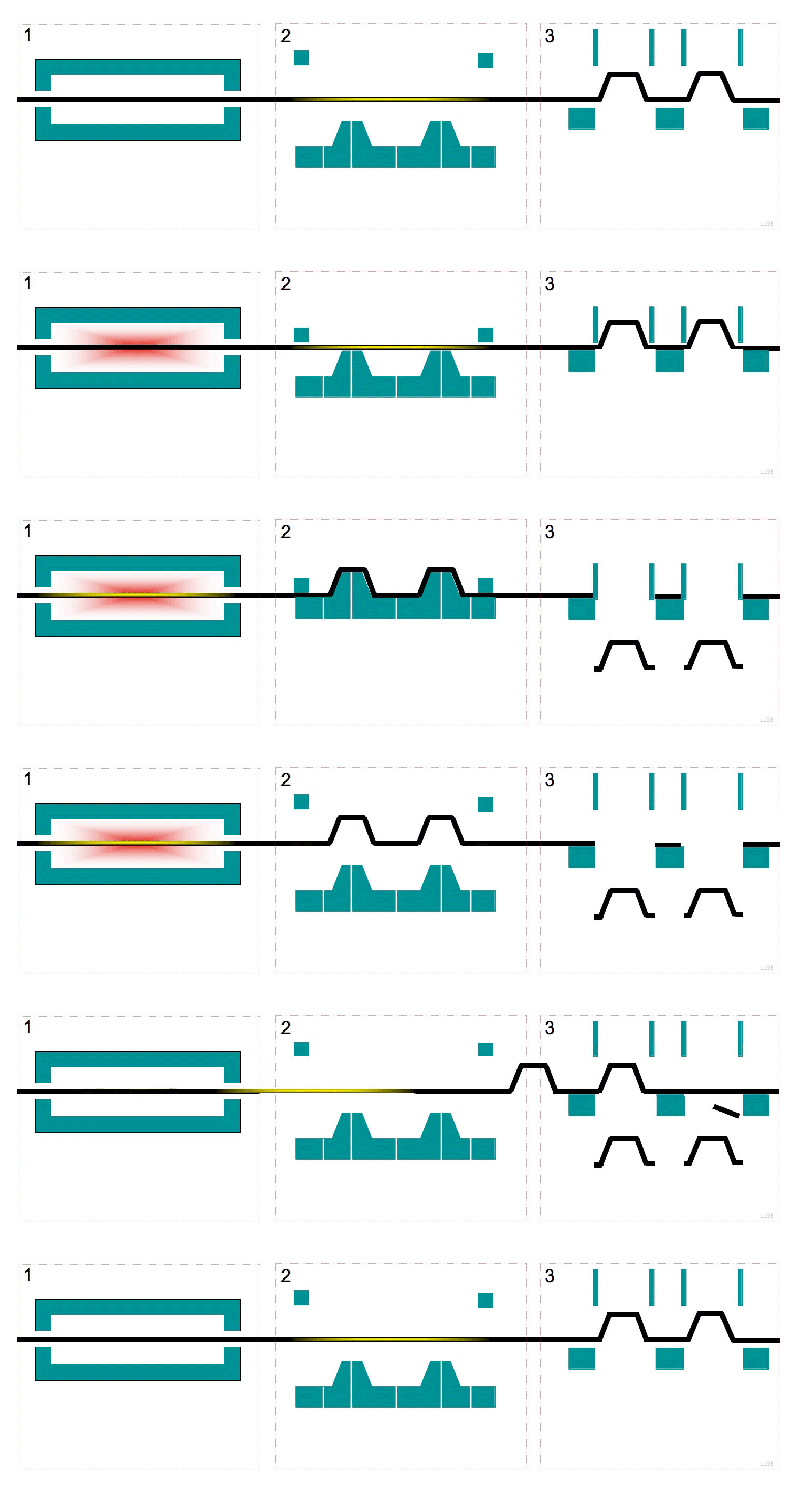
The process is simple; take a sheet of plastic material, usually really thin stuff, but it can get as thick as 1/8″, heat it up so that it is soft and pliable, put it over a mold, convince it to take all the contours of the mold, let it cool, remove it from the mold, and then cut it out of the sheet. Needless to say, there will be details.

https://commons.wikimedia.org/wiki/File:Thermoforming_animation.gif

Continue reading “Tools Of The Trade – Thermoforming”

Millennium Tower Is Sinking; And Waiting Is The Hardest Part

San Francisco’s Millennium Tower is sinking. Since its completion in 2009, the 58-story, 645-foot tall residential building has settled 16 inches and tilted perhaps 2 inches to the northwest. Since the foundation issues came to light in August 2016, the vertiginous ultra-luxury highrise has become the subject of outrage, ridicule, and at least two pieces of pending litigation.

Nothing that we build is static. Our office towers, apartment complexes, and single family homes move in response to loads applied by the environment. Buildings sway in the wind, expand and contract in response to temperature changes, and shift with the land upon which they rest. In most scenarios, these deflections are so minuscule that the occupants never even notice. Millennium Tower happens to be a large enough project with a severe enough problem that the whole world can’t help but gawk.

Millenium Tower located in San Francisco's SOMA, near the Financial District
Millenium Tower located in San Francisco’s SOMA, near the Financial District.

In foundation design, not all terra is firma. While a one or two story wood-framed building can be built safely with a shallow foundation on crummy soil, a major skyscraper requires a foundation that can transfer extremely high loads into the earth. But the strata below our city streets can consist of anything from sand to clay to solid rock, and many cities, including San Francisco, have infilled former marshes and bays with soil in order to expand their coastlines and generate valuable real estate. Millennium Tower was built in South of Market, a neighborhood that mostly used to belong to San Francisco Bay.

Continue reading “Millennium Tower Is Sinking; And Waiting Is The Hardest Part”

I Think I Failed. Yes, I Failed.

Down the rabbit hole you go.

In my particular case I am testing a new output matching transformer design for an audio preamplifier and using one of my go to driver circuit designs. Very stable, and very reliable. Wack it together and off you go to test and measurement land without a care in the world. This particular transformer is designed to be driven with a  class A amplifier operating at 48 volts in a pro audio setting where you turn the knobs with your pinky in the air sort of thing. Extra points if you can find some sort of long out of production parts to throw in there for audiophile cred, and I want some of that.

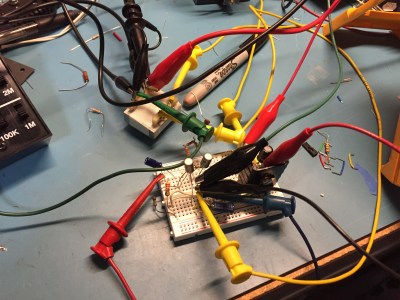
img_2857-2Lets use some cool retro transistors! I merrily go along for hours designing away. Carefully balancing the current of the long tailed pair input. Picking just the right collector power resistor and capacitor value to drive the transformer. Calculating the negative feedback circuit for proper low frequency cutoff and high frequency stability, and into the breadboard the parts go — jumper clips, meter probes, and test leads abound — a truly joyful event.
All of the voltages check out, frequency response is what you would expect, and a slight tweak to the feedback look brought everything right into happiness. Time to fire up the trusty old HP 334A Distortion Analyzer. Those old machines require you to calibrate the input circuit and the volt meter, tune a filter to the fundamental frequency you are applying to the device under test and step down to lower and lower orders of distortion levels until the meter happily sits somewhere in the middle of a range.

Most modern circuits in even cheap products just go right down to sub .1% total harmonic distortion levels without even a thought and I expected this to be much the same. The look of horror must have been pronounced on my face when the distortion level of my precious circuit was something more akin to a clock radio! A frantic search began. Was it a bad jumper, or a dirty lead in the breadboard, or an unseated component? Was my function generator in some state of disrepair? Is the Stephen King story Maximum Overdrive coming true and my bench is going to eat me alive? All distinct possibilities in this state of panic.

Continue reading “I Think I Failed. Yes, I Failed.”

So Where’s My Low Voltage DC Wall Socket?

What are the evocative sounds and smells of your childhood? The sensations that you didn’t notice at the time but which take you back immediately? For me one of them is the slight smell of phenolic resin from an older piece of consumer electronics that has warmed up; it immediately has me sitting cross-legged on our living room carpet, circa 1975.

"Get ready for a life that smells of hot plastic, son!" John Atherton [CC BY-SA 2.0], via Wikimedia Commons.
“Get ready for a life that smells of hot plastic, son!” John Atherton [CC BY-SA 2.0], via Wikimedia Commons.
That phenolic smell has gone from our modern electronics, not only because modern enclosures are made from ABS and other more modern plastics, but because the electronics they contain no longer get so hot. Our LCD TV for instance nowadays uses only 50 watts, while its 1970s CRT predecessor would have used several hundred. Before the 1970s you would not find many household appliances that used less than 100 watts, but if you take stock of modern electrical appliances, few use more than that. Outside the white goods in your kitchen and any electric heaters or hair dryers you may own, your appliances today are low-powered. Even your lighting is rapidly being taken over by LEDs, which are at their heart low-voltage devices.

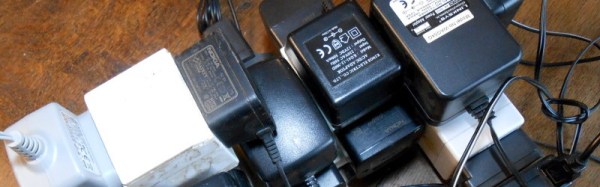
There are many small technological advancements that have contributed to this change over the decades. Switch-mode power supplies, LCD displays, large-scale integration, class D audio and of course the demise of the thermionic tube, to name but a few. The result is often that the appliance itself runs from a low voltage. Where once you would have had a pile of mains plugs competing for your sockets, now you will have an equivalent pile of wall-wart power supplies. Even those appliances with a mains cord will probably still contain a switch-mode power supply inside.

Continue reading “So Where’s My Low Voltage DC Wall Socket?”