You Own Your MRI Brainscan; Do Something Interesting With It

The most complicated and fascinating gadget you will ever own is your brain. Why not pay tribute to this wonder by creating a 3D scale model that you can print yourself? If you have had a full-head MRI scan, it is simple to take this data and create a 3D model that you can print out on any 3D printer. Here’s how to print your brain.

To begin, you are going to need an MRI scan. Unfortunately, the low-field MRI that [Peter Jansen] is working on won’t quite cut it (yet): you’ll have to get the pros to do it. The type of scan also matters, because we want a scan that focusses in on the brain itself, not the bits around it. What type you get depends on what your doctor wants to know, as the radiologist can run a lot of different scans and analysis of the data to show different types of tissue. After looking through the scans that I got, I settled on one that was labelled eB1000i(BRAIN) With and Without Contrast. To a radiologist, that information means a lot, telling you what type of scan it is, and that it was done with a contrast agent, a metal dye that is injected to make water-rich tissues (like my brain) more visible. The number refers to something called the diffusion weighting, which helps the doctor look for swelling that can indicate things like strokes, tumors, etc. There’s a good guide to some of the jargon here.

Continue reading “You Own Your MRI Brainscan; Do Something Interesting With It” →

The Problem With Kickstarter: A Lack Of Transparency

Since 2010, over one and a half billion dollars has been transferred from Kickstarter backers to project creators, and with Kickstarter’s 5% cut taken on each dollar collected, that means Kickstarter has had somewhere in the neighborhood of 75 to 80 million dollars in revenue in the last five years. That’s a success by any measure, and as with this huge amount of money, questions must be asked about the transparency of Kickstarter.

This is not a post about a Kickstarter project for an impossible project, a project that breaks the laws of physics, or one that is hyped beyond all reasonable expectations. This is a post about Kickstarter itself, and it’s been a long time coming. In the past, Kickstarter has shown at least some transparency by cancelling projects that are obvious rebrandings of white label goods – a direct violation of their rules. Kickstarter has even cancelled projects that violate the laws of physics, like this wireless charging Bluetooth tag. It’s a start, but Kickstarter has a much larger problem on its plate: the Staff Pick problem.

Continue reading “The Problem With Kickstarter: A Lack Of Transparency” →

Hollywood Finally Gets Hacking Right With Mr. Robot

Author’s note: I’m keeping spoilers out of this article, but they will surely show up in the comments.

A few weeks ago I started hearing about a new show on the USA network, Mr. Robot. The synopsis for the show was “Mr. Robot is a psychological thriller that follows a young programmer who works as a cyber-security engineer by day and a vigilante hacker by night.” Yeah, that sounds like another Hollywood crapfest. Cue crazy GUIs and virtual reality flybys representing hacking scenes. After watching the pilot though, I realized I couldn’t have been more wrong. I was hooked for the entire 10 week first season.

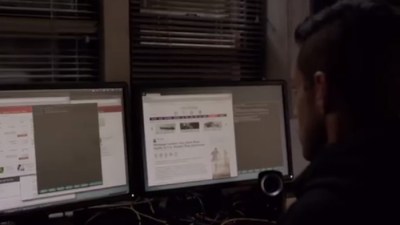
elliot-hacksLet’s start with the hacking, which is the whole reason this article is here on Hackaday. Show creator [Sam Esmail] isn’t a hacker himself, but he is tech savvy enough to see how poorly hacking has been portrayed on TV and in the movies. He knew he could do it better. The solution was good consultants, in the form of [Michael Bazzell] and others. The team helped shape the show into a rather realistic portrayal of hacking techniques. Elliot Alderson (Rami Malek), the main character, is the “vigilante” hacker described in the synopsis. Within the first 10 minutes of the pilot, he is turning a child pornographer in to the police. How does he catch the creeper? Tor exit node exploits, of course.

The onion routing protocol is not as anonymous as you think it is. Whoever’s in control of the exit nodes is also in control of the traffic, which makes me the one in control.

This is an accurate description of some of the exploits which have been demonstrated on the tor network. There aren’t any VR hacking scenes to be found either. In fact, several characters watch and make fun of the “flu shot” scene in Hackers. In this show, the command line isn’t hidden, it’s celebrated. We see every command the characters type, from netstat to CAN bus dumps. In one scene, Elliot even fires up a windows virtual machine so he can run DeepSound on his Kali Linux box.

The hacking isn’t all software either. Everyone’s favorite Linux single board computer is featured prominently in the first season. We can’t knock a show where a character looks at another and says “Ok, we all know what a Raspberry Pi is, what’s your point?”

Continue reading “Hollywood Finally Gets Hacking Right With Mr. Robot” →

Robots Are Coming For Our Jobs. Just Not All Of Them.

There is a lot to be said for replacing certain kinds of jobs with robots. Most people would agree that replacing physical human labor with automation is a good thing. It’s especially good to automate the dangerous kinds of labor like some facets of factory work. What about automation in fields that require more mental labor, where physical strain isn’t the concern? Is replacing humans really the best course of action? A year ago, a video called Humans Need Not Apply set forth an explanation of how robots will inevitably replace us. But that narrative is a tough sell.

Whether it is even possible depends on the job being automated. It also depends on how far we are able to take technology, and the amount of labor we are willing to offload. Automation has been replacing human workers in assembly and manufacturing industries for years. Even with equipment and upkeep expenses, the tireless nature of robotic workers means dramatically lower overhead for businesses.

Many of the current forms of factory automation are rather dumb. When something goes wrong and their task is compromised, they keep chugging away. That costs time and money. But there are companies out there producing robots that are better on many levels.

May Your Robot Overlords Be Cute and Cuddly

baxter-heroIn 2013, Rethink Robotics started filling orders for a new line called Baxter. They are a class of general purpose robot that can be programmed to do many kinds of manual tasks. Baxter bots have vision, and they can learn how to do a job simply by watching. They don’t need to be programmed in the traditional sense.

Baxter even has a face – a screen that shows different expressions depending on his state. When he’s in the midst of a task, his eyes are cast downward. If something goes wrong, he stops what he’s doing. His cartoon face appears sort of shocked, then sad. He goes into safe mode and waits to be fixed.

Continue reading “Robots Are Coming For Our Jobs. Just Not All Of Them.” →

Learning Verilog For FPGAs: Flip Flops

Last time I talked about how to create an adder in Verilog with an eye to putting it into a Lattice iCEstick board. The adder is a combinatorial circuit and didn’t use a clock. This time, we’ll finish the demo design and add two clocked elements: a latch that remembers if the adder has ever generated a carry and also some counters to divide the 12 MHz clock down to a half-second pulse to blink some of the onboard LEDs.

Why Clocks?

Clocks are an important part of practical digital design. Suppose you have a two input AND gate. Then imagine both inputs go from zero to one, which should take the output from zero to one, also. On paper, that seems reasonable, but in real life, the two signals might not arrive at the same time. So there’s some small period of time where the output is “wrong.” For a single gate, this probably isn’t a big deal since the delay is probably minuscule. But the errors will add up and in a more complex circuit it would be easy to get glitches while the inputs to combinatorial gates change with different delays.

Continue reading “Learning Verilog For FPGAs: Flip Flops” →

Learning Verilog For FPGAs: The Tools And Building An Adder

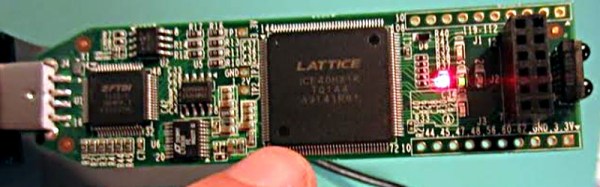
Over the last year we’ve had several posts about the Lattice Semiconductor iCEstick which is shown below. The board looks like an overgrown USB stick with no case, but it is really an FPGA development board. The specs are modest and there is a limited amount of I/O, but the price (about $22, depending on where you shop) is right. I’ve wanted to do a Verilog walk through video series for awhile, and decided this would be the right target platform. You can experiment with a real FPGA without breaking the bank.

In reality, you can learn a lot about FPGAs without ever using real hardware. As you’ll see, a lot of FPGA development occurs with simulated FPGAs that run on your PC. But if you are like me, blinking a virtual LED just isn’t as exciting as making a real one glow. However, for the first two examples I cover you don’t need any hardware beyond your computer. If you want to get ready, you can order an iCEstick and maybe it’ll arrive before Part III of this series if published.

Continue reading “Learning Verilog For FPGAs: The Tools And Building An Adder” →

The EM Drive Might Not Work, But We Get Helicarriers If It Does

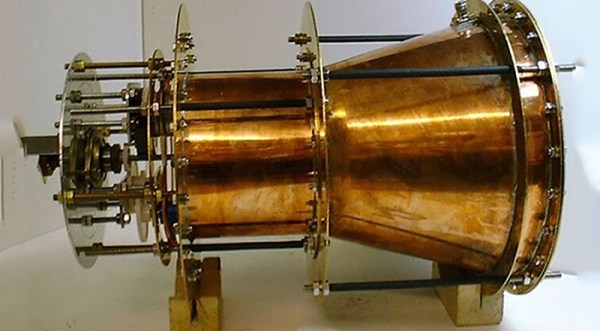
There is a device under test out there that promises to take humans to another star in a single lifetime. It means vacations on the moon, retiring at Saturn, and hovercars. If it turns out to be real, it’s the greatest invention of the 21st century. If not, it will be relegated to the history of terrible science right underneath the cold fusion fiasco. It is the EM drive, the electromagnetic drive, a reactionless thruster that operates only on RF energy. It supposedly violates the laws of conservation of momentum, but multiple independent lab tests have shown that it produces thrust. What’s the real story? That’s a little more complicated.

The EM Drive is a device that turns RF energy — radio waves — directly into thrust. This has obvious applications for spacecraft, enabling vacations on Mars, manned explorations of Saturn, and serious consideration of human colonization of other solar systems. The EM drive, if proven successful, would be one of the greatest inventions of all time. Despite the amazing amount of innovation the EM drive would enable, it’s actually a fairly simple device, and something that can be built out of a few copper sheets.

Continue reading “The EM Drive Might Not Work, But We Get Helicarriers If It Does” →