Take A Time-Lapse Or Bake A Cake With This Kitchen Timer Panning Rig

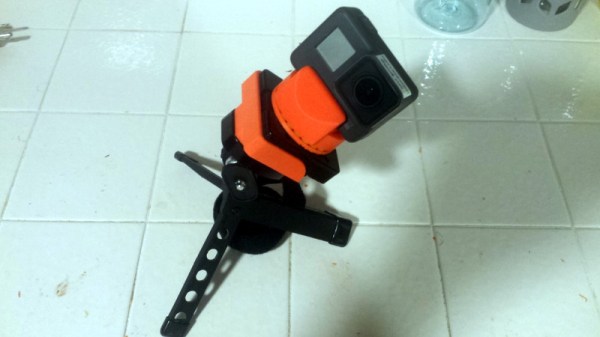
Seems like the first thing the new GoPro owner wants to do is a time-lapse sequence. And with good reason – time-lapses are cool. But they can be a bit bland without a little camera motion, like that provided by a dirt-cheap all-mechanical panning rig.

Let’s hope [JackmanWorks]’ time-lapse shots are under an hour, since he based his build on a simple wind-up kitchen timer, the likes of which can be had for a buck or two at just about any store. The timer’s guts were liberated from the case and a simple wooden disc base with a 1/4″-20 threaded insert for a tripod screw was added. The knob, wisely left intact so the amount of time left in the shot is evident, has a matching bolt for the camera’s tripod socket. Set up the shot, wind up the timer, and let it rip at 1/60 of an RPM. Some sample time-lapse shots are in the video below.

Turning this into a super-simple powered slider for dollying during a time-lapse wouldn’t be too tough — if you’ve already got a nice pantograph slide rig built.

Continue reading “Take A Time-Lapse Or Bake A Cake With This Kitchen Timer Panning Rig”

Low-Vision Reading Through A Camera’s Eye

Borescope cameras are great inspection tools. They’re flexible, they magnify on a variable scale, and they come with their own lighting. Oh, and they’re pretty cheap, too. Because of all this, these tiny cameras can serve a number of purposes. Doctors put them down your cake hole to look for ulcers and polyps, and mechanics probe pistons with them to check for buildup. [agulesin] used one to make a reading aid for his mom.

Mom suffers from macular degeneration, and can’t read print smaller than 1″ (2.5cm). This condition can cause issues ranging from blurred vision to complete loss of vision in the center of the visual field. Standard handheld magnifiers can work fairly well depending on a person’s condition, but they only provide a fixed magnification level and most offer no lighting.

[Agulesin] had the idea to make a reading magnifier by feeding video from a downward-facing borescope camera to an old netbook. The camera is mounted in a plywood arm that’s fixed to a bi-level platform made from scrap MDF. It’s a simple idea that’s well executed—just project flat, printed material on to a vertical screen. There’s nothing for the user to hold or mount, and no risk of neck strain from looking down over the material.

With any simple project comes limitations. The camera is fixed in place. This rig built to view sheets of A4 paper (between letter and legal size)  that are moved around by the user, and it can only handle a stack of so many sheets. If [agulesin]’s mom tried to read a thick novel this way, the camera would likely not focus.  Even so, it’s a great piece of assistive tech for people with low vision.

A Compact, Portable Pantograph Camera Slider

Ho, hum, another camera slider, right? Wrong — here’s a camera slider with a literal twist.

What sets [Schijvenaars]’ slider apart from the pack is that it’s not a slider, at least not in the usual sense. A slider is a mechanical contrivance that allows a camera to pan smoothly during a shot. Given that the object is to get a camera from point A to point B as smoothly as possible, and that sliders are often used for long exposures or time-lapse shots, the natural foundation for them is a ball-bearing linear slide, often powered by a stepper motor on a lead screw. [Schijvenaars] wanted his slider to be more compact and therefore more portable, so he designed and 3D-printed a 3-axis pantograph mechanism. The video below shows the slider panning the camera through a silky smooth 60 centimeters; a bonus of the arrangement is that it can transition from panning in one direction to the other without any jerking. Try that with a linear slider.

Granted, this slider is not powered, but given that the axes are synced with timing belts, it wouldn’t be difficult to add a motor. We’ve seen a lot of sliders before, from simple wooden units to complicated overhead cranes, but this one seems like a great design with a lot of possibilities.

Continue reading “A Compact, Portable Pantograph Camera Slider”

Stunning Fake Polaroid Camera Performs Magic

It’s high time us Muggles got our hands on the hardware used to take Magical Photographs as seen in The Daily Prophet. The first pioneering step in that direction has been taken by [Abhishek] who built this moving picture taking polaroid-ish camera, which he’s calling the “Instagif NextStep”. It’s a camera that records a short, three second video, converts it to GIF and ejects a little cartridge which displays the animated photo.

This amazing piece of hardware has been painstakingly built, and the finished product looks great. The nice thing about building such projects, in [Abhishek]’s own words, is that “it involves a bunch of different skill sets and disciplines – hardware, software, 3D modeling, 3D printing, circuit design, mechanical/electrical engineering, design, fabrication etc that need to be integrated for it to work seamlessly.”
Continue reading “Stunning Fake Polaroid Camera Performs Magic”

Yes, Of Course Someone Shot The Eclipse On A Game Boy Camera

This one shouldn’t surprise us, but there is something particularly enjoyable about seeing the total eclipse of the Sun through a Game Boy camera.

The Game Boy got its camera accessory back in 1998 when CCD-based cameras with poor resolution were just becoming widely available to the public. This camera can capture 128×112 pixel images in the four value grey scale for which the handheld is so loved.

Having taken part in eclipse mania ourselves we can tell you that unless you did some serious research and prep for photographing the thing, this makes as much sense as pulling out your smartphone did. We posit that it certainly produced a more pleasing result.

[jhx] says this is more a weird halo effect of the shot than it is a quality image of totality. At this resolution, the moon-covered Sun should be very few pixels in size, right? But fidelity is for photographers, this is for hackers. Getting the digital image off of the Game Boy camera involved using an Interact Mega Memory cartridge on a Game Boy Pocket to transfer it over, then using a USB 64M cartridge to copy from the Mega Memory and ultimately to a computer.

Glamour shots ain’t easy, yo. But it is possible to read images directly off the Game Boy camera thanks to some reverse engineering work.

[via Kotaku]

Live Stream To YouTube By Pointing A Box And Pressing A Button

YouTube has the ability to do live streaming, but [Tinkernut] felt that the process could be much more straightforward. From this desire to streamline was born the Raspberry Pi based YouTube live streaming camera. It consists of a Raspberry Pi with some supporting hardware and it has one job: to make live streaming as simple as pointing a box and pressing a button. The hardware is mostly off-the-shelf, and once all the configuration is done the unit provides a simple touchscreen based interface to preview, broadcast live, and shut down. The only thing missing is a 3D printed enclosure, which [Tinkernut] says is in the works.

Getting all the software configured and working was surprisingly complex. Theoretically only a handful of software packages and functionality are needed, but there were all manner of gotchas and tweaks required to get everything to play nice and work correctly. Happily, [Tinkernut] has documented the entire process so others can benefit. The only thing the Pi is missing is a DIY onboard LED lighting and flash module.

Shoot The Eclipse With A Phone And Do Not Go Blind

So you want to photograph Eclipse 2017 but you don’t want to rush out and buy an expensive DSLR just for the event? Not a problem, if you build this simple smartphone filter and occluder.

It all started innocently enough for [Paul Bryson] with his iPhone and a lens from those cheap cardboard eclipse glasses we’re starting to see everywhere. Thinking that just taping the filter over the stock lens would do, [Paul] got a painful faceful of sunshine when he tried framing a shot. Turns out the phone body was not big enough to blot out the sun, and besides, the stock lens doesn’t exactly make for a great shot. So with an iPhone telephoto lens affixed to a scrap of wood and a properly positioned filter, [Paul] has a simple rig that’ll let him get some great pre-totality shots of the eclipse, and it’ll be easy to bust out the phone for two minutes of totality selfies. Looks like this setup would be easy to adapt to other phones, too.

We’re all over Eclipse 2017, from Hackaday Eclipse Meetups in at least four different points along the path of totality to experiments on relativity to citizen science efforts so you can get in on the action too. Mark your calendars – August 21 will be here before you know it.