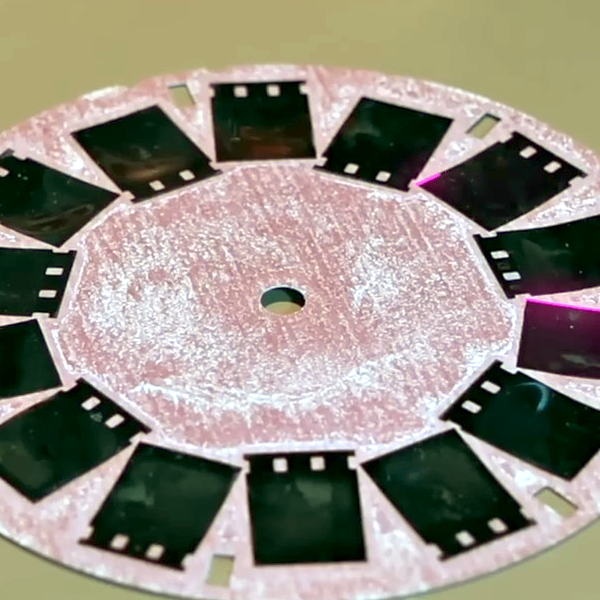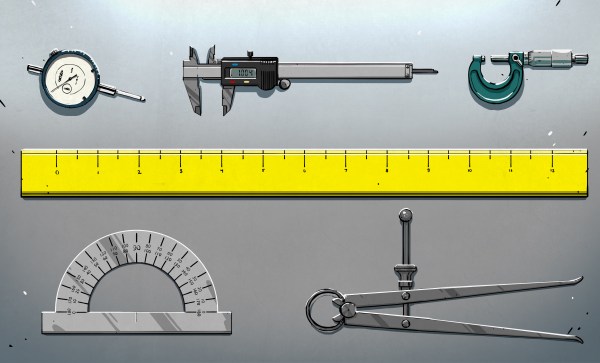
The story of precision, as told by Simon Winchester, is captured in The Perfectionists: How Precision Engineers Created the Modern World. Published in 2018, Winchester’s overview stretches as far back to the Antikythera mechanism and brings us to present day silicon wafer manufacturing. Of course, this isn’t a chronology of all-things made precisely. Instead, it’s a romp through engineering highlights that hallmark either a certain level of precision manufacturing or a particular way of thinking with repercussions for the future. Continue reading “Books You Should Read: The Perfectionists”

Featured3043 Articles
Longform articles, the best of what the Hackaday writing crew has to offer.
From Nanoamps To Gigahertz: The World’s Most Extreme Op Amps
The operational amplifier, or op amp, is one of the most basic building blocks used in analog circuits. Ever since single-chip op amps were introduced in the 1960s, thousands of different types have been developed, some more successful than others. Ask an experienced analog designer to name a few op amps, and they’ll likely mention the LM324, the TL072, the NE5534, the LM358, and of course the granddaddy of all, the uA741.
If those part numbers don’t mean anything to you, all you need to know is that these are generic components that you can buy anywhere and that will do just fine in the most common applications. You can buy fancier op amps that improve on some spec or another, sometimes by orders of magnitude. But how far can you really push the concept of an operational amplifier? Today we’ll show you some op amps that go way beyond these typical “jellybean” components.
Before we start, let’s define what exactly we mean when we say “operational amplifier”. We’re looking for integrated op amps, meaning a single physical component, that have a differential high-impedance voltage input, a single-ended voltage output, DC coupling, and high gain meant to be used in a feedback configuration. We’re excluding anything made from discrete components, as well as less-general circuits like fixed-gain amplifiers and operational transconductance amplifiers (OTAs).
Continue reading “From Nanoamps To Gigahertz: The World’s Most Extreme Op Amps”
Does This Lead Make My Car Look Fat?
When looking at the performance of a vehicle, weight is one of the most important factors in the equation. Heavier vehicles take more energy to accelerate and are harder to stop. They’re also more difficult to control through the corners. Overall, anything that makes a vehicle heavier typically comes with a load of drawbacks to both performance and efficiency. You want your racecar as light as possible.
However, now and then, automakers have found reason to intentionally add large weights to vehicles. We’ll look at a couple of key examples, and discuss why this strange design decision can sometimes be just what the engineers ordered.
Painted Over But Not Forgotten: Restoring Lost Paintings With Radiation And Mathematics
An intrinsic property of paintings, that makes them both wonderful and very annoying, is the fact that they are physical objects. Sometimes they survive across the ages as amazing artifacts of their era, but they are also susceptible to being lost and even destroyed. Sometimes this destruction is deliberate, such as when a painting is painted over.
Artists reuse canvas all the time — painting over what was already there. Sometimes they might be coerced by a client into altering a painting, or removing entire elements from a scene. Fortunately, nowadays we have many techniques, involving x-rays and infrared radiation, that can analyze paintings to determine not only the composition of what we can see with the naked eye, but also that what lies underneath.
In some cases, we can then reconstruct what was previously hidden, returning to physical reality paintings and sketches which haven’t seen the light of day for sometimes centuries. Continue reading “Painted Over But Not Forgotten: Restoring Lost Paintings With Radiation And Mathematics”
2021: As The Hardware World Turns
Well, that didn’t go quite as we expected, did it? Wind the clock back 365 days, and the world seemed to be breathing a collective sigh of relief after making it through 2020 in one piece. Folks started getting their COVID-19 vaccines, and in-person events started tentatively putting new dates on the calendar. After a rough year, it seemed like there was finally some light at the end of the tunnel.
Turns out, it was just a another train. New variants of everyone’s favorite acute respiratory syndrome have kept the pandemic rolling, and in many parts of the world, the last month or so has seen more new cases of the virus than at any point during 2020. This is the part of the Twilight Zone episode were we realize that not only have we not escaped the danger, we didn’t even understand the scope of it to begin with.
Case in point, the chip shortages. We can’t blame it entirely on the pandemic, but it certainly hasn’t helped matters. From video game systems to cars, production has crawled to a standstill as manufacturers fight to get their hands on integrated circuits that were once plentiful. It’s not just a problem for industry either, things have gotten so bad that there’s a good chance most of the people reading this have found themselves unable to get their hands on a part or two these last few months. If you were working on a hobby project, it’s a temporary annoyance. But for those who planned on finally bringing their latest big idea to market, we’ve heard tales of heartbreaking delays and costly redesigns.
It would be easy to look at the last twelve months and see nothing but disappointment, but that’s hardly the attitude you want to have at the beginning of the year. So let’s take the high road, and look back on some of the highlights from 2021 as we turn a hopeful eye towards the future.
New Cars Will Nickel-and-Dime You – It’s Automotive As A Service
Every few years, someone pushing a startup to investors comes up with an acronym or buzzword which rapidly becomes the new hotness in those circles. One of the most pernicious is “as a Service,” which takes regular things and finds a way to charge you a regular fee to use them.
Automotive companies just absolutely loved the sound of this, and the industry is rapidly moving to implement subscription services across the board. Even if there’s hardware in your car for a given feature, you might find you now need to pay a monthly fee to use it. Let’s explore how this came about, and talk about which cars are affected. You might be surprised to find yours already on the list.
Continue reading “New Cars Will Nickel-and-Dime You – It’s Automotive As A Service”
Astronaut Food Is Light Years Beyond Tang And Freeze-Dried Ice Cream
When it comes down to it, we humans have two major concerns when venturing away from home for an extended period of time: what we’ll eat, and where we will sleep. Depending on the mode of travel, you might take some snacks along, or else rely on restaurants and/or the pantry of your possible hosts. Until the day we can reliably grow many types of food in space, or that Milliways, that five-star eatery at the end of the universe is operational, astronauts and other space-bound travelers will have to bring most of their food with them.
Cubes and Tubes
Space food has its roots in military rations, which in the United States were devised during the Revolutionary War. Both the variety and delivery methods of food have changed significantly since the beginning of the space program. While the menu may have at first been limited to tubes of nutrient-rich goo, bite-sized cubes and freeze-dried powdered beverages, the fare is more far-out these days. Astronauts on the ISS even enjoy tortillas, fresh fruits, and vegetables thanks to resupply missions, though they have to eat some of these types of foods quickly.
The average astronaut has also changed quite a bit, too. At first, they were all young and super-fit ex-military men, but nowadays they are more likely to be middle-aged science-y types and women. All three of these groups have different nutritional needs when faced with the rigors of living and working in space.
Continue reading “Astronaut Food Is Light Years Beyond Tang And Freeze-Dried Ice Cream”