Climate change promises to cause untold damage across the world if greenhouse gas emissions continue at current levels for much longer. Despite the wealth of evidence indicating impending doom, governments have done what humans do best, and procrastinated on solving the issue.
However, legislatures around the world are beginning to snap into action. With transportation being a major contributor to greenhouse gas emissions — 16% of the global total in 2016 — measures are being taken to reduce this figure. With electric cars now a viable reality, many governments are planning to ban the sale of internal combustion vehicles in the coming decades.
Game cartridges are perhaps the hardiest of all common storage schemes. Short of blunt traumatic force or application of electrical surges to the cartridge’s edge connectors, damaging a game cartridge is hard to do by accident. The same is also true for the data on them, whether one talks about an Atari 2006 cartridge from the late 1970s or a 1990s Nintendo 64 cartridge.
The secret sauce here are mask ROMs (MROM), which are read-only memory chips that literally have the software turned into a hardware memory device. A mask layer unique to each data set is used when metalizing the interconnects during chip fabrication. This means that the data stored on them is as durable as the processor in the game console itself. Yet this is not a technology that we can use in our own hobby projects, and it’s not available for personal long-term data storage due to the costs associated with manufacturing what is essentially a custom chip.
Despite its value as truly persistent storage, MROM has fallen out of favor over the decades. You may be surprised to find a lot of what’s currently used in the consumer market is prone to data corruption over time spans as short as one year to one decade depending on environmental conditions.
So what are we to do if we need to have read-only data that should remain readable for the coming decades?
Even when we share the design files for open source hardware, the step between digital files and a real-world mechatronics widget is still a big one. That’s why I set off on a personal vendetta to find ways to make that transfer step easier for newcomers to an open source mechantronics project.
Today, I want to spill the beans on one of these finds: part numbers, and showcase how they can help you share your project in a way that helps other reproduce it. Think of part numbers as being like version numbers for software, but on real objects.
I’ll showcase an example of putting part numbers to work on one of my projects, and then I’ll finish off by showing just how part numbers offer some powerful community-building aspects to your project.
Everybody loves solar power, right? It’s nice, clean, renewable energy that’s available pretty much everywhere the sun shines. If only the panels weren’t so expensive. Even better, solar is now the cheapest form of electricity for companies to build, according to the International Energy Agency. But solar isn’t all apples and sunshine — there’s a dark side you might not know about. Manufacturing solar panels is a dirty process from start to finish. Mining quartz for silicon causes the lung disease silicosis, and the production of solar cells uses a lot of energy, water, and toxic chemicals.
The other issue is that solar cells have a guanteed life expectancy of about 25 years, with average efficiency losses of 0.5% per year. If replacement begins after 25 years, time is running out for all the panels that were installed during the early 2000s boom. The International Renewable Energy Agency (IREA) projects that by 2050, we’ll be looking at 78 million metric tons of bulky e-waste. The IREA also believe that we’ll be generating six million metric tons of new solar e-waste every year by then, too. Unfortunately, there are hardly any measures in place to recycle solar panels, at least in the US.
How are solar panels made, anyway? And why is it so hard to recycle them? Let’s shed some light on the subject.
Lithium (from Greek lithos or stone) is a silvery-white alkali metal that is the lightest solid element. Just one atomic step up from Helium, this magic metal seems to be in everything these days. In addition to forming the backbone of many kinds of batteries, it also is used in lubricants, mood-stabilizing drugs, and serves as an important additive in iron, steel, and aluminum production. Increasingly, the world is looking to store more and more power as phones, solar grids, and electric cars continue to rise in popularity, each equipped with lithium-based batteries. This translates to an ever-growing need for more lithium. So far production has struggled to keep pace with demand. This leads to the question, do we have enough lithium for everyone?
It takes around 138 lbs (63 kg) of 99.5% pure lithium to make a 70 kWh Tesla Model S battery pack. In 2016, OICA estimated that the world had 1.3 billion cars in use. If we replace every car with an electric version, we would need 179 billion pounds or 89.5 million tons (81 million tonnes) of lithium. That’s just the cars. That doesn’t include smartphones, laptops, home power systems, massive grid storage projects, and thousands of other products that use lithium batteries.
In 2019 the US Geological Survey estimated the world reserves of identified lithium was 17 million tonnes. Including the unidentified, the estimated total worldwide lithium was 62 million tonnes. While neither of these estimates is at that 89 million ton mark, why is there such a large gap between the identified and estimated total? And given the general rule of thumb that the lighter a nucleus is, the more abundant the element is, shouldn’t there be more lithium reserves? After all, the US Geological Survey estimates there are around 2.1 billion tonnes of identified copper and an additional 3.5 billion tonnes that have yet to be discovered. Why is there a factor of 100x separating these two elements?
The leap to self-driving cars could be as game-changing as the one from horse power to engine power. If cars prove able to drive themselves better than humans do, the safety gains could be enormous: auto accidents were the #8 cause of death worldwide in 2016. And who doesn’t want to turn travel time into something either truly restful or alternatively productive?
But getting there is a big challenge, as Alfred Jones knows all too well. The Head of Mechanical Engineering at Lyft’s level-5 self-driving division, his team is building the roof racks and other gear that gives the vehicles their sensors and computational hardware. In his keynote talk at Hackaday Remoticon, Alfred Jones walks us through what each level of self-driving means, how the problem is being approached, and where the sticking points are found between what’s being tested now and a truly steering-wheel-free future.
Check out the video below, and take a deeper dive into the details of his talk.
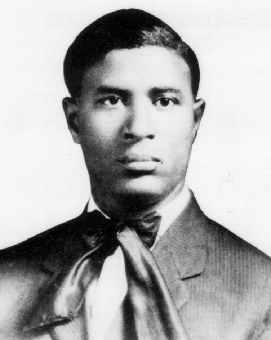
Some people invent with the intent of seeking fame and prestige. Few inventors seem to truly care about other people the way that Garrett Augustus Morgan did. His inventions saved many lives, including those of a few people who were rescued by Garrett himself after an explosion tore through a tunnel beneath Lake Erie.
Though he had little formal education, Garrett’s curiosity took him into many fields from sewing machine repair to gas masks to transportation problems. He achieved great success and improved many lives along the way.
Garrett Augustus Morgan was born March 4th, 1877 in Claysville, Kentucky. He was the seventh of eleven children born to Sydney and Elizabeth Morgan, who had both been slaves. His mother was part Native American.
Armed with a sixth grade education and ten cents in his pocket, Garrett left home at fourteen look for work, which was common for kids his age at the time. He first landed in Cincinnati and spent a few years working as a handyman.
In 1895 he moved to Cleveland and started repairing sewing machines. This is where he developed his taste for the way things work. After a decade or so, he opened his own sewing machine shop. He had gotten married in the meantime, and a few years later, he and his wife Mary Anne, a seamstress, opened a discount ladies clothing store and hired thirty-two employees to make all the suits, coats, and dresses in-house.
One day Garrett was sewing a woolen fabric that kept getting scorched by the extremely high speed of the sewing machine needle. He experimented with a few chemicals to coat the needle and keep it cool. As the story goes, he wiped his hands off on a piece of cloth and went to lunch. When he came back, the wavy fibers in the fabric had been completely straightened by the chemical.
Curious, he tried the solution on his neighbor’s dog’s fur, and it straightened that, too. Then he worked up the nerve to try it on his own hair, and discovered the hair relaxer. He turned the solution into a cream and established the G.A. Morgan Hair Refining Company to sell his hair relaxer to African Americans. The company was terrifically successful and Garrett earned enough money from sales to keep inventing.