In-Band Signaling: Dual-Tone Multifrequency Dialing

One late night many decades ago, I chanced upon a technical description of the Touch-Tone system. The book I was reading had an explanation of how each key on a telephone sends a combination of two tones down the wire, and what’s more, it listed the seven audio frequencies needed for the standard 12-key dial pad. I gazed over at my Commodore 64, and inspiration hit — if I can use two of the C64’s three audio channels to generate the dual tones, I bet I can dial the phone! I sprang out of bed and started pecking out a Basic program, and in the wee hours I finally had it generating the recognizable Touch-Tones of my girlfriend’s phone number. I held the mouthpiece of my phone handset up to the speaker of my monitor, started the program, and put the receiver to my ear to hear her phone ringing! Her parents were none too impressed with my accomplishment since it came at 4:00 AM, but I was pretty jazzed about it.

Since that fateful night I’ve always wondered about how the Touch-Tone system worked, and in delving into the topic I discovered that it’s part of a much broader field of control technology called in-band signaling, or the use of audible or sub-audible signals to control an audio or video transmission. It’s pretty interesting stuff, even when it’s not used to inadvertently prank call someone in the middle of the night. Continue reading “In-Band Signaling: Dual-Tone Multifrequency Dialing” →

Ethereum: GPU Mining Is Back But For How Long?

By now, everyone and their dog has at least heard of Bitcoin. While no government will accept tax payments in Bitcoin just yet, it’s ridiculously close to being real money. We’ve even paid for pizza delivery in Bitcoin. But it’s not the only cryptocurrency in town.

Ethereum initially launched in 2015 is an open source, it has been making headway among the 900 or so Bitcoin clones and is the number two cryptocurrency in the world, with only Bitcoin beating it in value. This year alone, the Ether has risen in value by around 4000%, and at time of writing is worth $375 per coin. And while the Bitcoin world is dominated by professional, purpose-built mining rigs, there is still room in the Ethereum ecosystem for the little guy or gal.

Ethereum is for Hackers

There may be many factors behind Ethereum’s popularity, however one reason is that the algorithm is designed to be resistant to ASIC mining. Unlike Bitcoin, anyone with a half decent graphics card or decent gaming rig can mine Ether, giving them the chance to make some digital currency. This is largely because mining Ethereum coins requires lots of high-speed memory, which ASICs lack. The algorithm also has built-in ASIC detection and will refuse to mine properly on them.

Small-scale Bitcoin miners were stung when the mining technology jumped from GPU to ASICs. ASIC-based miners simply outperformed the home gamer, and individuals suddenly discovered that their rigs were not worth much since there was a stampede of people trying to sell off their high-end GPU’s all at once. Some would go on to buy or build an ASIC but the vast majority just stopped mining. They were out of the game they couldn’t compete with ASICs and be profitable since mining in its self uses huge amounts of electricity.

Economies of scale like those in Bitcoin mining tend to favor a small number of very large players, which is in tension with the distributed nature of cryptocurrencies which relies on consensus to validate transactions. It’s much easier to imagine that a small number of large players would collude to manipulate the currency, for instance. Ethereum on the other hand hopes to keep their miners GPU-based to avoid huge mining farms and give the average Joe a chance at scoring big and discovering a coin on their own computer.

Ethereum Matters

Ethereum’s rise to popularity has basically undone Bitcoin’s move to ASICs, at least in the gamer and graphics card markets. Suddenly, used high-end graphics cards are worth something again. And there are effects in new equipment market. For instance, AMD cards seem to outperform other cards at the moment and they are taking advantage of this with their release of Mining specific GPU drivers for their new Vega architecture. Indeed, even though AMD bundled its hottest RX Vega 64 GPU with two games, a motherboard, and a CPU in an attempt to make the package more appealing to gamers than miners, AMD’s Radeon RX Vega 56 sold out in five minutes with Ethereum miners being blamed.

Besides creating ripples in the market for high-end gaming computers, cryptocurrencies are probably going to be relevant in the broader economy, and Ethereum is number two for now. In a world where even banks are starting to take out patents on blockchain technology in an attempt to get in on the action, cryptocurrencies aren’t as much of a fringe pursuit as they were a few years ago. Ethereum’s ASIC resistance is perhaps its killer feature, preventing centralization of control and keeping the little hacker in the mining game. Only time will tell if it’s going to be a Bitcoin contender, but it’s certainly worth keeping your eye on.


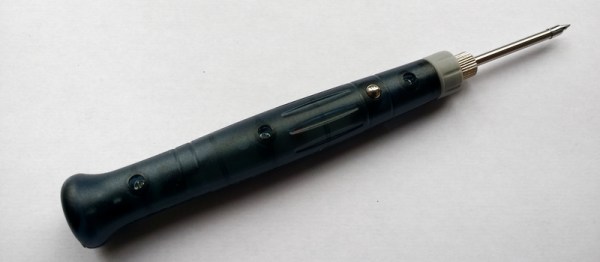
Review: Aneng LT-001 USB Soldering Iron

When it comes to soldering irons, most of us are likely to be in agreement that there is a level of quality below which we will not descend. To do a decent job requires a decent tool, and when it comes to soldering that means a good quality temperature controlled iron with a decent power level and a quality bit. Anything else just isn’t worth considering.

But what if you look at it from the opposite angle? When it comes to soldering, just how low can you go? In that case probably the ultimate scraping of the soldering barrel comes courtesy of USB soldering irons, taking their juice from a five volt phone charger socket and providing tiny power levels you’d expect to be barely enough to work at all. Surely these are toys, not irons! Continue reading “Review: Aneng LT-001 USB Soldering Iron” →

Way To Go, Einstein; His Time Spent Being Wrong

When you hear someone say “Einstein”, what’s the first thing that pops into your head? Is it high IQ… genius… or maybe E=MC2? Do you picture his wild grey hair shooting in all directions as he peacefully folds the pages back from his favorite book?  You might even think of nuclear bombs, clocks and the Nobel Prize. It will come as a surprise to many that these accomplishments were a very small part of his life. Indeed, Einstein turned the world of classical physics upside down with his general theory of relativity. But he was only in his early twenties when he did so.

What about the rest of his life? Was Einstein a “one-hit-wonder”? What else did he put his remarkable mind to? Surely he tackled other dilemmas that plagued the scientific world during his moment in history. He was a genius after all… arguably one of the smartest people to have ever walked the earth. His very name has become synonymous with genius. He pulled the rug out from under Isaac Newton, whose theories had held the universe together for over 300 years. He talked about enigmatic concepts like space and time with an elegance that laid bare the beauty hidden within their simplicity. Statues have been made of him. His name and face are recognizable across the globe.

But when you hear someone say “Einstein”, do you think of a man who spent the better half of his life… being wrong?  You should.

Continue reading “Way To Go, Einstein; His Time Spent Being Wrong” →

Lu Ban’s Axe And Working With Your Chinese Suppliers

It is nearly impossible to build any kind of hardware these days without at some point in the process dealing with China — Chinese suppliers, and so by extension Chinese culture. Difficulties can be as simple as the usual inconvenience of everything stopping for weeks up to and after Chinese New Year, or engineers that you know to be otherwise reasonably competent simply choosing not to bring up glaring and obvious problems. Having encountered my share of Western hardware entrepreneurs on the verge of a breakdown, and just as many flummoxed Chinese bosses completely unable to see exactly why they’re so upset, I thought I’d try to offer at least a little insight into one of the many issues that comes up.

Nearly any school child in the world will be able to tell you whom they were taught invented the lightbulb, the telephone, the radio transmitter. Those same children will usually be able to tell you of at least a few Chinese inventions as well — gunpowder, paper, the compass etc. But with one key difference, even the Chinese children are unlikely to be able to credit even a group of people for their invention let alone a single (usually misattributed) individual.

China does not really have an Edison, or Tesla, or Bell — oh we’ve had people as brilliant, but they are not celebrated in quite the same way for cultural reasons. If you were to do an alternate history of China where we went through the Industrial Revolution first, you’d want to split the timeline around Mozi (墨子). The Mohists (followers of Mozi) had advanced siege engine design, schools of logic, mathematics and theory for the physical sciences. much of the same foundation that set the West on its particular trajectory. In the end, Confucian ideals won out and China became a culture that celebrated scholarship over ingenuity (to vastly oversimplify things).

Even our respective terms for engineer reflect this. The word engineer (Latin ingeniator) is derived from the Latin words ingeniare (“to contrive, devise”) and ingenium (“cleverness”). Yet in Chinese 工程师, the first character for engineer in Chinese is the carpenters square 工. He or she is a simple worker (工人 literally “Work Person”). Even now, engineers are not held in anywhere near the same regard in China as they are in the West.

Continue reading “Lu Ban’s Axe And Working With Your Chinese Suppliers” →

Control Thy LED

In a previous article, I discussed LEDs in general and their properties. In this write-up, I want to give some examples of driving LEDs and comparing a few of the most commonly used methods. There is no “one size fits all” but I will try and generalize as much as possible. The idea is to be able to effectively control the brightness of the LED and prolong their life while doing it. An efficient driver can make all the difference if you plan to deploy them for the long-haul. Let’s take a look at the problem and then discuss the solutions. Continue reading “Control Thy LED” →

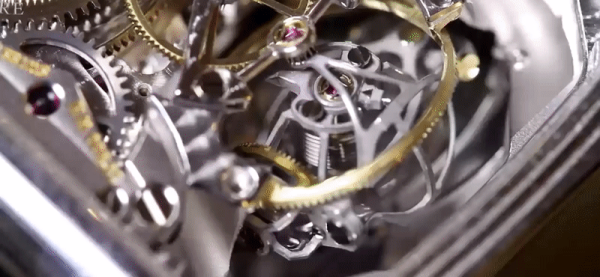
The Tourbillon: Anti-Gravity For Watch Movements

Do you know what time it is? Chances are good that you used a computer or a cell phone to answer that question. The time on your phone is about as accurate as chronometry gets these days. That’s because cell networks are timed from satellites, which are in turn timed from atomic clocks. And these days, it may be that atomic clocks are the only clocks that matter.

Before this modern era of quartz and atomic accuracy, though, timepieces were mechanical. Clocks were driven by heavy weights that made them impractical for travel. It wasn’t until the mainspring-driven movement came along that timekeeping could even begin to become portable.

But while the invention of the mainspring made portable timepieces possible, it hurt their accuracy. That’s because the driving force of a tightly wound spring isn’t constant like that of an inert, solid weight.  So pocket watches weren’t exactly an overnight success. Early pieces were largely ornamental, and only told the hour. Worst of all, they would slow down throughout the day as the mainspring unwound, becoming useless unless wound several times a day. The mainspring wasn’t the only problem plaguing pocket watches, but it was the among the most obvious.

Continue reading “The Tourbillon: Anti-Gravity For Watch Movements” →