Official Teardown Gives Unexpected Look Into PS5

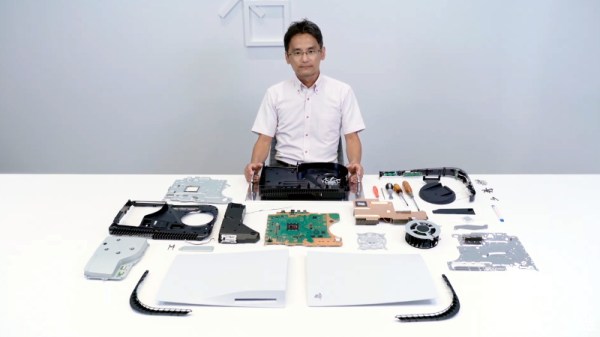
With Sony and Microsoft still a month away from the public release of their next-generation game consoles, you’d expect technical details of their respective systems to still be under a veil of secrecy. But both companies look to be taking things a bit differently this generation, as it becomes increasingly clear that modern consumers are interested in what makes their devices tick. Today, Sony really threw down the gauntlet by beating the tech media to the punch and posting their own in-depth teardown on the new PlayStation 5.

Unsurprisingly, the video after the break is almost entirely in Japanese. But even if you don’t know the language, there’s plenty of interesting details to be had. For one thing, the heatsink and fan that cools the PS5’s AMD CPU and GPU are collectively so massive that they appear to take up most of the console’s internal volume.
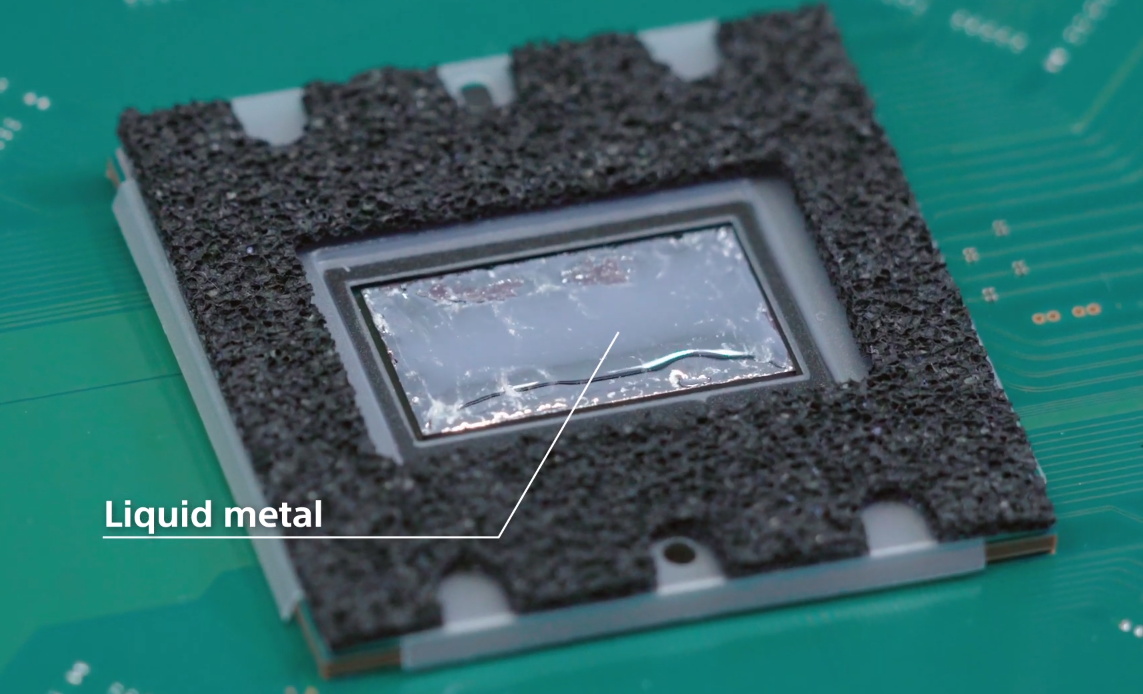
In fact, the heatsink itself is so large that the motherboard is actually mounted to it instead of the other way around. So if you want to take out the board, you have to unbolt it from the heatsink and remove it first. In the process you’ll expose the unique liquid metal thermal compound that Sony apparently developed specifically for this application. Good luck to you if any dust gets in that expensive-looking goop.

It’s also interesting to note that, unlike the previous two generations of Sony consoles, the PS5 has no discrete hard drive. Instead, onboard flash with a custom controller is used to provide 825 GB of storage for software. Hopefully Sony has put the requisite amount of R&D into their wear leveling, as a shot flash chip will mean a whole new motherboard. That said, gamers with extensive collections will be happy to see there appears to be an expansion bay where you can install your own M.2 drive.

Between this and the recent PS4 assembly line tour, it’s refreshing to see a company like Sony be a bit more transparent. After years of adversarial treatment from the tech giants, we’d almost forgotten that the customer is supposed to be king. Continue reading “Official Teardown Gives Unexpected Look Into PS5”


Linux Fu: The Linux Android Convergence

The Android phone that you carry in your pocket is basically a small computer running Linux. So why is it so hard to get to a usable Linux environment on your phone? If you could run Linux, you could turn your cell phone into an ultra-portable laptop replacement.

Of course, the obvious approach is just to root the phone and clean-slate install a Linux distribution on it. That’s pretty extreme and, honestly, you would probably lose a lot of phone function unless you go with a Linux-specific phone like the PinePhone. However, using an installer called AnLinux, along with a terminal program and a VNC client, you can get a workable setup without nuking your phone’s OS, or even having root access. Let’s see what we can do. Continue reading “Linux Fu: The Linux Android Convergence”

Typhoon-Tough Turbines Withstand Wild Winds

It’s really beginning to feel as though the problem of climate change is a huge boulder rolling down a steep hill, and we have the Sisyphean task of trying to reverse it. While we definitely need to switch as much of the planet over to clean, green energy as soon as possible, the deployment should be strategic. You know, solar panels in sunny places, and wind turbines in windy places. And for the most part, we’re already doing that.

A test unit in Okinawa, Japan. Image via Challenergy

In the meantime, there are also natural disasters to deal with, some of which are worsened by climate change. Eastern and Southeast Asian countries are frequently under the threat of typhoons that bring strong, turbulent winds with them. Once the storms pass, they leave large swaths of lengthy power outages in their wake.

Studies have shown that these storms are gaining strength over the years, leading to more frequent disruption of existing power systems in those areas. Wind power is the ideal solution where storms have come through and knocked out traditional power delivery all over a region. As long as the turbines themselves can stand up to the challenge, they can be used to power micro-grids when other delivery is knocked out.

Bring On the Typhoons?

Unfortunately, the conventional three-bladed wind turbines you see dotting the plains can’t stand up to the awesome power of typhoons. But vertical axis wind turbines can. Though they have been around for many years, they may have finally found their niche.

A Japanese startup called Challenergy wants to face the challenge of typhoons head on. They’ve built a vertical axis wind turbine that’s built to not only to withstand typhoon-level winds, it’s designed to make the most of them. Instead of horizontally-situated blades arranged like spokes or flower petals, these turbines have vertical cylinders that collect wind by harnessing the Magnus effect.

Continue reading “Typhoon-Tough Turbines Withstand Wild Winds”

Art of 3D printer in the middle of printing a Hackaday Jolly Wrencher logo

3D Printering: Wash Parts Better And Make Solvent Last Longer

SLA printing in resin is great, but part washing can be a hassle. The best results come from a two-stage wash, but that also means more material and more processing steps. Fortunately, there are ways to make it easier and more effective. One such way is to use a part washing machine, and I’ll cover a DIY option to make your own, but despite what the advertising implies for the commercial ones, a wash machine isn’t a cure-all.

Let’s go through how to get the best results from part washing, how to make the solvent last as long as possible, and how to dispose of the eventual waste.

Resin-Printed Parts Need Washing

All parts printed in resin emerge from the printer coated in syrupy, uncured goop. This needs to be removed completely, or the print ends up sticky and no amount of drying or additional UV curing will change that. (There is a way to fix sticky prints, but it’s better to avoid the situation in the first place.)

Simple part washing can be done with nothing more than a jar in which to rinse and soak a small part for about ten minutes, but agitation and a secondary wash will go a long way toward better and more consistent results. As mentioned, part washing machines like to present themselves as a one-appliance solution, but best results still come from a two-stage wash, and that means some additional steps.

Continue reading “3D Printering: Wash Parts Better And Make Solvent Last Longer”

Welcome To Solar Cycle 25; Our Sun Enters A New 11-Year Period

Most of us perceive time as an arrow, a one-way trip into the future. And while that’s true, nature has a way of interpolating circular patterns onto that linear model — day follows night, the seasons progress through the year, and generations are born, live, and die after creating the next generation to do experience the same cycles in the future.

Our star, too, follows this cyclical model, and goes through observable, periodic changes that are of keen interest to solar scientists. So it was with some fanfare that they recently announced that the sun had transitioned into Solar Cycle 25. But what exactly does that mean? Does the Sun’s changing face make much difference to the average person’s daily life? History shows that it can, so it pays to know what we’re in store for over the next couple of decades. Welcome to your primer on Solar Cycle 25.

Continue reading “Welcome To Solar Cycle 25; Our Sun Enters A New 11-Year Period”

Tesla’s New Tabless Batteries Unlock New Levels Of Performance

Telsa are one of the world’s biggest purchasers of batteries through their partnerships with manufacturers like Panasonic, LG and CATL. Their endless hunger for more cells is unlikely to be satiated anytime soon, as demand for electric cars and power storage continues to rise.

As announced at their Battery Day keynote, Tesla has been working hard on a broad spectrum of projects to take battery technology to the next level in order to reach their goal of 3 TWh annual production by 2030. One of the most interesting aspects of this was the announcement of Tesla’s new tabless 4680 battery, which will be manufactured by the company itself. Let’s take a look at what makes the 4680 so exciting, and why going tabless is such a big deal. Continue reading “Tesla’s New Tabless Batteries Unlock New Levels Of Performance”

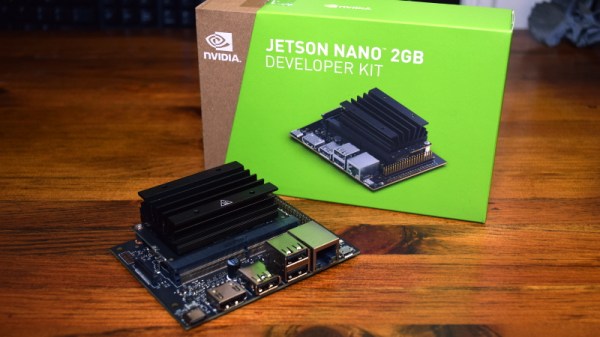
NVIDIA Announces $59 Jetson Nano 2GB, A Single Board Computer With Makers In Mind

NVIDIA kicked off their line of GPU-accelerated single board computers back in 2014 with the Jetson TK1, a $200 USD development system for those looking to get involved with the burgeoning world of so-called “edge computing”. It was designed to put high performance computing in a small and energy efficient enough package that it could be integrated directly into products, rather than connecting to a data center half-way across the world.

The TK1 was an impressive piece of hardware, but not something the hacker and maker community was necessarily interested in. For one thing, it was fairly expensive. But perhaps more importantly, it was clearly geared more towards industry types than consumers. We did see the occasional project using the TK1 and the subsequent TX1 and TX2 boards, but they were few and far between.

Then came the Jetson Nano. Its 128 core Maxwell CPU still packed plenty of power and was fully compatible with NVIDIA’s CUDA architecture, but its smaller size and $99 price tag made it far more attractive for hobbyists. According to the company’s own figures, the number of active Jetson developers has more than tripled since the Nano’s introduction in March of 2019. With the platform accessible to a larger and more diverse group of users, new and innovative applications for machine learning started pouring in.

Cutting the price of the entry level Jetson hardware in half was clearly a step in the right direction, but NVIDIA wanted to bring even more developers into the fray. So why not see if lightning can strike twice? Today they’ve officially announced that the new Jetson Nano 2GB will go on sale later this month for just $59. Let’s take a close look at this new iteration of the Nano to see what’s changed (and what hasn’t) from last year’s model.

Continue reading “NVIDIA Announces $59 Jetson Nano 2GB, A Single Board Computer With Makers In Mind”