Most people’s personal experience with seismographs begins and ends with simple childhood science experiments. Watching a pendulum make erratic marks on a piece of paper while your classmates banged on the table gave you an idea on how the device worked, and there’s an excellent chance that’s the last time you gave the concept much thought. Even among hackers, whose gear in general tends to be more technologically equipped than the norm, you’re unlikely to find a dedicated seismograph up and running.
But that’s not because the core technology is hard to come by or particularly expensive. In fact, one could say with almost absolute certainty that if you aren’t actively reading these words on a device with a sensitive accelerometer onboard, you have one (or perhaps several) within arm’s reach. Modern smartphones, tablets, and even some laptops, now pack in sensors that could easily be pushed into service as broad strokes seismometers; they just need the software to collect and analyze the data.
Or at least, they did. By the time you read this article, Google will have already started rolling out an update to Android devices which will allow them to use their onboard sensors to detect possible earthquakes. With literally billions of compatible devices in operation all over the planet, this will easily become the largest distributed sensor network of its type ever put into operation. But that doesn’t mean you’re going to be getting a notification on your phone to duck and cover anytime soon.
At any given time I’m likely to have multiple projects in-flight, by which of course I mean in various stages of neglect. My current big project is one where I finally feel like I have a chance to use some materials with real hacker street cred, like T-slot extruded aluminum profiles. We’ve all seen the stuff, the “Industrial Erector Set” as 80/20 likes to call their version of it. And we’ve all seen the cool projects made with it, from CNC machines to trade show displays, and in these pandemic times, even occasionally as sneeze guards in retail shops.
Aluminum T-slot profiles are wonderful to work with — strong, lightweight, easily connected with a wide range of fasteners, and infinitely configurable and reconfigurable as needs change. It’s not cheap by any means, but when you factor in the fabrication time saved, it may well be a net benefit to spec the stuff for a project. Still, with the projected hit to my wallet, I’ve been looking for more affordable alternatives.
My exploration led me into the bewilderingly rich world of aluminum extrusions. Even excluding mundane items like beer and soda cans, you’re probably surrounded by extruded aluminum products right now. Everything from computer heatsinks to window frames to the parts that make up screen doors are made from extruded aluminum. So how exactly is this ubiquitous stuff made?
In the fast food industry, speed is everything. The concept has never just been about cooking quickly. Players in this competitive space spend huge fortunes every year on optimizing every aspect of the experience, from ordering, to queueing, to cleaning up afterwards. And while fast food restaurants are major employers worldwide, there’s always been a firm eye cast over the gains that automation has to offer.
Flipping Burgers
In the West, fast food most commonly brings burgers to mind. Preparing a quality burger requires attention to the grade of meat, fat content, as well as the preparation steps before it hits the grill. Then it’s all about temperature and time, and getting just the right sear to bring out the natural flavors of the beef. While a boutique burger joint will employ a skilled worker to get things just right, that doesn’t fly for fast food. Every order needs to be preparable by whichever minimum-wage worker got the shift, and be as repeatable as possible across entire countries, or even the world, to meet customer expectations.
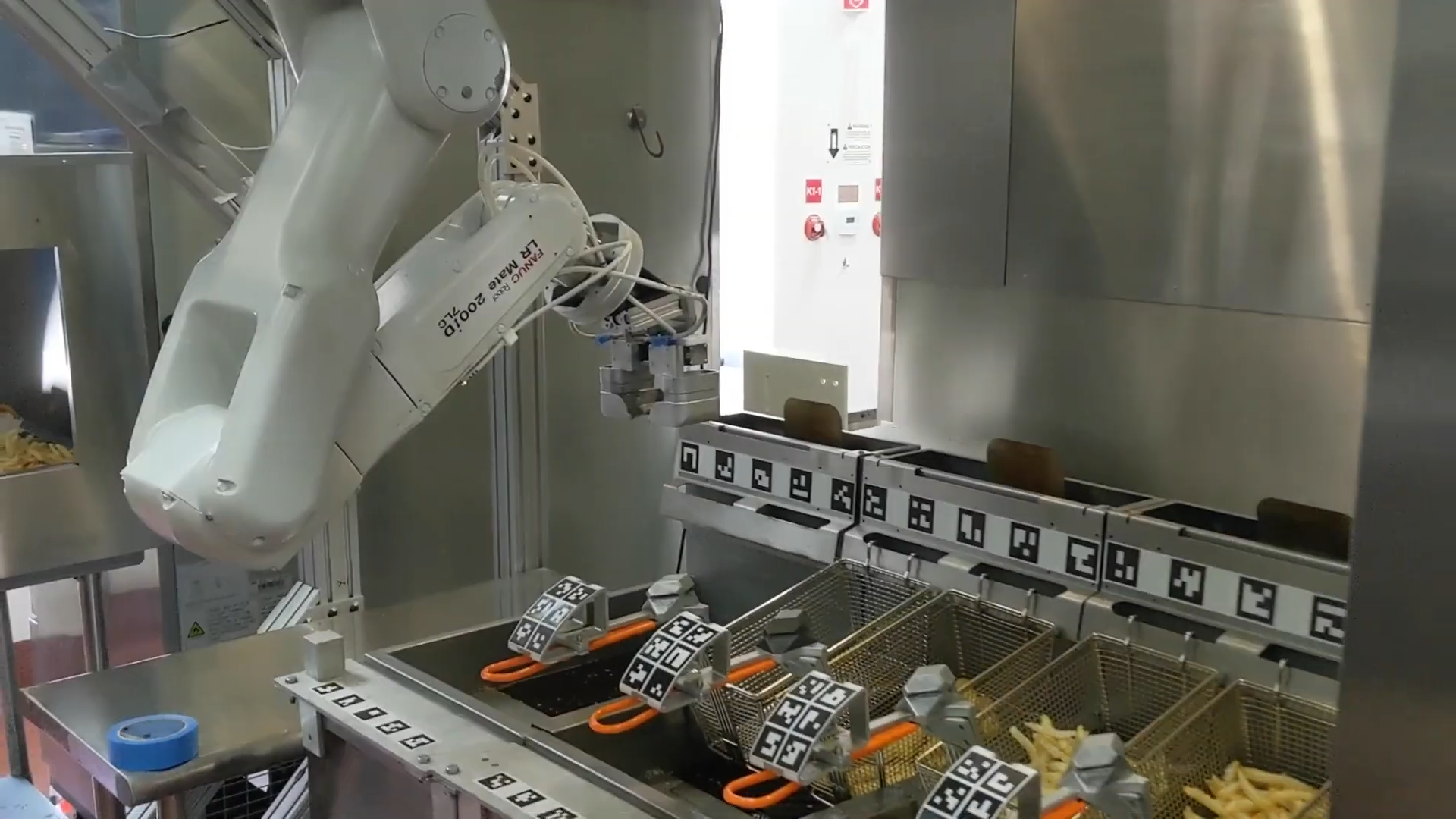
Flippy ROAR (Robot On A Rail) at work on the fryers in a White Castle in Chicago.
In their efforts to improve efficiency, White Castle have taken the bold step of installing a robotic burger flipper, imaginitively named Flippy. Built by Miso Robotics, the robot hangs from a ceiling rail to minimise the space taken up in the kitchen area. Based on a Fanuc robot arm, the system uses artificial intelligence to manage kitchen resources, Flippy is capable of managing both the grill and fryers together to ensure fries don’t get cold while the burgers are still cooking, for example. Currently undergoing a trial run in Chicago, White Castle has ambitions to roll the technology out to further stores if successful.
We’ve seen other robotic burger systems before, too. In late 2018, our own [Brian Benchoff] went down to check out Creator, which cooks and assembles its burgers entirely by machine. Despite suspicions about the business model, Creator have persisted until the present day with their unique blend of technology and culinary arts. Particularly impressive were their restaurant modifications in the face of COVID-19. The restaurant received an overhaul, with meals being robotically prepared directly in a take-out box with no human contact. Take-out meals are double-bagged and passed to customers through an airlock, with a positive-pressure system in the restaurant to protect staff from the outside world.
Pizzabots
Pizza is a staple food for many, with high demand and a stronger dependence on delivery than other fast food options. This has led to the industry exploring many avenues for automation, from preparation to order fulfillment.
In terms of outright throughput, Zume were a startup that led the charge. Their system involves multiple robots to knead dough, apply sauce and place the pie in the oven. Due to the variable nature sizes and shapes of various toppings, these are still applied by humans in the loop. Capable of turning out 120 pizzas per hour, a single facility could compete with many traditional human-staffed pizza shops. They also experimented with kitchens-on-wheels that use predictive algorithms to stock out trucks that cook pizzas on the way to the customer’s door. Unfortunately, despite a one-time $4 billion USD valuation, the startup hit a rocky patch and is now focusing on packaging instead.
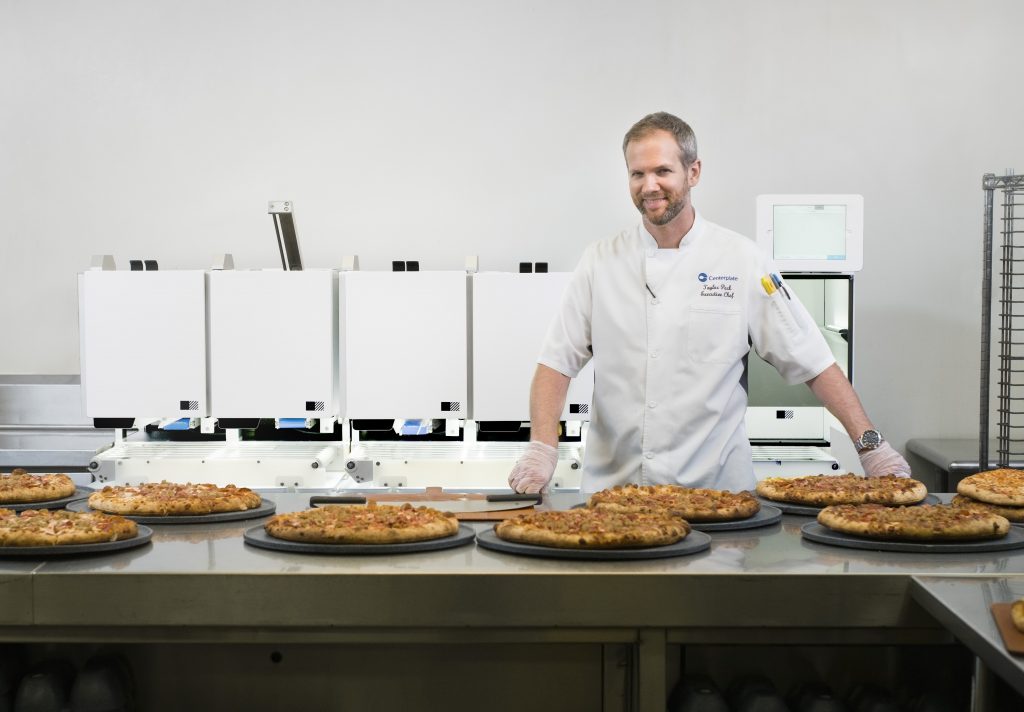
Picnic aim to make lots of pizza, fast. Their business model involves working directly with existing restaurants, rather than creating their own fast-food brand from scratch.
Picnic have gone further, claiming an output rate of up to 300 twelve-inch pies an hour. The startup aims to work with a variety of existing pizza restaurants, rather than striking out as their own brand. One hurdle to overcome is the delivery of a prepared pizza into the oven. There are many varieties and kinds of pizza oven used in commercial settings, and different loading techniques are required for each. This remains an active area of development for the company. The company has a strong focus on the emerging ghost kitchen model, where restaurants are built solely to fulfill online delivery orders, with no dining area.
Domino’s is one of the largest pizza companies in the world, and thus far have focused their efforts on autonomous delivery. The DRU, or Domino’s Robotic Unit, was launched to much fanfare, promising to deliver pizzas by a small wheeled robotic unit. Equipped with sensors to avoid obstacles and GPS navigation, the project has not entered mainstream service just yet. However, between this and the multitude of companies exploring drone delivery, expect to see this become more of a thing in coming years.
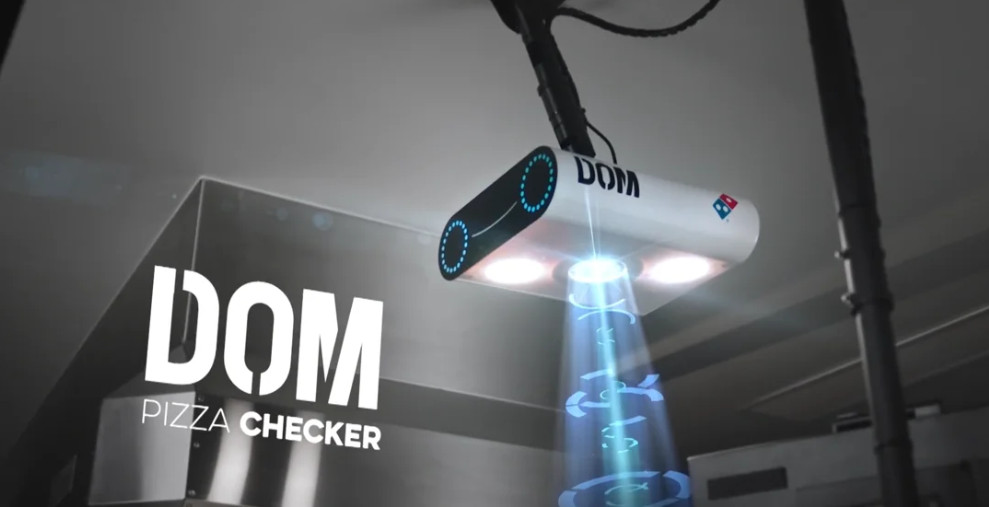
Despite the marketing sizzle, the DOM Pizza Checker does not project holograms.
A more immediate innovation from Domino’s has been the DOM Pizza Checker. With customer complaints about pizza quality plaguing the chain, the pizza checker is an AI-powered visual system. It’s responsible for determining if the correct pizza has been made, with the right toppings and good distribution. An impressive practical use of AI imaging technology, it sounds an alarm if the pizza isn’t up to scratch, prompting it to be remade. However, it has come under scrutiny as a potential method to harass franchisees and workers. Additionally, the limitations of the system mean that Domino’s are still perfectly capable of turning out a bad pizza on occasion.
Other Efforts
One of the most visible examples of fast food automation is the widespread adoption of order kiosks by McDonalds, which kicked off in earnest in 2015. The majority of stores in the US now rely on these to speed up the ordering process, while also enabling more customization for customers with less fuss. Over-the-counter ordering is still possible at most locations, but there’s a heavy emphasis on using the new system.
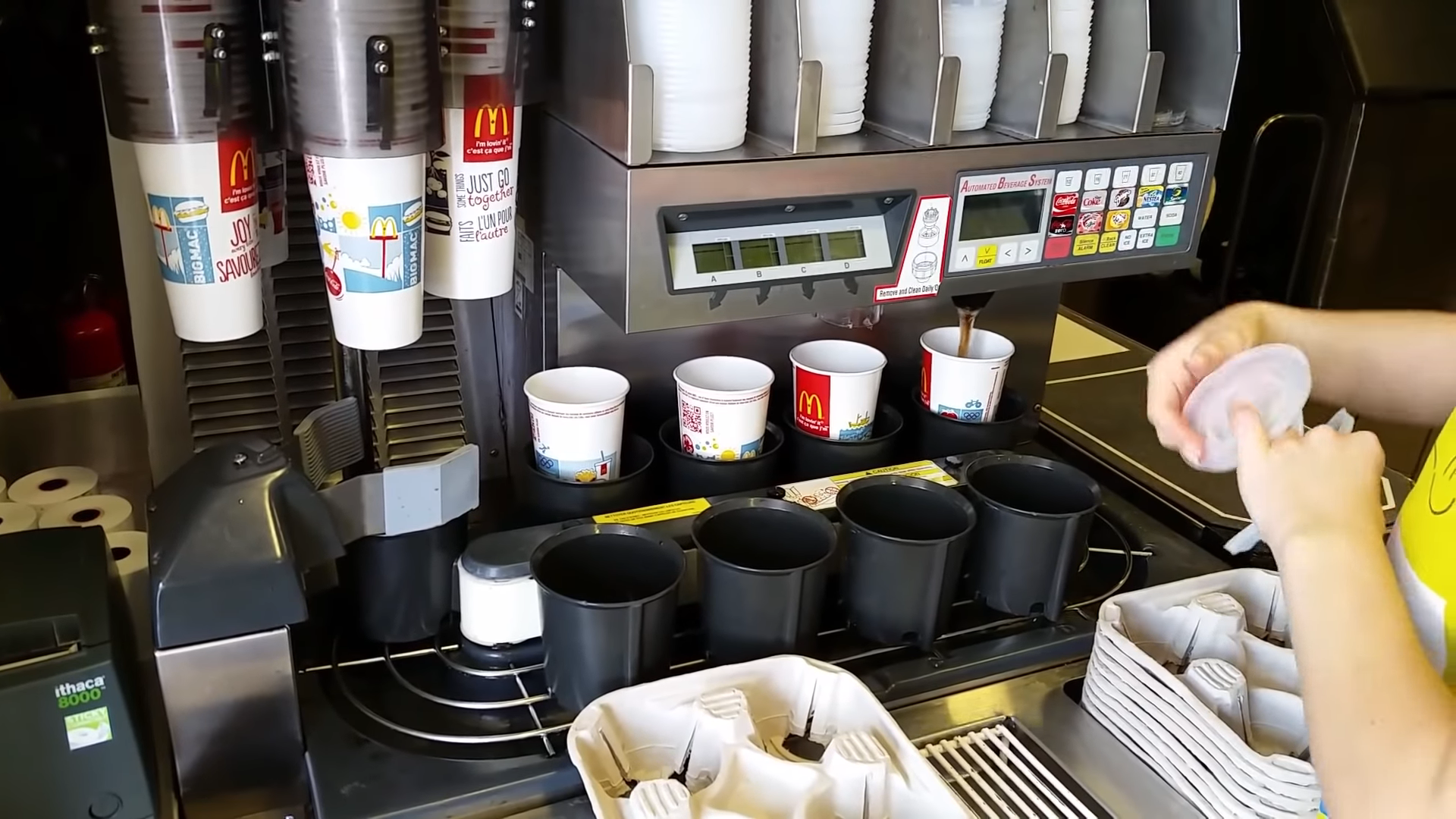
McDonald’s automated beverage dispenser will be a familiar sight to many. Considered a great help when it works, and a great hindrance when it jams, spills, or simply shuts down.
In general, online ordering and delivery has become the norm, where ten years ago, the idea of getting McDonalds delivered was considered magical and arcane. This writer made seven attempts to take advantage of an early version of the service in China in 2015, succeeding only once, largely due to a lack of understanding of addresses written in non-Latin characters. However, due to the now-ubiquitous nature of services like Ubereats, Postmates, and Menulog, it’s simple for any restaurant to largely automate their ordering and fulfillment process, and reach customers at a distance from their brick-and-mortar locations.
Other efforts are smaller in scope, but contribute to great efficiency gains back-of-house. McDonalds and other chains have widely adopted automated beverage systems. Capable of automatically dispensing cups and the requisite fluids, they take instructions directly from the digital ordering system and take the manual labor out of drink preparation. They’re also great at slightly underfilling the cups, in a way that any human would consider incredibly rude.
Conclusion
Robots in the fast-food kitchen stand to reduce or eliminate tedious, repetitive work. Robots don’t get sick, and less human labour means fewer rostering hassles. It seems to be a foregone conclusion that more automation is on the way, and while some startups may falter, others will surely succeed. Your next meal may just yet be entirely prepared by a robot, even if it’s still delivered by a tired grad student on a moped. Come what may!
Any modern computer with an x86 processor, whether it’s Intel or AMD, is a lost cause for software freedom and privacy. We harp on this a lot, but it’s worth repeating that it’s nearly impossible to get free, open-source firmware to run on them thanks to the Intel Management Engine (IME) and the AMD Platform Security Processor (PSP). Without libre firmware there’s no way to trust anything else, even if your operating system is completely open-source.
The IME or PSP have access to memory, storage, and the network stack even if the computer is shut down, and even after the computer boots they run at such a low level that the operating system can’t be aware of what they’re really doing. Luckily, there’s a dark horse in the race in the personal computing world that gives us some hope that one day there will be an x86 competitor that allows their users to have a free firmware that they can trust. ARM processors, which have been steadily increasing their user share for years but are seeing a surge of interest since the recent announcement by Apple, are poised to take over the personal computing world and hopefully allow us some relevant, modern options for those concerned with freedom and privacy. But in the real world of ARM processors the road ahead will decidedly long, windy, and forked.
Even ignoring tedious nitpicks that the distinction between RISC vs CISC is more blurred now than it was “back in the day”, RISC machines like ARM have a natural leg up on the x86 CISC machines built by Intel and AMD. These RISC machines use fewer instructions and perform with much more thermal efficiency than their x86 competitors. They can often be passively cooled, avoiding need to be actively cooled, unlike many AMD/Intel machines that often have noisy or bulky fans. But for me, the most interesting advantage is the ability to run ARM machines without the proprietary firmware present with x86 chips.
If you have SSH and a few other tools set up, it is pretty easy to log into another machine and run a few programs. This could be handy when you are using a machine that might not have a lot of memory or processing power and you have access to a bigger machine somewhere on the network. For example, suppose you want to reencode some video on a box you use as a media server but it would go much faster on your giant server with a dozen cores and 32 GB of RAM.
Remote Execution
However, there are a few problems with that scenario. First, you might not have the software on the remote machine. Even if you do, it might not be the version you expect or have all the same configuration as your local copy. Then there’s the file problem. the input file should come from your local file system and you’d like the output to wind up there, too. These aren’t insurmountable, of course. You could install the program on the remote box and copy your files back and forth manually. Or you can use Outrun.
There are a few limitations, though. You do need Outrun on both machines and both machines have to have the same CPU architecture. Sadly, that means you can’t use this to easily run jobs on your x86-64 PC from a Raspberry Pi. You’ll need root access to the remote machine, too. The system also depends on having the FUSE file system libraries set up.
As the world grapples with the spectre of the so-called “hockey stick” graph of climate change, there have been a variety of solutions proposed to the problem of carbon emissions from sectors such as transport which have become inseparable from the maintenance of 21st century life. Sometimes these are blue-sky ideas that may just be a little bit barmy, while other times they make you stop and think: “That could just work!”.
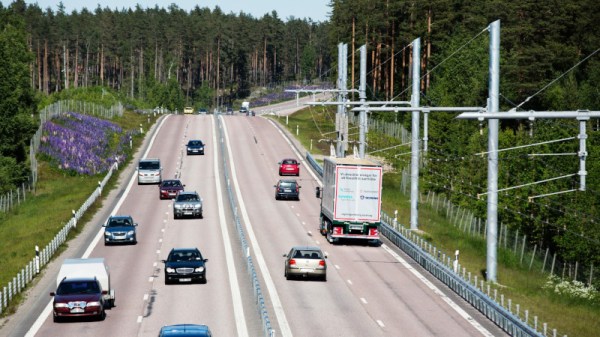
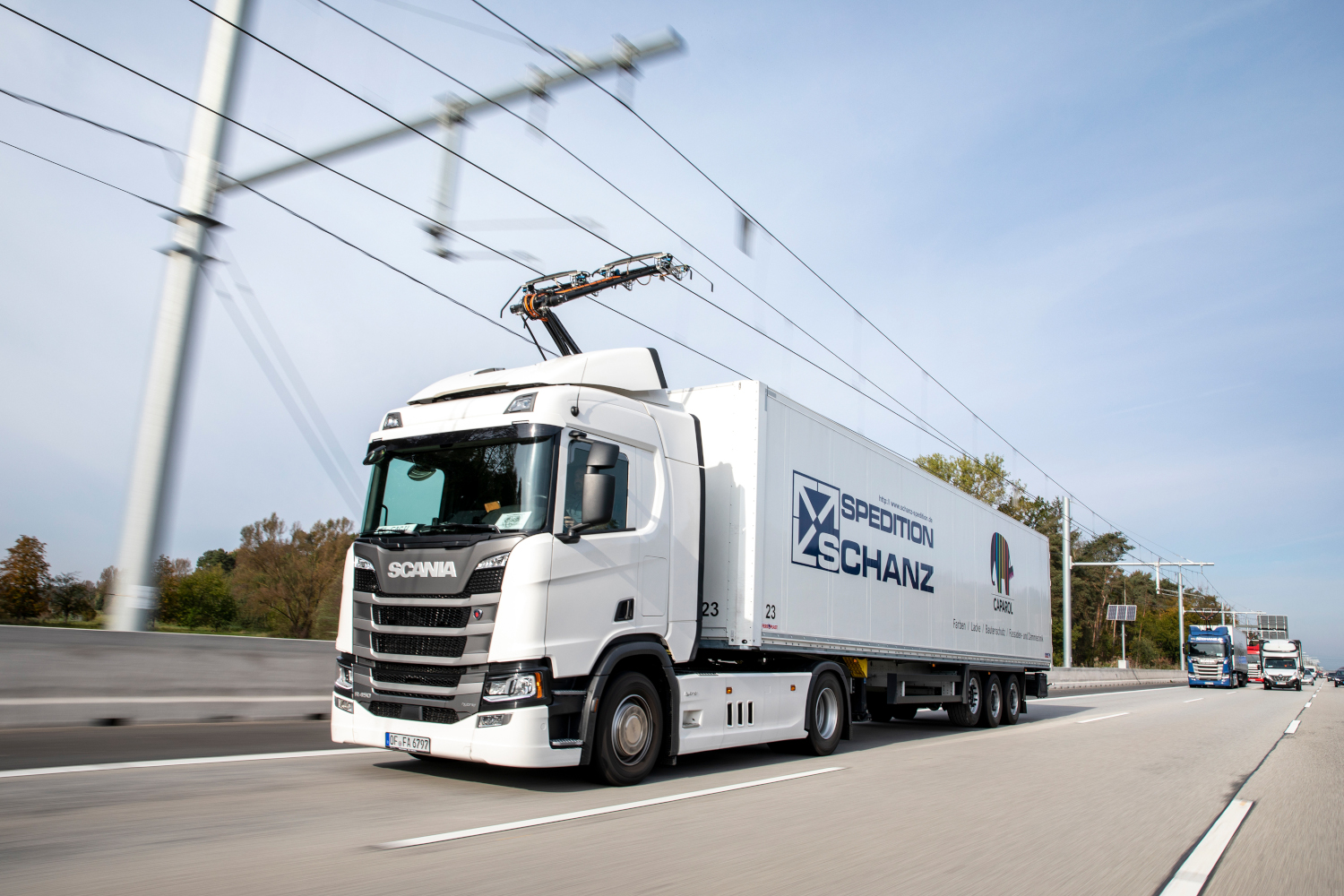
Siemens and Scania are justifiably proud of their electrified stretch of autobahn and electric trucks in Germany.
One thing that should be obvious to all is that moving our long-distance freight around by means of an individual fossil-fuel-powered diesel engine for every 38 tonne or so freight container may be convenient, but it is hardly either fuel-efficient or environmentally friendly The most efficient diesel engines on the road are said to have a 43% efficiency, and when hauling an single load they take none of the economies of scale afforded to the diesel engines that haul for example a freight train. Similarly they spread any pollution they emit across the entirety of their route, and yet again fail to benefit from the economies of scale present in for example a power station exhaust scrubber. However much I have a weakness for the sight of a big rig at full stretch, even I have to admit that its day has passed.
The battery technology being pursued for passenger cars is a tempting alternative, as we’ve seen with Tesla Semi. But for all its technology that vehicle still walks the knife-edge between the gain in cost-effectiveness versus the cost of hauling around enough batteries to transport that quantity of freight. Against that the overhead wire truck seems to offer the best of both worlds, the lightness and easy refueling of a diesel versus the lack of emissions from an electric. In the idealised world of a brochure it runs on renewable wind, sun, and water power, so all our problems are solved, right? But does it really stack up?
Since the last Concorde rolled to a stop in 2003, supersonic flight has been limited almost exclusively to military aircraft. Many have argued that it’s an example of our civilization seeming to slip backwards on the technological scale, akin to returning to the Age of Sail. There’s no debating that we have the capability of moving civilian passengers and cargo at speeds above Mach 1 safely, it’s just something that isn’t done anymore.
Concorde on its final flight, November 2003
Of course to be fair, there’s plenty of good reasons why the sky isn’t filled with supersonic aircraft. For one, they’ve historically been more drastically expensive to build and operate than their slower peers. The engineering that goes into an aircraft that can operate for an extended period of time at supersonic speeds doesn’t come cheap, nor do the materials required. But naturally, the same could have been said for commercial jet aircraft at one time. With further development, the cost would eventually come down.
The real problem holding supersonic aircraft back is much more practical: they are just too loud. From the roar of their powerful engines on takeoff to the startling and sometimes even dangerous “sonic boom” they leave in their wake, nobody wants them flying over their homes or communities. In fact, civilian flight above Mach 1 over land has been outlawed in the United States for exactly this reason since 1973 under the Federal Aviation Administration’s regulation 91.817.
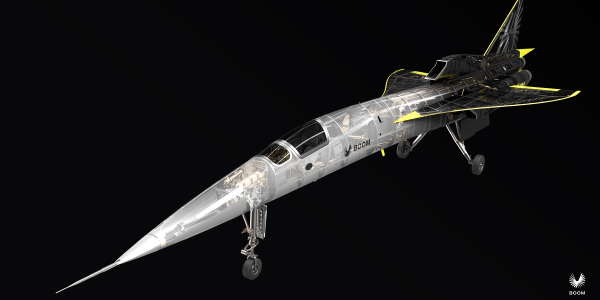
For any commercial supersonic aircraft to be viable, it needs to not only be much cheaper to build and operate than older designs, but it also needs to be far quieter. Which is exactly what Boom hopes to demonstrate with their XB-1 prototype. The sleek craft will never enter into commercial service itself, but if all goes according to plan during its 2021 test flights, it may prove that the state-of-the-art in aircraft design is ready to usher in a new era of supersonic civilian transport.