
Converting A TP Link Router To Mission Control For Cheap 433MHz Home Automation

[Jean-Christophe Rona] found himself with some free time and decided to finish a project he started two years ago, reverse engineering cheap 433MHz home automation equipment. He hopes to control his space heaters remotely, in preparation for a cold and, now, robotic winter.

In a previous life, he had reverse engineered the protocol these cheap wireless plugs, garage doors, and electric window shutters all use. This eventually resulted in a little library called rf-ctrl that can toggle and read GPIO pins in the correct way to control these objects. He has a few of the more popular protocols built into the library and even wrote a guide on how to do the reverse engineering yourself if you have need.

Having successfully interfaced with the plugs to use with his space heaters, [Jean-Christophe] went about converting a cheap TP Link router into a command center for them. Since TP Link never expected anyone to hammer their square peg into a mismatched hole, it takes a careful hand at soldering and some enamel wire to break out the GPIO pins, but it’s well within the average skill set.

The end result is a nicely contained blue box with a little antenna hanging out of it, and we hope, a warm abode for the coming winter.
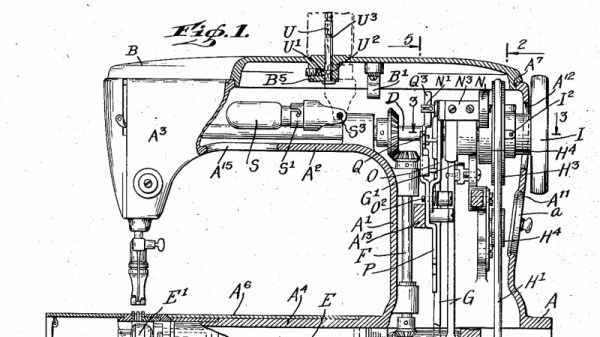
Why You Should Own A Sewing Machine

This could probably be any of our grandmothers at work. George Grantham Bain Collection [PD], via Wikimedia Commons
This could probably be any of our grandmothers at work. George Grantham Bain Collection [PD], via Wikimedia Commons.
In our hackspace, we’ve opened a textile room in the last month. We have high hopes for it as a focal point for cosplayers and LARPers as well as the makers of wearable electronics and more traditional textile users. Putting it in has involved several months of hard work bringing a semi-derelict and previously flooded room that was once the walk-in safe for our local school authority to a point at which it is a light and welcoming space, but a surprising amount of work has also had to go into winning the hearts and minds of our community for the project.

Putting it quite simply, textiles aren’t seen as very cool, in hackspace terms. You know, Women’s stuff. Your mother does it, or even maybe if you are a little younger, your grandmother. It’s just not up there with laser cutting or 3D printing, and as a result those of us for whom it’s a big part of making stuff have had to fight its corner when it comes to resources within the space.

Yet not so long ago when I brought a pair of worn-out jeans into the space on a social night and hauled out our Lervia sewing machine to fix them, I had a constant stream of fellow members passing by amazed at what I was doing. “You can repair jeans?” they asked, incredulously. For some reason this prospect had not occurred to them, I was opening up a new vista in clothing reincarnation, to the extent that before too long in our new facility I may be giving a workshop on the subject as the beloved former trousers of Oxford Hackspace denizens gain a chance of new life.

Continue reading “Why You Should Own A Sewing Machine”

Botnet Recall Of Things

After a tough summer of botnet attacks by Internet-of-Things things came to a head last week and took down many popular websites for folks in the eastern US, more attention has finally been paid to what to do about this mess. We’ve wracked our brains, and the best we can come up with is that it’s the manufacturers’ responsibility to secure their devices.

Chinese DVR manufacturer Xiongmai, predictably, thinks that the end-user is to blame, but is also consenting to a recall of up to 300 million 4.3 million of their pre-2015 vintage cameras — the ones with hard-coded factory default passwords. (You can cut/paste the text into a translator and have a few laughs, or just take our word for it. The company’s name gets mis-translated frequently throughout as “male” or “masculine”, if that helps.)

Xiongmai’s claim is that their devices were never meant to be exposed to the real Internet, but rather were designed to be used exclusively behind firewalls. That’s apparently the reason for the firmware-coded administrator passwords. (Sigh!) Anyone actually making their Internet of Things thing reachable from the broader network is, according to Xiongmai, being irresponsible. They then go on to accuse a tech website of slander, and produce a friendly ruling from a local court supporting this claim.

Whatever. We understand that Xiongmai has to protect its business, and doesn’t want to admit liability. And in the end, they’re doing the right thing by recalling their devices with hard-coded passwords, so we’ll cut them some slack. Is the threat of massive economic damage from a recall of insecure hardware going to be the driver for manufacturers to be more security conscious? (We kinda hope so.)

Meanwhile, if you can’t get enough botnets, here is a trio of recent articles (one, two, and three) that are all relevant to this device recall.

Via threatpost.

Death To The 3.5mm Audio Jack, Long Live Wireless

There’s been a lot of fuss over Apple’s move to ditch the traditional audio jack. As for me, I hope I never have to plug in another headphone cable. This may come off as gleeful dancing on the gravesite of my enemy before the hole has even been dug; it kind of is. The jack has always been a pain point in my devices. Maybe I’ve just been unlucky. Money was tight growing up. I would save up for a nice set of headphones or an mp3 player only to have the jack go out. It was a clear betrayal and ever since I’ve regarded them with suspicion. Is this the best we could do?

I can’t think of a single good reason not to immediately start dumping the headphone jack. Sure it’s one of the few global standards. Sure it’s simple, but I’m willing to take bets that very few people will miss the era of the 3.5mm audio jack once it’s over. It’s a global episode of the sunk cost fallacy.

In the usual way hindsight is 20/20, the 3.5mm audio jack can be looked at as a workaround, a stop over until we didn’t need it.  It appears to be an historic kludge of hack upon hack until something better comes along. When was the last time it was common to hook an Ethernet cable into a laptop? Who would do this when we can get all the bandwidth we want reliably over a wireless connection. Plus, it’s not like most Ethernet cables even meet a spec well enough to meet the speeds they promise. How could anyone reasonably expect the infinitely more subjective and variable headphone and amplifier set to do better?

But rather than just idly trash it, I’d like to make a case against it and paint a possible painless and aurally better future.

Continue reading “Death To The 3.5mm Audio Jack, Long Live Wireless”

Engage Tinfoil Hat: Samsung Note 7 Battery Theory

For the most part I believe things are as they seem. But every once in a while I begin to look at notable technology happenings from a different angle. What if things are not like they seem? This is conspiracy theory territory, and I want to be very clear about this: what follows is completely fictitious and not based on fact. At least, I haven’t tried to base it on facts surrounding the current events. But perhaps you can. What if there’s more to the battery fires in Samsung’s Galaxy Note 7 phones?

I have a plausible theory, won’t you don your tinfoil hat and follow me down this rabbit hole?

Continue reading “Engage Tinfoil Hat: Samsung Note 7 Battery Theory”

Should You Outsource Manufacturing? A Handy Guide

A lot of people assume that the product development cycle involves R&D, outsourcing to a Chinese manufacturer, and then selling the finished product. It’s almost ingrained in our heads that once a prototype has been developed, the next step involves a visa and airplane tickets. Here is a guide that will explore a few other options, and why outsourcing may not be appropriate for everyone.

First, let’s talk about goals. We’ll assume you’re not a large company, and that you don’t have a huge budget, and that you’re just getting started with your product and don’t have big volumes; a startup trying to sell a kit or breakout board, or a consumer electronics product. Your goals are the following:

  1. Validate your product in the market. Build a minimum viable product and get it in the hands of lots of users
  2. Get the most bang for your limited bucks. All money should go towards getting products out the door
  3. Reduce risk to your company so that any single failure doesn’t crater the whole operation and you can safely grow.

With that in mind, what are your options?

Continue reading “Should You Outsource Manufacturing? A Handy Guide”

Umbrella drone jellyfish

Umbrella Drones — Jellyfish Of The Sky

Mount an umbrella to a drone and there you go, you have a flying umbrella. When [Alan Kwan] tried to do just that he found it wasn’t quite so simple. The result, once he’d worked it out though, is haunting. You get an uneasy feeling like you’re underwater watching jellyfish floating around you.

A grad student in MIT’s ACT (Art, Culture and Technology) program, [Alan’s] idea was to produce a synesthesia-like result in the viewer by having an inanimate object, an umbrella, appear as an animate object, a floating jellyfish. He first tried simply attaching the umbrella to an off-the-shelf drone. Since electronics occupy the center of the drone, the umbrella had to be mounted off-center. But he discovered that drones want most of their mass in the center and so that didn’t work. With the help of a classmate and input from peers and faculty he made a new drone with carbon fiber and metal parts that allowed him to mount the umbrella in the center. To further help with stability, the batteries were attached to the very bottom of the umbrella’s pole.

In addition to just making them fly, [Alan] also wanted the umbrella to gently undulate like a jellyfish, slowly opening and closing a little. He tried mounting servo motors inside the umbrella for the task. These turned out to be too heavy, but also unnecessary. Once flying outside at just the right propeller speed, the umbrellas undulated on their own. Watch them doing this in the video below accompanied by haunting music that makes you feel you’re watching a scene from Blade Runner.

Continue reading “Umbrella Drones — Jellyfish Of The Sky”