Hacking Online Reviews

For this post, I want to return the word hacking to its nefarious definition. We prefer the kinder definition of a hacker as someone who creates or modifies things to fit some purpose or to improve its function. But a hacker can also be someone who breaks into computer systems or steals phone service or breaks encryption.

There are some “hacker battlefields” that are very visible. Protecting credit card numbers from hackers is a good example. But there are some subtle ones that many people don’t notice. For example, the battle for online reviews. You know, like on Amazon when you rate the soldering iron you bought and leave a note about how it works. That might seem like a strange place for hacking until you stop and think about why people do bad hacking.
Continue reading “Hacking Online Reviews”

3D Printed Tourbillon Clock

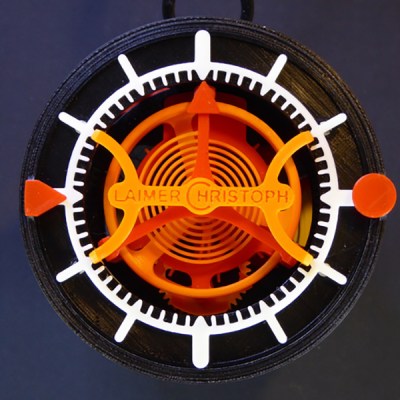
3D printed clocks have been done before, but never something like this. It’s a 3D printed clock with a tourbillon, a creative way to drive an escapement developed around the year 1800. Instead of a pendulum, this type of clock uses a rotating cage powered by a spring. It’s commonly found in some very expensive modern watches, but never before has something like this been 3D printed.

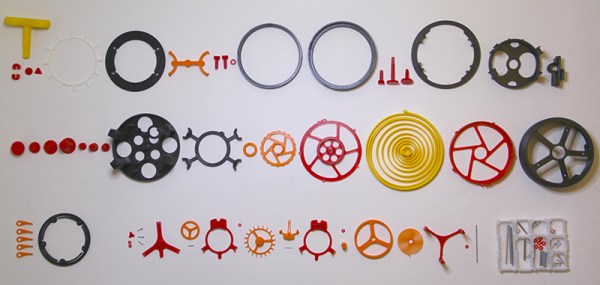
3D Printed Clock[Christoph Lamier] designed this tourbillon clock in Autodesk Fusion 360, with 50 printable parts, and a handful of pins, screws, and washers. The most delicate parts – the hairspring, anchor, escapement wheel, and a few gears were printed at 0.06 layer height. Everything else was printed at a much more normal resolution with 0.1mm layer height.


Because nearly the entire clock is 3D printed, this means the spring is 3D printed as well. This enormous 2 meter-long spiral of printed plastic could not have been printed without altering a few settings on the printer. The setting in question is Cura’s ‘combing’ or the ‘avoid crossing perimeters’ setting. If you don’t disable this setting, the print time increases by 30%, and moving the print head causes the plastic to ooze out over the spring.

There’s a 26-minute long video of the 3D printed tourbillon clock in action that is horrendously boring. It does demonstrate this clock works, though. You can check out the more interesting videos below.

Continue reading “3D Printed Tourbillon Clock”

Hackers And Heroes: A Tale Of Two Countries

Hacker culture in Germany and the US is very similar in a lot of ways, from the relative mix of hardware versus software types to the side-affinities for amateur radio and blinkenlights. Reading Hackaday, you’ll find similar projects coming out of both countries. Both countries have seen hackerspaces bloom in the last decade to the point that there’s probably one or two in whatever city you’re living in. But there’s one thing that hackers in the USA are still lacking that German hackers have had for a while: respect.

Say the word “hacker” in different social circles, and you never know what kind of response you’re going to get. Who exactly are “hackers” anyway? Are we talking about the folks blackmailing you for your account details on Ashley Madison? Or stealing credit card numbers from Target? Or are we talking about the folks who have a good time breaking stuff and building stuff, and taking things apart to see how they work?

hacker_montage

The discussion over who’s a “hacker” is as old as the hills, by Internet standards anyway, and it’s not going to get settled here. But think about the last time you heard the word “hacker” used in anything but its negative sense in the popular press. If you can’t remember a single instance in this century, you’re living in the USA. If you answered, “just yesterday, in one of the nation’s most important newspapers”, then you’re living in Germany.

Continue reading “Hackers And Heroes: A Tale Of Two Countries”

Flat Camera Uses No Lens

Early cameras and modern cameras work pretty much the same way. A lens (or a pinhole acting as a lens) focuses an image onto a sensor. Of course, sensor, in this case, is a broad term and could include a piece of film that–after all–does sense light via a chemical reaction. Sure, lenses and sensors get better or, at least, different, but the basic design has remained the same since the Chinese built the camera obscura around 400BC (and the Greeks not long after that).

Of course, the lens/sensor arrangement works well, but it does limit how thin you can make a camera. Cell phone cameras are pretty skinny, but there are applications where even they are too thick. That’s why researchers at Rice University are working on a new concept design for a flat camera that uses no lens. You can see a video about the new type of camera below.

Continue reading “Flat Camera Uses No Lens”

PIC32 Smart Watch For Less Than A Benjamin

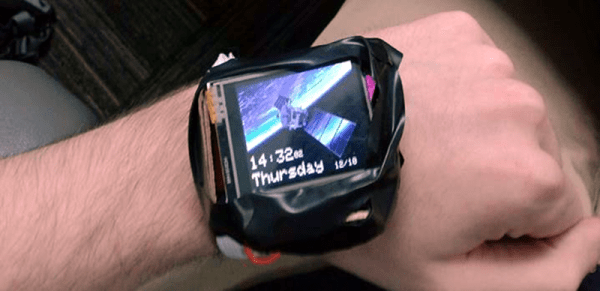
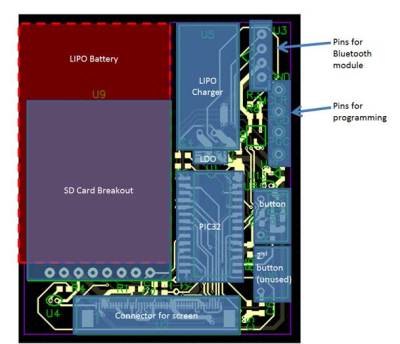
[Matthew Filipek] likes smart watches, but wanted to build one for under $100, so he did. The watch has a 1.7 inch LCD touchscreen, a rechargeable LiPo battery, an SD card, and Bluetooth. The watch is a little large since [Matthew] had only a month to complete the project that drove him to use some pre-made modules image004and meant one shot at getting his custom PCB right.


The watch sports three applications: a settings app, a simple game, and a sketch program (you can see a demo in the video below). Power management is a primary goal, of course, although the clock rate is held high enough to make the game playable. To simplify the software, [Matthew] uses protothreads–a lightweight thread abstraction for embedded systems.

We’ve seen several DIY smartwatches in the past including one entry for the Hackaday Prize. It is hard to roll your own watch that has the same small size and style as a commercial offering. However, there is something to be said for having a homebrew watch for boosting your hacker cred.

Continue reading “PIC32 Smart Watch For Less Than A Benjamin”

WingBoard: Wakeboarding Behind An Airplane

[Aaron Wypyszynski] or [Wyp] for short had a dream as a youngster about jumping out of a plane and “carving through the sky” (paraphrasing the video embedded after the break), so when he grew up [Wyp] went ahead and pursued that dream.

What that boyhood dream produced is [Wyp] offering to pull you through the sky on what looks like a proper model of a blunt nosed paper airplane glider. Seems to be a bit like wakeboarding for skydivers, cause that needed to be a thing.

Continue reading “WingBoard: Wakeboarding Behind An Airplane”

Very Detailed BB-8 Robot Build

[James Bruton] has just finished and posted the designs for his very impressive BB-8 robot build. We covered the start of his adventures some time ago when we were theorizing about the secret in the new droid, but it was for a completely different robot design. [James] was pursuing a design that used a little robot sitting on top of a big ball.

This new version has a robot sitting inside a ball with the head being magnetically coupled to the body. Among many things with this build, we thought it was cool how the robot has one drive motor and turns by spinning up and reversing a big flywheel in the base of the robot. That was certainly not one of the top theories proposed for the secret behind the robot. The robot is mostly made with a 3d printer, with the occasional cosmetic piece being vacuum formed. If you’d like to make one for yourself, [James] has also posted all of the design and cad for the robot on his GitHub. On Thursday he posted the final installment of his 10-part video series on the build. Check out part one after the break.

Continue reading “Very Detailed BB-8 Robot Build”