Hacking A Pi Camera With A Nikon Lens

Cell phones have killed many industries. It is getting harder and harder to justify buying an ordinary watch, a calculator, or a day planner because your phone does all those things at least as well as the originals. Cell phones have cameras too, so the days of missing a shot because you don’t have a camera with you are over (although we always wonder where the flood of Bigfoot and UFO pictures are). However, you probably still have a dedicated camera tucked away somewhere because, let’s face it, most cell phone cameras are just not that good.

The Raspberry Pi camera is about on par with a cheap cell phone camera. [Martijn Braam] has a Nikon camera, and he noticed that he could get a Raspberry Pi camera with a C-mount for lenses. He picked up a C to F adapter and proceeded to experiment with Nikon DSLR lenses on the Raspberry Pi camera.

Continue reading “Hacking A Pi Camera With A Nikon Lens” →

Transparent ESP8266 WiFi-to-Serial Bridge

These days, connecting your microcontroller project to a WiFi network is pretty easy — you connect up an ESP8266 to your microcontroller project and pretend it’s a WiFi modem, using these old-school-style AT commands. But what do you do if you need to flash new code into the microcontroller? You can’t reprogram the micro remotely through the ESP8266 because those stupid AT commands get in the way.

The solution? By flashing the esp-link firmware into your ESP8266, you talk directly to the microcontroller over WiFi as if it were connected by a serial cable: the ESP8266 becomes a totally transparent WiFi-serial bridge. Now, with a serial bootloader and an ESP8266 in Wifi-to-serial bridge mode, you can reflash your microcontroller wirelessly, and then telnet in to interact with and debug the system remotely. Once you’ve fixed the bugs, you can re-flash the microcontroller: all over WiFi, without having to climb up a ladder to reach your IoT attic-temperature sensor.

To flash a connected Arduino, for instance, all you need to do is convince AVRDUDE to use the network instead of a locally-connected USB-serial cable: avrdude -p m328p -c arduino -b 115200 -P net:192.168.1.123:23 -U:yourHexFile.hex. The ESP8266 passes the data straight through its TX and RX lines to your microcontroller and everything works as if it were wired.

Configuration to allow the ESP8266 to join your WiFi network takes place on a self-hosted webpage that uses [Sprite_tm]’s esp-httpd standalone server, which makes setup pretty painless. And then after that you can simply telnet to the ESP8266 at port 23 and type away, or do anything else you would with a wired serial connection.

Although the simple bridge mode came first, esp-link looks like it’s growing to be a one-stop shop for all your IoT or microcontroller + WiFi needs. In addition to the serial bridge code, there is also a REST-based microcontroller-to-internet mode and there is bi-directional MQTT support in the wings. We haven’t had a chance to dig into these yet, so if you have, let us know in the comments.

If you want to dig in deeper, head over to [Jeelabs]’ blog for a slightly outdated tour of the project written by the code’s author, [Thorsten von Eicken]. For the most up-to-date development news, follow the very active development of esp-link in this thread on the esp8266 forums.


Dear TSA: This Is Why You Shouldn’t Post Pictures Of Your Keys Online

We have to hand it to the Transportation Security Administration (TSA). They seem to have a perfect track record of screwing up – and that’s not an easy thing to accomplish if you think about it. If it’s not reports of TSA agents stealing valuables or inappropriately groping passengers, there is the fun fact that in all the years since it was created in 2001, the agency hasn’t caught a single person seeking to do harm in the friendly skies. We’re actually okay with that if it means nobody is trying to do anything shady.

The most recent TSA folly seemed to practically fall into the Internet’s lap when a reporter for the The Washington Post published a hi-res picture of the entire set of TSA master keys while writing an article about how the TSA handles your bags after checking them at the counter. Well, the lock picking community when nuts and in a short time had 3D printed versions available and working. You can see it in action in the (twitter) video after the break.

For those that are not familiar with travel in the US, you are not allowed to use just any old lock on your bags. It has to be approved by the TSA – and that means that they have to be able to open it. So the TSA agents have a set of master keys that can open any bag if they need to look inside for some reason. If you put a non-TSA approved lock on the bag, that can make them a little angry, and you risk having your bag delayed or even cut open.

Of course, you can get into just about any suitcase with a ball point pen, so maybe this isn’t a real “security” issue, but it sure isn’t what you want to see from the agency that is supposed to protect you. Who knew that you could make keys from a photograph? We did way back in 2009 and way more in depth this May… maybe the TSA should start reading Hackaday?

Continue reading “Dear TSA: This Is Why You Shouldn’t Post Pictures Of Your Keys Online” →

Learn And Build A High Side Switch

As electronics engineer I have a mental collection of circuits that I’ve gathered over the years, much like a mechanic collects specialized tools as they work. All engineers do this and the tools in their tool boxes usually represent their project history and breadth.

A useful circuit to have in designer’s toolbox is the “high side switch”. Like it sounds, this is a circuit that switches the “high side” or positive voltage to a load.

We usually tend to switch things to ground as seen by outputs such as an Open Collector output, the reason being that ground usually is a known entity and is usually low impedance and is at a known voltage. But there are advantages to using a high-side switch in your circuits.

Continue reading “Learn And Build A High Side Switch” →

Don’t Understand The Periodic Table? It’s Just A Quantum Truth Table

In the wee hours of the late 17th century, Isaac Newton could be found locked up in his laboratory prodding the secrets of nature. Giant plumes of green smoke poured from cauldrons of all shapes and sizes, while others hissed  and spat new and mysterious chemical concoctions, like miniature volcanoes erupting with knowledge from the unknown. Under the eerie glow of twinkling candle light, Newton would go on to write over a million words on the subject of alchemy. He had to do so in secret because the practice was frowned upon at that time.  In fact, it is now known that alchemy was the ‘science’ in which he was chiefly interested in. His fascination with turning lead into gold via the elusive philosopher’s stone is now evident. He had even turned down a professorship at Cambridge and instead opted for England’s Director of Mint, where he oversaw his nation’s gold repository.

Not much was known about the fundamental structure of matter in Newton’s time. The first version of the periodic table would not come along for more than a hundred and forty years after his death. With the modern atomic structure not surfacing for another 30 years after that. Today, we know that we can’t turn lead into gold without setting the world on fire. Alchemy is recognized as a pseudoscience, and we opt for modern chemistry to describe the interactions between the elements. Everyone walking out of high school knows what atoms and the periodic table are. They know what the sub-atomic particles and their associated electric charges are. In this article, we’re going to push beyond the basics. We’re going to look at atomic structure from a quantum mechanical view, which will give you a new understanding of why the periodic table looks the way it does. In fact, you can construct the entire periodic table using nothing but the quantum numbers.

Continue reading “Don’t Understand The Periodic Table? It’s Just A Quantum Truth Table” →

9th Grader Arrested, Searched For Building A Clock

A 14-year-old in Dallas, Texas has been arrested for bringing a clock to his school. [Ahmed Mohamed] could be any one of us. He’s a tinkerer, pulling apart scrap appliances and building projects from the parts. He was a member of the his middle school robotics team. The clock was built from a standard four digit seven segment display and a circuit board. [Ahmed] built the circuit inside a Vaultz hard pencil case like this one. He then did what every other experimenter, inventor, hacker, or maker before him has done: He showed off his creation.

Unfortunately for [Ahmed] one of his teachers immediately leapt to the conclusion that this electronic project was a “hoax bomb” of some sort. The police were called, [Ahmed] was pulled out of class and arrested. He was then brought to a detention center where he and his possessions were searched. [Ahmed] is now serving a three-day suspension from school. His clock is considered evidence to be used in a possible criminal case against him.

If this situation doesn’t get your blood boiling, then we don’t know what does. Not only is there a glaring racial issue here, but also an issue of allowing kids to bring their projects to school. We hope you’ll join us in expressing outrage at this whole debacle, as well as supporting [Ahmed] in any way you can. Let’s join together as a community to make sure a few small-minded individuals don’t break the spirit of this budding hardware hacker.

For anyone out there who would like to support [Ahmed]’s education even when his school won’t, [Anil Dash] is will be in contact with the family later today. We’re offering a gift card for the hackaday store and we would assume other contributions would also be welcome. -Ed.

Continue reading “9th Grader Arrested, Searched For Building A Clock” →

No User Serviceable Parts Inside? The Rise Of The Fix-It Culture

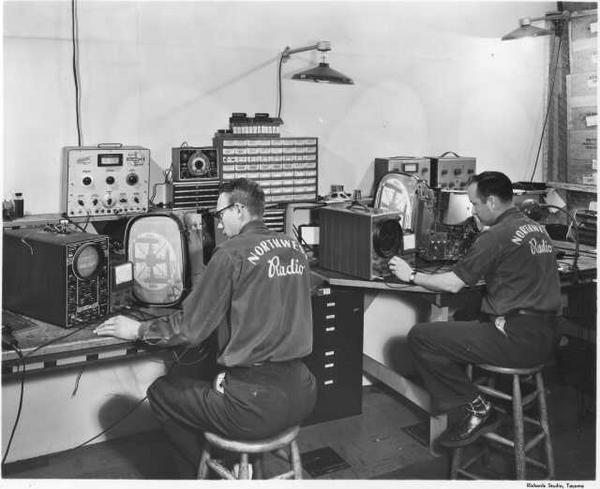
pix-tv-repair-shop
[Source: 1950s Television]
My first job out of high school was in a TV shop. I was hired mainly for muscle; this was the early 1980s and we sold a lot of console TVs that always seemed to need to be delivered to the third floor of a walk up. But I also got to do repair work on TVs and stereos, and I loved it. Old TVs from the 60s and 70s would come in, with their pre-PCB construction and hand-wired chassis full of terminal strips and point to point wiring that must have been an absolute nightmare to manufacture. We’d replace dodgy caps, swap out tubes, clean the mechanical tuners, and sometimes put a new picture tube in  – always the diagnosis that customers dreaded the most, like being told they’d need a heart transplant. We kept those old sets alive, and our customers felt like they were protecting their investment in their magnificent Admiral or Magnavox console with the genuine – and very, very heavy – walnut cabinet.

I managed to learn a lot from my time as a TV repairman, and I got the bug for keeping things working well past the point which a reasonable person would recognize as the time to go shopping for a new one. Fixing stuff is where I really shine, and my house is full of epic (in my mind, at least) repairs that have saved the family tens of thousands of dollars over the years. Dishwasher making a funny noise? I’ll just pull it out to take a look. You say there’s a little shimmy in the front end when you brake? Pull the car into the garage and we’ll yank the wheels off. There’s basically nothing I won’t at least try to fix, and more often than not, I succeed.

I assumed that my fix-it bug made me part of a dying breed of cheapskates and skinflints, but it appears that I was wrong. The fix-it movement seems to be pretty healthy right now, fueled in part by the explosion in information that’s available to anyone with basic internet skills.

Continue reading “No User Serviceable Parts Inside? The Rise Of The Fix-It Culture” →