This excellent content from the Hackaday writing crew highlights recurring topics and popular series like Linux-Fu, 3D-Printering, Hackaday Links, This Week in Security, Inputs of Interest, Profiles in Science, Retrotechtacular, Ask Hackaday, Teardowns, Reviews, and many more.
Eleven years ago, the Airbus A380 entered commercial service with Singapore Airlines. In the time since then it has become the queen of the skies. It’s a double-decker airliner, capable of flying 550 passengers eight thousand nautical miles. Some configurations of the A380 included private suites. Some had a shower. This is the epitome of luxury, a dream of flying with long-stemmed glasses, a movie, and a pleasant dream in mid-air.
Now, after the cancellation of A380 orders by Emirates, Airbus has announced it will end production of this massive, massive plane. No, it’s not the last flight of the Concorde, but it is the beginning of the end of an era. The biggest and most impressive planes just aren’t economical; it’s possible to fly three 787s across the globe for a single flight of an A380. The skies won’t fall silent, but soon the A380 will be no more.
What’s the buzz in the hackersphere this week? Hackaday Editors Elliot Williams and Mike Szczys recap their favorite hacks and articles from the past seven days. In Episode Six we cover an incredible reverse engineering effort Mike Harrison put in with iPod nano replacement screens. We dip our toes in the radioactive world of deep-space power sources, spend some time adoring parts and partsmakers, and take a very high-brow look at toilet-seat technology. In our quickfire hacks we discuss coherent sound (think of it as akin to laminar flow, but for audio), minimal IDEs for embedded, hand-tools for metalwork, and the little ESP32 bot that could.
Links for all discussed on the show are found below. As always, join in the comments below as we’ll be watching those as we work on next week’s episode!
Take a look at the links below if you want to follow along, and as always, tell us what you think about this episode in the comments!
RISC-V is the new hotness, and companies are churning out code and announcements, but little actual hardware. Eventually, we’re going to get to the point where RISC-V microcontrollers and SoCs cost just a few bucks. This day might be here, with Seeed’s Sipeed MAix modules. it’s a RISC-V chip you can buy right now, the bare module costs eight US dollars, there are several modules, and it has ‘AI’.
Those of you following the developments in the RISC-V world may say this chip looks familiar. You’re right; last October, a seller on Taobao opened up preorders for the Sipeed M1 K210 chip, a chip with neural networks. Cool, we can ignore some buzzwords if it means new chips. Seeed has been busy these last few months, and they’re now selling modules, dev boards, and peripherals that include a camera, mic array, and displays. It’s here now, and you can buy one. If it seems a little weird for Seeed Studios to get their hands on this, remember: the ESP8266 just showed up on their web site one day a few years ago. Look where we are with that now.
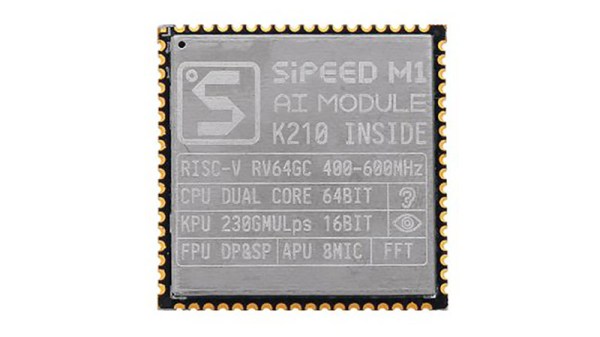
The big deal here is the Sipeed MAix-I modulewith WiFi, sold out because it costs nine bucks. Inside this module is a Kendryte K210 RISC-V CPU with 8MB of on-chip SRAM and a 400MHz clock. This chip is also loaded up with a Neural Network Processor, an Audio Processor with support for eight microphones, and a ‘Field Programmable IO array’, which sounds like it’s a crossbar on the 48 GPIOs on the chip. Details and documentation are obviously lacking.
In addition to a chip that’s currently out of stock, we also have the same chip as above, without WiFi, for a dollar less. It’ll probably be out of stock by the time you read this. There’s a ‘Go Suit’ that puts one of these chips in an enclosure with a camera and display, and there’s a microphone array add-on. There’s a binocular camera module if you want to play around with depth sensing.
The first time we heard of this chip, it was just a preorder on Taobao. It told us two things: RISC-V chips are coming sooner than we expected, and you can do preorders on Taobao. Seeed has a history of bringing interesting chips to the wider world, and if you want a RISC-V chip right now, here you go. Just be sure to tell us what you did with it.
Every year at Superconference, Editor-in-Chief Mike Szczys gets the chance to talk about what we think are the biggest, most important themes in the Hackaday universe. This year’s talk was about science and technology, and more importantly who gets to be involved in building the future. Spoiler: all of us! Hackaday has always stood for the ideal that you, yes you, should be taking stuff apart, improving it, and finding innovative ways to use, make, and improve. To steal one of Mike’s lines: “Hackaday is an engine of engagement in engineering fields.”
We all know CERN as that cool place where physicists play with massive, superconducting rings to smash atoms and subatomic particles to uncover secrets of matter in the Universe. To achieve this aim, they need to do a ton of research in other areas, such as development of special particle detectors.
While such developments are essential to the core research needs of the Centre, they also lead to spinoff applications for the benefit of society at large. One such outcome has been the Medipix Collaborations – a family of read-out chips for particle imaging and detection that can count single photons, allowing X-rays and gamma rays to be converted to electrical signals. It may not be possible for us hackers to get our hands on these esoteric sensors, but these devices are pretty interesting and deserve a closer look. Medipix sensors work like a camera, detecting and counting each individual particle hitting the pixels when its electronic shutter is open. This enables high-resolution, high-contrast, noise hit free images – making it unique for imaging applications.
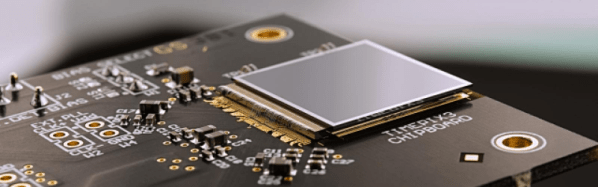
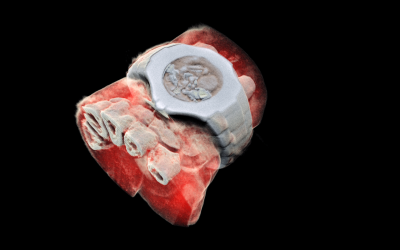
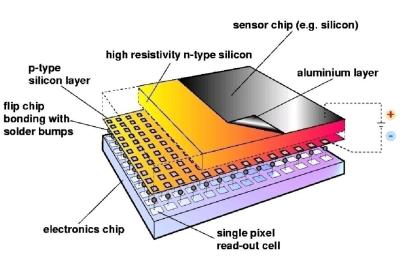
Some months back, CERN announced the first 3D color X-ray of a human made possible using the Medipix devices. The result is a high-resolution, 3D, color image of not just living structures like bones, muscular tissues and vessels, but metal objects too like the wrist watch, seen in the accompanying photograph. The Medipix sensors have been in development since the 1990’s and are presently in their 4th “generation”. Each chip consists of a top semiconducting sensor array, made from gallium arsenide or cadmium telluride. The charge collected by each pixel is transported to the CMOS ASIC electronics via “bump bonds”. The integration is vertical, with each sensing pixel connected via the bump bond to an analog section followed by a digital processing layer. Earlier versions were limited, by technology, in their tiling ability for creating larger matrices of multiple sensors. They could be abutted on three sides only, with the fourth being used for on-chip peripheral logic and wire-bond pads that permit electronic read-out. The latest Medipix4 Collaboration, still under some development, eliminates this short coming. Through-silicon-via (TSV) technology provides the possibility of reading the chips through copper-filled holes that bring the signals from the front side of the chip to its rear. All communication with the pixel matrix flows through the rear of the chip – the peripheral logic and control elements are integrated inside the pixel matrix.
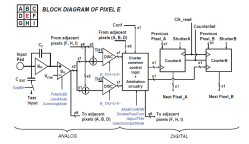
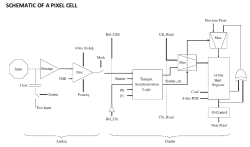
The Analog front end consists of a pre-amplifier followed by a window discriminator which has upper and lower threshold levels. The discriminator has four bits for threshold adjustment as well as polarity sensing. This allows the capture window to be precisely set. The rest of the digital electronics – multiplexers, shift registers, shutter and logic control – helps extract the data.
Further development of the Medipix (Tech Brief, PDF) devices led to a separate version called Timepix (Tech Brief, PDF). These new devices, besides being able to count photons, are capable of two additional modes. The first mode records “Time-Over-Threshold”, providing rough analog information about the energy of the photon. It does this by counting clock pulses for the duration when the signal stays above the discrimination levels. The other mode, “Time of Arrival”, measures arrival time of the first particle to impinge on the pixel. The counters record time between a trigger and detection of radiation quanta with energy above the discrimination level, allowing time-of-flight applications in imaging.
Medipix3 pixel schematic
Timepix2 pixel schematic
Besides medical imaging, the devices have applications in space, material analysis, education and of course, high energy physics. Hopefully, in a few years, hackers will lay their hands on these interesting devices and we can get to know them better. At the moment, the Medipix website has some more details and data sheets if you would like to dig deeper. For an overview on the development of such single photon detectors, check out this presentation from CERN – “Single X-Ray Photon Counting Systems: Existing Systems, Systems Under Development And Future Trends” (PDF).
Today’s story is one of victory and defeat, of mystery and adventure… It’s time to automate the garage door. Connecting the garage door to the internet was a must on my list of smart home features. Our opener has internet connection capabilities built-in. As you might guess, I’m very skeptical of connecting a device to the internet when I have no control over the software running on it.
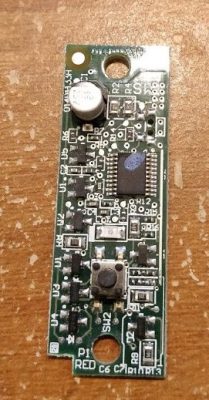
The garage door is controlled by a button hung on the garage wall. There is only a pair of wires, so a simple relay should be all that is needed to simulate the button press from a Raspberry Pi. I wired a relay module to a GPIO on the Pi mounted in the garage ceiling, and wrote a quick and dirty test program in Python. Sure enough, the little relay was clicking happily– but the garage door wasn’t budging. Time to troubleshoot. Does the push button still work? *raises the garage door* yep. How about the relay now? *click…click* nope.
You may have figured out by now, but this garage door opener isn’t just a simple momentary contact push button. Yes, that’s a microcontroller, in a garage door button. This sort of scenario calls for forensic equipment more capable than a simple multimeter, and so I turned to Amazon for a USB oscilloscope that could do some limited signal analysis. A device with Linux support was a must, and Pico Technology fit the bill nicely.
Searching for a Secret We Don’t Actually Need
My 2 channel Picotech oscilloscope, the 2204A, finally arrived, and it was time to see what sort of alien technology was in this garage door opener. There are two leads to the button, a ground and a five volt line. When the button is pressed, the microcontroller sends data back over that line by pulling the 5 V line to ground. If this isn’t an implementation of Dallas 1-wire, it’s a very similar concept.
From today’s perspective, vacuum tubes are pretty low tech. But for a while they were the pinnacle of high tech, and heavy research followed the promise shown by early vacuum tubes in transmission and computing. Indeed, as time progressed, tubes became very sophisticated and difficult to manufacture. After all, they were as ubiquitous as ICs are today, so it is hardly surprising that they got a lot of R&D.
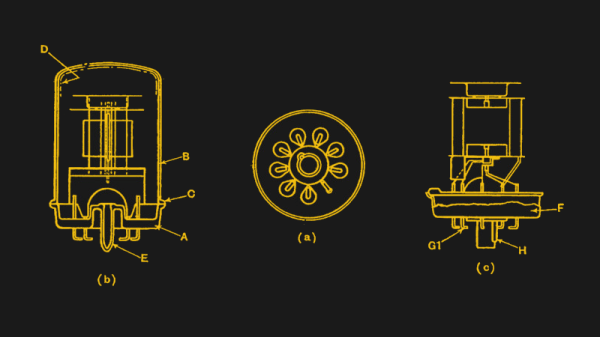
Prior to 1938, for example, tubes were built as if they were light bulbs. As the demands on them grew more sophisticated, the traditional light bulb design wasn’t sufficient. For one, the wire leads’ parasitic inductance and capacitance would limit the use of the tube in high-frequency applications. Even the time it took electrons to get from one part of the tube to another was a bottleneck.
There were several attempts to speed tubes up, including RCA’s acorn tubes, lighthouse tubes, and Telefunken’s Stahlröhre designs. These generally tried to keep leads short and tubes small. The Philips company started attacking the problem in 1934 because they were anticipating demand for television receivers that would operate at higher frequencies.
Dr. Hans Jonker was the primary developer of the proposed solution and published his design in an internal technical note describing an all-glass tube that was easier to manufacture than other solutions. Now all they needed was an actual application. While they initially thought the killer app would be television, the E50 would end up helping the Allies win the war.




 Some months back, CERN announced
  The Analog front end consists of a pre-amplifier followed by a window discriminator which has upper and lower threshold levels. The discriminator has four bits for threshold adjustment as well as polarity sensing. This allows the capture window to be precisely set. The rest of the digital electronics – multiplexers, shift registers, shutter and logic control – helps extract the data.