Using Pad Printers To Add Color To Artistic PCBs

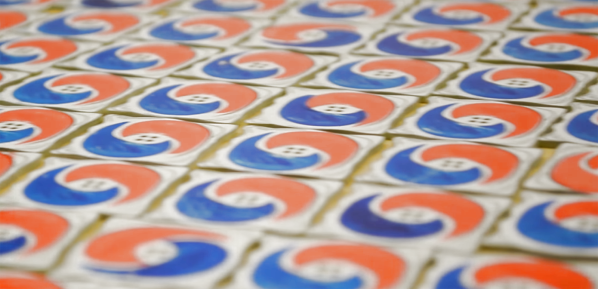
I’ve done a few experiments in adding color to printed circuit boards. These experiments used a process known as pad printing, and so far all indications are that pad printing is a viable process for truly multicolor artistic PCBs. For this year’s DEF CON, I’m stepping things up and taking them to their logical conclusion. I’m making true multicolor PCBs with orange and blue ink. This is, I believe, the first time this has ever been done with printed circuit board art, and it is certainly the first time it has ever been documented.

You may be wondering why I need more color on my boards. It’s that time of year again where PCB artisans all around the world are gearing up for badgecon DEF CON. For the last few years, independent badge makers have come together to form a demoscene of hardware creation. This year, add-ons for badges are a thing, and everyone is getting in on the game. Tindie is filled with amazing electronic badges and add-ons that will be found at this year’s DEF CON. There are badges featuring the Cromulon from Rick and Morty, baby Benders from Futurama, pikachus, and glowing tacos.

This is all about badge art, but when it comes to rendering an image in fiberglass and soldermask, everyone is working with a limited palette. Yes, you can get pink and orange soldermask, but I can’t find a place that will do it inexpensively. For any PCB, your choice of colors are only green, red, yellow, blue, purple, black, or white. No, you can’t mix them.

But I want both orange and blue, on the same board, cheaply and easily — here’s how I did it.

Continue reading “Using Pad Printers To Add Color To Artistic PCBs”
3D Printed Gun Saga: Court Case Over CAD Files Settled

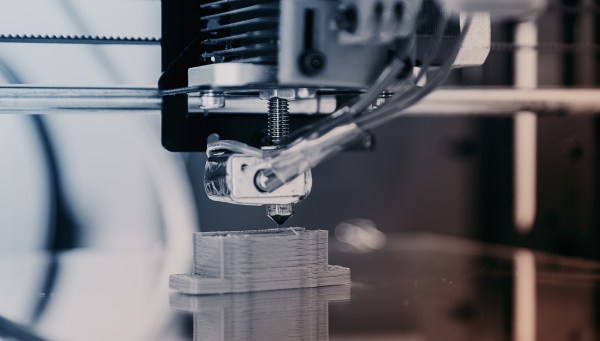
Can you create 3D printed designs and distribute them freely and without restriction? Maybe, and it’s likely to become easier in the future. A settlement has been reached in the saga of the US Department of State versus Cody Wilson, and beginning August 1st the Defense Distributed library of gun designs will once again become available.

Cody is well known for creating the first 3D printed gun. He went on to found Defense Distributed, a company that published designs and technical files for 3D printing firearms before being pulled into litigation that sought to curb the distribution of such plans by subjecting them to International Traffic in Arms Regulations (ITAR) restrictions. Read that carefully, it’s the (international) distribution of CAD files at question here, and not the act of 3D printing, and Defense Distributed has been granted an ITAR exemption. Will other arms-related design files be similarly exempted? The settlement mentions upcoming rule changes seeking to make this type of exemption the standard.

As members of the Hackaday community, we’re the people to whom our friends and family turn for perspective when new technology makes it into their news feeds. Those with little or no exposure to 3D printing may easily fall to doom and gloom reports. But is this a story of doom and gloom? Absolutely not, guns are still guns and 3D printers are still 3D printers. Let’s take a look.

Continue reading “3D Printed Gun Saga: Court Case Over CAD Files Settled”

ERRF 18: The Start Of Something Great

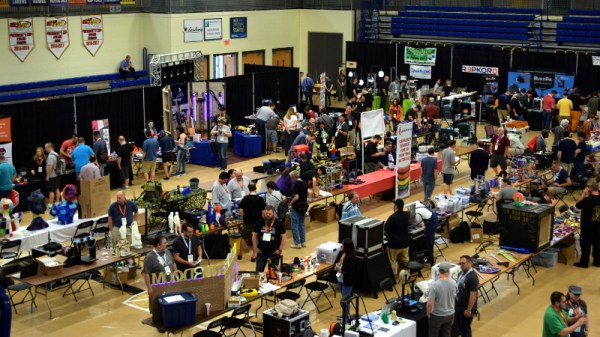
For years, the undisputed king of desktop 3D printing conferences has been the Midwest RepRap Festival (MRRF). Hosted in the tropical paradise that is Goshen, Indiana, MRRF has been running largely unopposed for the top spot since its inception. There are other conferences focused on the industrial and professional end of the 3D printing spectrum, and of course you’d find a Prusa or two popping up at more or less any hacker con; but MRRF is focused on exploring what the individual is capable of once they can manifest physical objects from molten plastic.

But on June 23rd, 2018, MRRF finally got some proper competition. As the name might indicate, the East Coast RepRap Festival (ERRF) is an event very much inspired by its Hoosier State predecessor. Held in Bel Air, Maryland, hackers on the right side of the United States for the first time had the opportunity to attended a true 3D printing festival without having to get on a plane. Not to say it was a neighborhood block party; people from all over the country, and indeed the globe, descended on the APG Federal Credit Union Arena for the two-day celebration of everything plastic.

This inaugural ERRF was, to put it mildly, a massive success. A couple of Hackaday Field Agents were in attendance, and we definitely came away impressed with the event considering it was the first attempt. We saw evidence that the RepRap dream of printable printers is still going strong, a gaggle of new printers and products that will be prying at your wallet this year, and an American-made hotend that challenges traditional wisdom. Of course we also saw a huge number of 3D printing fanatics who were eager to show off their latest creations.

We have no doubt that ERRF will return again next year, but until then, you’ll have to settle for the following collection of selected highlights from this year’s show.

Continue reading “ERRF 18: The Start Of Something Great”

Françoise Barré-Sinoussi: Virus Hunter

It was early 1983 and Françoise Barré-Sinoussi of the prestigious Pasteur Institute in Paris was busy at the centrifuge trying to detect the presence of a retrovirus. The sample in the centrifuge came from an AIDS patient, though the disease wasn’t called AIDS yet.

Barré-Sinoussi and Montagnier in 1983
Barré-Sinoussi and Montagnier in 1983, Image source: Le Globserver

Just two years earlier in the US, a cluster of young men had been reported as suffering from unusual infections and forms of cancer normally experienced by the very old or by people using drugs designed to suppress the immune system. More cases were reported and US Centers for Disease Control and Prevention (CDC) formed a task force to monitor the unusual outbreak. In December, the first scientific article about the outbreak was published in the New England Journal of Medicine.

By May 1983, researchers Barré-Sinoussi and Luc Montagnier of the Pasteur Institute had isolated HIV, the virus which causes AIDS, and reported it in the journal Science. Both received the Nobel prize in 2008 for this work and the Nobel prize citation stated:

Never before have science and medicine been so quick to discover, identify the origin and provide treatment for a new disease entity.

It’s only fitting then that we take a closer look at one of these modern detectives of science, Françoise Barré-Sinoussi, and what led to her discovery.

Continue reading “Françoise Barré-Sinoussi: Virus Hunter”

Fail Of The Week: When Good Foundries Go Bad

Like many of us, [Tony] was entranced by the idea of casting metal, and set about building the tools he’d need to melt aluminum for lost-PLA casting. Little did he know that he was about to exceed the limits of his system and melt a hole in his patio.

[Tony]’s tale of woe begins innocently enough, and where it usually begins for wannabe metal casters: with [The King of Random]’s homemade foundry-in-a-bucket. It’s just a steel pail with a homebrew refractory lining poured in place, with a hole near the bottom to act as a nozzle for forced air, or tuyère. [Tony]’s build followed the plans pretty faithfully, but lacking the spent fire extinguisher [The King] used for a crucible in the original build, he improvised and used the bottom of an old propane cylinder. A test firing with barbecue charcoal sort of worked, but it was clear that more heat was needed. So [Tony] got hold of some fine Welsh anthracite coal, which is where the fun began. With the extra heat, the foundry became a mini-blast furnace that melted the thin steel crucible, dumping the molten aluminum into the raging coal fire. The video below shows the near catastrophe, and we hope that once [Tony] changed his pants, he hustled off to buy a cheap graphite or ceramic crucible for the next firing.

All kidding aside, this is a vivid reminder of the stakes when something unexpected (or entirely predictable) goes wrong, and the need to be prepared to deal with it. A bucket of dry sand to smother a fire might be a good idea, and protective clothing is a must. And it pays to manage your work area to minimize potential collateral damage, too — we doubt that patio will ever be the same again.

Continue reading “Fail Of The Week: When Good Foundries Go Bad”

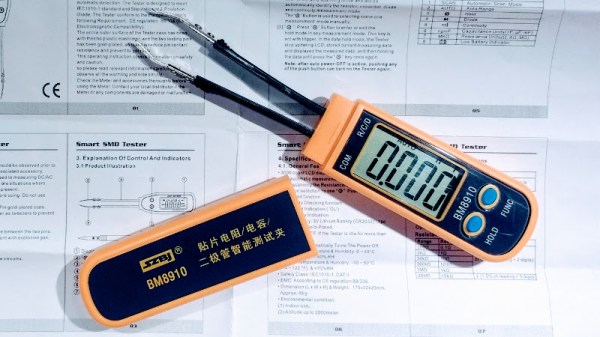
Review: SMD Tweezer Meter Or Tweezer Probes For Your Multimeter?

It’s remarkable how tiny electronics have become. Heaven knows what an old-timer whose experience started with tubes must think, to go from solder tags to SMD in a lifetime is some journey. Even  the generation that started with discrete transistors has lived through an incredible shift. But it’s true, SMD components are tiny, and that presents a challenge aside from the one you’ll face when soldering them. Identifying and measuring the value of a chip component too small to have any writing upon it becomes almost impossible with a pair of standard test probes.

Happily the test equipment manufacturers have risen to the challenge, and produced all sorts of meters designed for SMD work that have a pair of tweezers instead of test prods. When I was looking for one I did my usual thing when it comes to Hackaday reviews. I looked at the budget end of the market, and bought an inexpensive Chinese model for about £16($21). And since I was browsing tweezers I couldn’t resist adding another purchase to my order. I found a pair of tweezer test probes for my multimeter which cost me just over a pound ($1.30) and would provide a useful comparison. For working with SMD components in situ, do you even need the special meter?

Continue reading “Review: SMD Tweezer Meter Or Tweezer Probes For Your Multimeter?”

Human-Computer Interface Challenge: Change How We Interact With Computers, Win Prizes

Pay no attention to the man behind the curtain. It’s a quote from the Wizard of Oz but also an interesting way to look at our interactions with electronics. The most natural interactions free us from thinking about the ones and zeros behind them. Your next challenge is to build an innovative interface for humans to talk to machines and machines to talk to humans. This is the Human-Computer Interface Challenge!

The Next Gen of HCI

A Human-Computer Interface (or HCI) is what we use to control computers and what they use to control us get information to us. HCIs have been evolving since the beginning. The most recent breakthroughs include touchscreens and natural-language voice interaction. But HCI goes beyond the obvious. The Nest thermostat used a novel approach to learning your habits by observing times and days that people are near it, and when the temperature setting is changed. This sort of behavior feels more like the future than having to program specific times for temperature control adjustments. But of course we need to go much further.

You don’t need to start from scratch. There are all kinds of great technologies out there offering APIs that let you harness voice commands, recognize gestures, and build on existing data sets. There are chips that make touch sensing a breeze, and open source software suites that let you get up and running with computer vision. The important thing is the idea: find something that should feel more intuitive, more fun, and more natural.

The Best Interfaces Have Yet to Be Dreamed Up

No HCI is too simple; a subtle cue that makes sure you don’t miss garbage collection day can make your day. Of course no idea is too complex; who among you will work on a well-spoken personal assistant that puts Jarvis to shame? We just saw that computers sound just like people if you only tell them to make random pauses while speaking. There’s a ton of low-hanging fruit in this field waiting to be discovered.

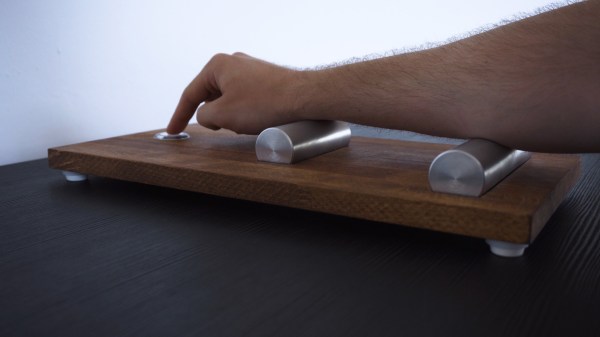
An HCI can be in an unexpected place, or leverage interactions not yet widely used like olfactory or galvanic responses.  A good example of this is the Medium Machine which is pictured above. It stimulates the muscles in your forearm, causing your finger to press the button. The application is up to you, and we really like it that Peter mentions that Medium Machine reaches for something that wouldn’t normally come to mind when you think about these interfaces; something that hasn’t been dreamed up yet. Get creative, get silly, have some fun, and show us how technology can be a copilot and not a dimwitted sidekick.

You have until August 27th to put your entry up on Hackaday.io. The top twenty entries will each get $1,000 and go on to the finals where cash prizes of $50,000, $20,000, $15,000, $10,000, and $5,000 await.