All The Badges Of DEF CON 26 (vol 4)

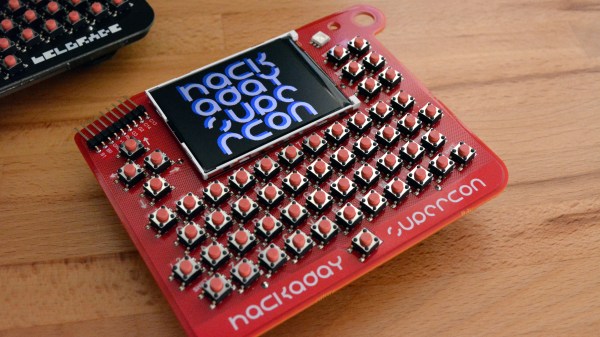
From a cockroach filled with LEDs, to an impressively dense 576 RGB LED display, and even a hunk of carpet, our final installment of the unofficial hardware badges at DEF CON 26 are beyond impressive. I tried to see every badge and speak to every badge maker this year. So far we’ve covered a ton of badges in volume 1, volume 2, and volume 3 of this series, and now it’s time to finish up!

If I didn’t get a chance to cover your badge in these articles, we still want to hear about it. What everyone wants is to dig into the details of these gorgeous examples of unique hardware. So post a project page for you badge on Hackaday.io, and make sure you get on the Conference Badges list that has been growing by leaps and bounds.

Continue reading “All The Badges Of DEF CON 26 (vol 4)”

Friday Hack Chat: Environmental Sensors

When it comes to IoT and robotics, the name of the game is sensors. These aren’t just IMUs and the stuff that makes robots move — we’re talking about environmental sensors here. Everything from sensors that measure temperature, air quality, humidity, chemical sensors, and radiation sensors are on the table here. For this week’s Hack Chat, we’re talking all about environmental sensors with a hardware designer who has put them to the test.

Our guest for this week’s Hack Chat is Radu Motisan. He was a finalist in the 2014 Hackaday Prize with the uRad Monitor, a self-contained radiation monitoring network that sends radiation measurements out to a central server, that can be viewed by the entire world. The goal of this project is to create a worldwide network of radiation monitoring devices, and we’re going to say Radu has succeeded. There are hundreds of these uRad Monitors in over forty countries, and all of them are churning out data about the radiation environment in their neck of the woods.

By training, Radu is a software engineer with a masters in science. In his spare time, Radu plays around with chemistry, physics, and electronics. It’s this background that led Radu to create one of the most amazing Hackaday Prize projects ever.

We’ll kick off with a discussion of Radu’s uRad Monitor, and that means we’ll be covering:

  • Radiation Detection, why is it important, and what does it mean?
  • How do you detect radiation?
  • The differences between Geiger-Mueller tubes and scintillators

You are, of course, encouraged to add your own questions to the discussion. You can do that by leaving a comment on the Environmental Sensor Hack Chat Event Page and we’ll put that in the queue for the Hack Chat discussion.join-hack-chat

Our Hack Chats are live community events on the Hackaday.io Hack Chat group messaging. This week is just like any other, and we’ll be gathering ’round our video terminals at noon, Pacific, on Friday, September 7th. Need a countdown timer? We should look into hosting these countdown timers on hackaday.io, actually.

Click that speech bubble to the right, and you’ll be taken directly to the Hack Chat group on Hackaday.io.

You don’t have to wait until Friday; join whenever you want and you can see what the community is talking about.

Printed It: Logitech C270 Conversion

One of the most practical applications for a home 3D printer is the ability to produce replacement parts; why wait a week for somebody to ship you a little plastic widget when you’ve got a machine that can manufacture a facsimile of it in a couple of hours? But what if your skills and passion for the smell of melting PLA push you even farther? You might move on from printing replacement parts to designing and building whole new devices and assemblies. Arguably this could be considered “peak” 3D printing: using a printer to create new devices which would otherwise be difficult or impractical for an individual to manufacture by more traditional means.

A perfect example is this fantastic total conversion for the Logitech C270 webcam designed by [Luc Eeckelaert]. Officially he calls it a “tripod”, and perhaps that’s how the design started, but the final product is clearly much more than that. It puts the normally monitor-mounted Logitech camera onto an articulated arm, greatly improving the device’s usability. The conversion even includes the ability to manually adjust the focus, a feature the original hardware doesn’t have. It turns the affordable and widely available Logitech C270 into an excellent camera to have on the workbench for documenting projects, or pointing at the bed of your 3D printer.

Continue reading “Printed It: Logitech C270 Conversion”

Superconference Submission Deadline Extended

Who among us doesn’t procrastinate from time to time? We can’t count the number of times that we’ve taken advantage of the Post Office staying open until midnight on April 15th. And when the 15th falls on a weekend? Two glorious additional days to put off the inevitable!

If you’ve been sitting on submitting your talk or workshop proposal to the 2018 Hackaday Superconference, we’ve got the next best thing for you: we’re extending the deadline until 5 pm PDT on September 10th.

The Hackaday Superconference is a singularity of hardware hackers: more of the best people in the same space at the same time than anywhere else. And that means that your ideas and experiences will be shared with the people most likely to appreciate them. From heroic hacks to creative robotics or untold hardware histories, if there’s a crowd who’ll appreciate how a serial console saved your bacon, it’s this one.

And if you give a talk or workshop, you get in free. But it’s more than that — there’s a different experience of a convention, even a tight-knit and friendly one like Hackaday’s Supercon, when you’re on the other side of the curtain. Come join us! We’d love to hear what you’ve got to say. And now you’ve got a little more time to tell us.

(If you want to get in the old-fashioned way, tickets are still available, but they won’t be once we announce the slate of speakers. You’ve been warned.)

Hackaday Links Column Banner

Hackaday Links: September 2, 2018

It’s (was, is?) the end of August, and that means the entire dreadlocked population of San Francisco is out in the middle of the Nevada Desert for a week. Yes, it’s Burning Man, and as always we have a host of builds that make you ask, ‘how did they do that, and how did they get that here’.

For the last few years, the greatest logistical feat of art cars is the 747. Yes, it’s the fuselage of a 747, turned into an art car. The top deck is a convertible. The biggest question surrounding this 747 is how do you transport this thing? You can’t fly it in (well, you could, once), it’s not going to fit on a train, and it’s extraordinarily long. Now we have an answer: they did it on a truck. The 747 was stationed in the Mojave, and from there it’s a relatively quick shot up Nevada to Black Rock City. Several power lines had to be raised, and you’re still looking at an enormous logistical endeavour.

I’m saying it now. Sphere, the 1998 movie with Dustin Hoffman. There’s a 25 meter diameter mirror ball that looks like the sphere in Sphere. It’s inflatable, so that takes care of the obvious questions, but we’re still asking how this thing looks in person, how massive wind storms are going to affect what is basically a gigantic sale sail, and what the reflections of the sun will actually do. I suppose being convex, you’re not going to get the accidental architectural parabolic mirror effect that melts cars, but one can always hope.

Want a neat story on the features of Burning Man that doesn’t get a lot of press? IEEE Spectrum did a feature on Black Rock City airport. For one week a year, it is the third busiest airport in Nevada, behind McCarren and Reno. It’s also a towered, yet uncontrolled airport. This makes no logical sense, but it’s something that can happen with FAA regs.

[alicestewwwart] has left us with a quandary. She’s creating highly artistic circuits out of ICs, discrete parts, and wire. These circuits are functional, but we don’t know what to call them. They’re not quite deadbug, because SMD parts don’t have legs, and ‘deadbug’ gets its name from upside down DIPs that looks like dead centipedes. It’s not Manhattan style, although this might be closer to Manhattan than deadbug. So what is it? Leave your answer in the comments.

Retrotechtacular: The Iron Giants That Built The Jet Age

In the closing months of World War II, the Axis and the Allies were throwing everything they had at each other. The tide was turning to the Allies’ favor, but the Germans were showing a surprising resilience, at least in terms of replacing downed fighter and bomber aircraft. When the Allies examined the wreckage of these planes, they discovered the disturbing truth: the planes contained large pieces forged from single billets of metal, which suggested a manufacturing capability none of the Allies possessed and which allowed the Germans to quickly and cheaply make better and faster planes.

When the war was over, the Allies went looking for the tools the Germans had used to make their planes, and found massive closed-die forging presses that could squeeze parts out of aluminum and magnesium alloys in a single step. The Soviets carted off a 30,000 ton machine, while the Americans went home with a shipload of smaller presses and the knowledge that the Russians had an edge over them. Thus began the Heavy Press Program, an ultimately successful attempt by the US military to close a huge gap in strategic manufacturing capabilities that [Machine Thinking] details in the excellent video below.

One doesn’t instantly equate monstrous machines such as the Mesta 50,000-ton press, over nine stories tall with half of it buried underground and attached directly to bedrock, with airplane manufacture. But without it and similar machines that came from the program, planes from the B-52 to the Boeing 747 would have been impossible to build. And this isn’t dead technology by any means; sold to Alcoa in 1982 after having been operated by them for decades, the “Fifty” recently got a $100 makeover after cracks appeared in some castings, and the press and its retro-brethren are still squeezing out parts for fighters as recent as the F-35.

Continue reading “Retrotechtacular: The Iron Giants That Built The Jet Age”

GSM Phone Network At EMF Camp Built On Raspberry Pi And LimeSDR

The Electromagnetic Field 2018 hacker camp in the UK will have its own GSM phone network, and as we have already covered its badge will be a fully-functional GSM phone. This is as far as we are aware a first in the world of badges, and though it may not be a first in hacker camp connectivity it is still no mean achievement at the base station side. To find out more we talked to two of the people behind the network, on the radio side Lime Microsystems‘ [Andrew Back], and on the network side Nexmo‘s developer advocate, [Sam Machin].

There are sixteen base stations spread around the site, of which each one is a Raspberry Pi 3 B+ with a LimeSDR Mini. Development of the system was undertaken prior to the release of the Raspberry Pi Foundation’s PoE board, so they take a separate 24V supply which powers the Pi through a DC-to-DC converter. This arrangement allows for a significant voltage drop should any long cable runs be required.

On the software side the base stations all run the Osmocom (Open Source Mobile Communications) cellular base station infrastructure package. It was a fine decision between the all-in-one Osmocom NITB package and the fully modular Osmocom, going for the former for its reliability. It was commented that this would not necessarily be the case at a future event but that it made sense in the present. It appears on the network as a SIP phone system, meaning that it can easily integrate with the existing DECT network. Let’s take a look at how the network operates from the user side, and the licencing loophole that makes everything possible.

Continue reading “GSM Phone Network At EMF Camp Built On Raspberry Pi And LimeSDR”