Carbon Monoxide: Hunting A Silent Killer

Walt and Molly Weber had just finished several long weeks of work. He was an FBI agent on an important case. She had a management job at Houghton Mifflin. On a sunny Friday evening in February of 1995, the two embarked on a much needed weekend skiing getaway. They drove five hours to the Sierra Mountains in California’s Mammoth Lakes ski area. This was a last-minute trip, so most of the nicer hotels were booked. The tired couple checked in at a lower cost motel at around 11:30pm on Friday night. They quickly settled in and went to bed, planning for an early start with a 7am wakeup call Saturday morning.

When the front desk called on Saturday, no one answered the phone. The desk manager figured they had gotten an early start and were already on the slopes. Sunday was the same. It wasn’t until a maid went to check on the room that the couple were found to be still in bed, unresponsive.

Continue reading “Carbon Monoxide: Hunting A Silent Killer”

Retrotechtacular: TV Troubleshooting

As technology advances, finding the culprit in a malfunctioning device has become somewhat more difficult. As an example, troubleshooting an AM radio is pretty straightforward. There are two basic strategies. First, you can inject a signal in until you can hear it. Then you work backwards to find the stage that is bad. The other way is to trace a signal using a signal tracer or an oscilloscope. When the signal is gone, you’ve found the bad stage. Of course, you still need to figure out what’s wrong with the stage, but that’s usually one or two transistors (or tubes) and a handful of components.

A common signal injector was often a square wave generator that would generate audio frequencies and radio frequency harmonics. It was common to inject at the volume control (easy to find) to determine if the problem was in the RF or audio sections first. If you heard a buzz, you worked backwards into the RF stages. No buzz indicated an audio section problem.

A signal tracer was nothing more than an audio amplifier with a diode demodulator. Starting at the volume control was still a good idea. If you heard radio stations through the signal tracer, the RF section was fine. Television knocked radio off of its pedestal as the primary form of information and entertainment in most households, and thus the TV repair industry was created.

Continue reading “Retrotechtacular: TV Troubleshooting”

The Dark Arts: Anonymity

Love him or hate him, Edward Snowden knew a thing or two about anonymity. In June of 2013, he blew the whistle on the NSA’s out-of-control programs that can target virtually anyone plugged into the digital age. The former CIA employee was working as a contractor for the NSA, where he had access to highly classified documents for many of these general populace surveillance programs. He eventually took off to Hong Kong and released the documents to a handful of reporters. One of these documents was a power point presentation of the NSA complaining about how the TAILS operating system was a major thorn in their side. Naturally, Snowden insisted that the reporters and himself only communicate via the TAILS O/S. He used PGP, which is an encryption method with the highly sophisticated title of “Pretty Good Privacy”, and asked not to be quoted at length for fear of identification via stylometry.

In this article, we’re going to go over the basics of anonymity, and introduce you to methods of staying anonymous while online.

Continue reading “The Dark Arts: Anonymity”

Curiously Delightful Things Done With Lasers And Projectors

Seb Lee-Delisle has built a career around large installations that use powerful lasers and high-end projects to make people happy. It’s a dream job that came to fruition through his multi-discipline skill set, his charismatic energy, and a mindset that drives him to see how he can push the boundaries of what is possible through live interaction.

His talk at the Hackaday | Belgrade conference is about his Laser Light Synth project, but we’re glad he also takes a detour into some of the other installations he’s built. The synth itself involves some very interesting iterative design to end up with a capacitive touch audio keyboard that is lit with addressable LEDs. It controls a laser that projects shapes and images to go along with the music, which sounds great no matter who is at the keyboard thanks to some very creative coding. As the talk unfolds we also hear about his PixelPyros which is essentially a crowd-controlled laser fireworks show.

See his talk below and join us after the break for a few extra details.

Continue reading “Curiously Delightful Things Done With Lasers And Projectors”

Hackaday Links: May Day, 2016

Humble Bundle is a great way to fill up your Steam library – just pay what you want, and get some indie video games. The Humble Bundle is much more than video games, because No Starch Press just put up a bundle of books on hacking. No, there are no books about wearing balaclavas and using laptops with one hand. I haven’t written that book yet. There’s some choice books in this bundle, including [Bunnie]’s Hacking the XboxAutomate the Boring Stuff with Python, and Practical Malware Analysis.

The Raspberry Pi camera – the $25 add-on webcam that plugs directly into the Pi – is getting an upgrade. The original camera was a five Megapixel sensor that was EOL’d at the end of 2014. The Raspberry Pi foundation bought up a lot of stock, but eventually there would be a replacement. The new sensor is a Sony IMX219 eight Megapixel deal, available at the same price. We assume a NoIR version without the IR filter will be released shortly.

Here’s a little hardware review that doesn’t quite merit a full post. The Raspberry Pi Zero is great, and will be even better once production ramps up again and stock lands in warehouses. One problem with the Zero is the lack of USB ports, leading to at least two Hackaday posts with the exact same headline, ‘Yet Another Pi Zero USB Hub‘. Obviously, there’s a market for an easy to use USB hub for the Zero, and this company is stepping up to fill the need. The killer feature here is the use of pogo pins to tap into the USB differential lines, power and ground pads on the bottom of the Pi Zero. The USB hub is based on the popular FE 1.1 4-port USB hub controller, giving the Pi Zero four USB 2.0 ports. Does it work? Yeah, and it’s only $10. A pretty neat little device that will be very useful when Pi Zeros flood workbenches the world over.

It was announced in 2014, released in 2015, but the STM32F7 hasn’t seen a lot of action around these parts. A shame, because this is the upgrade to the famously powerful STM32F4 microcontroller that’s already capable of driving high-resolution displays through VGA, being an engine control unit for a 96 Ford Aspire, and being a very complex brushless motor driver. The STM32F7 can do all of these and more, and now ST is cutting prices on the F7’s Discovery Board. If you’re looking for a high-power ARM micro and don’t need to run Linux, you won’t do better elsewhere.

Need to reflow a board, but don’t have a toaster oven? Use a blowtorch! By holding a MAPP blowtorch a foot away from a board, [whitequark] was able to successfully reflow a large buck converter. There’s a lot of water vapor that will condense on the board, so a good cleaning afterward is a good idea.

A few weeks ago, [Mr. LeMieux] built a 360 degree, all-metal hinge. He’s been up to something a little more dangerous since then: building piles of mini table saws. Small table saws are useful for miniatures, models, and the like. [Mr. LeMieux]’s table saw is a piece of CNC’d aluminum, with a bearing and saw arbor that attaches to an electric drill. Dangerous, you say? Not compared to the competition. Behold the worst forty dollars I’ve ever spent. This Horror Freight mini table saw is by far the worst tool I’ve ever used. The bed was caked with streaky layers of paint, uneven, the blade wasn’t set at 90 degrees, and the whole thing was horrifically underpowered. Trust me when I say the CNC electric drill version is safer.

Hacklet 105 – More Mind And Brain Hacks

A mind is a terrible thing to waste – but an awesome thing to hack. We last visited brain hacks back in July of 2015. Things happen fast on Hackaday.io. Miss a couple of days, and you’ll miss a bunch of great new projects, including some awesome new biotech hacks. This week, we’re checking out some of the best new mind and brain hacks on Hackaday.io

We start with [Daniel Felipe Valencia V] and Brainmotic. Brainmotic is [Daniel’s] entry in the 2016 Hackaday Prize. Smart homes and the Internet of Things are huge buzzwords these days. [Daniel’s] project aims to meld this technology with electroencephalogram (EEG). Your mind will be able to control your home. This would be great for anyone, but it’s especially important for the handicapped. Brainmotic’s interface is using the open hardware OpenBCI as the brain interface. [Daniel’s] software and hardware will create a bridge between this interface and the user’s home.


biofeed1Next we have [Angeliki Beyko] with Serial / Wireless Brainwave Biofeedback. EEG used to be very expensive to implement. Things have gotten cheap enough that we now have brain controlled toys on the market. [Angeliki] is hacking these toys into useful biofeedback tools. These tools can be used to visualize, and even control the user’s state of mind. [Angeliki’s] weapon of choice is the MindFlex series of toys. With the help of a PunchThrouch LightBlue Bean she was able to get the EEG headsets talking on Bluetooth. A bit of fancy software on the PC side allows the brainwave signals relieved by the MindFlex to be interpreted as simple graphs. [Angeliki] even went on to create a Mind-Controlled Robotic Xylophone based on this project.

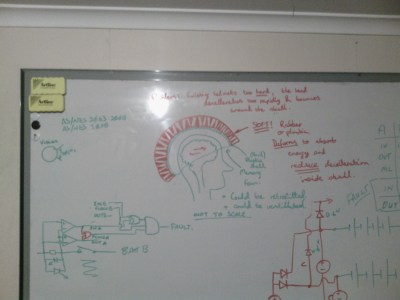
brainhelmetNext is [Stuart Longland] who hopes to protect brains with Improved Helmets. Traumatic Brain Injury (TBI) is in the spotlight of medical technology these days. As bad as it may be, TBI is just one of several types of head and neck injuries one may sustain when in a bicycle or motorcycle accident. Technology exists to reduce injury, and is included with some new helmets. Many of these technologies, such as MIPS, are patented. [Stuart] is working to create a more accurate model of the head within the helmet, and the brain within the skull. From this data he intends to create a license free protection system which can be used with new helmets as well as retrofitted to existing hardware.

mindwaveFinally we have [Tom Meehan], whose entry in the 2016 Hackaday Prize is Train Your Brain with Neurofeedback. [Tom] is hoping to improve quality of life for people suffering from Epilepsy, Autism, ADHD, and other conditions with the use of neurofeedback. Like [Angeliki ] up above, [Tom] is hacking hardware from NeuroSky. In this case it’s the MindWave headset. [Tom’s] current goal is to pull data from the TAGM1 board inside the MindWave. Once he obtains EEG data, a Java application running on the PC side will allow him to display users EEG information. This is a brand new project with updates coming quickly – so it’s definitely one to watch!

If you want more mind hacking goodness, check out our freshly updated brain hacking project list! Did I miss your project? Don’t be shy, just drop me a message on Hackaday.io. That’s it for this week’s Hacklet, As always, see you next week. Same hack time, same hack channel, bringing you the best of Hackaday.io!

Saving Lives With Open-Source Electrocardiography

A few months ago, MobilECG wowed us with a formidable electrocardiograph (ECG, also EKG) machine in the format of a business card, complete with an OLED display. We’ve seen business card hacks before, but that was the coolest. But that’s peanuts compared with the serious project that it supports: making an open-source ECG machine that can actually save lives by being affordable enough to be where it’s needed, when it’s needed.

The project, MobilECG, is an open-source, wearable device that supports all of the major ECG modes. In their talk, [Péter Isza] and [Róbert Csordás] taught us a lot about what that exactly entails and how the heart works. We learned a lot, and we’ll share some of that with you after the break.

Continue reading “Saving Lives With Open-Source Electrocardiography”