Exploring Basement Humidity With A Raspberry Pi

Sometimes a hack isn’t about building something cool. Sometimes it’s more tactical, where the right stuff is cobbled together to gather the information needed to make decisions, or just to document some interesting phenomenon.

Take this impromptu but thorough exploration of basement humidity undertaken by [Matthias Wandel]. Like most people with finished basements in their homes, [Matthias] finds the humidity objectionable enough to warrant removal. But he’s not one to just throw a dehumidifier down there and forget about it. Seeking data on how well the appliance works, [Matthias] wired a DHT22 temperature/humidity sensor to a spare Raspberry Pi to monitor room conditions, and plugged the dehumidifier into a Kill-A-Watt with a Pi camera trained on the display to capture data on electrical usage.

His results were interesting. The appliance does drop the room’s humidity while raising its temperature, a not unexpected result given the way dehumidifiers work. But there was a curious cyclical spike in humidity, corresponding to the appliance’s regular defrost cycle driving moisture back into the room. And when the dehumidifier was turned off, room humidity gradually increased, suggesting an unknown source of water. The likely culprit: moisture seeping up through the concrete slab, or at least it appeared so after a few more experiments. [Matthias] also compared three different dehumidifiers to find the best one. The video below has all the details.

We always appreciate [Matthias]’ meticulous approach to problems like these, and his field expedient instrumentation. He seems to like his creature comforts, too – remember the target-tracking space heater from a few months back?

Continue reading “Exploring Basement Humidity With A Raspberry Pi” →

Turn A Ceiling Fan Into A Wind Turbine… Almost

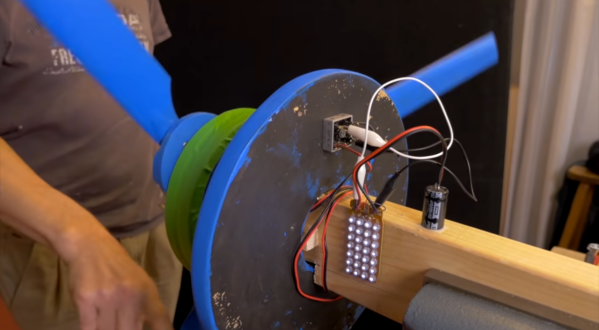
It’s not uncommon to drive around the neighborhood on trash day and see one or two ceiling fans haphazardly strewn onto a pile of garbage bags, ready to be carted off to the town dump. It’s a shame to see something like this go to waste, and [Giesbert Nijhuis] decided he would see what he could do with one. After some painstaking work, he was able to turn a ceiling fan into a wind turbine (of sorts).

While it’s true that some generators and motors can be used interchangeably by reversing the flow of electricity (motors can be used as generators and vice-versa) this isn’t true of ceiling fans. These motors are a type called induction motors which, as a cost saving measure, have no permanent magnets and therefore can’t simply be used as a generator. If you make some modifications to them, though, like rewiring some of the windings and adding permanent magnets around them, you can get around this downside of induction motors.

[Giesbert] does note that this project isn’t a great way to build a generator. Even after making all of the changes needed to get it working, the motor just isn’t as efficient as one that was built with its own set of magnets. For all the work that went into it, it’s not that great of a time investment for a low-quality generator. However, it’s interesting to see the theory behind something like this work at all, even if the end result wasn’t a complete wind turbine. Perhaps if you have an old ceiling fan lying around, you can put it to better use.

Continue reading “Turn A Ceiling Fan Into A Wind Turbine… Almost” →

Electronic Candle Charges Inductively

Humans like things that look like other things. A great example are faux LED tea light candles, with a plastic “flame” and flickering orange LED to recreate the effect of their waxy brethren. [gzumwalt] wanted to take the concept a little further, however, and got down to work.

The design harvests the orange LED and flame lens from an existing LED candle, but the rest is all original. [gzumwalt] printed a full-size candle, and fitted it with inductive charging hardware and a lithium-polymer battery. A corresponding charging base is used to supply power to the candle when it’s not in use. This is all handled automatically, with neodymium magnets used to activate reed switches to turn the charger on and the LED off.

It’s a tidy build that can be easily replicated with a 3D printer and some off-the-shelf parts. It’s also less wasteful than using disposable batteries, and safer than using real candles – so if you find yourself routinely shooting candle scenes in your budget film studio, it might be worth printing up a set of these.

LED candles range from the basic to the extreme – we’ve seen builds so realistic, you can light them with a match.

You’re Sitting On An Engineering Masterpiece: Chairs As A Design Challenge

If you move as a hardware hacker through the sometimes surprisingly similar world of artists, craftspeople, designers, blacksmiths, and even architects, there’s one piece of work that you will see time and time again as an object that exerts a curious fascination. It seems that designing and building a chair is a rite of passage, and not just a simple chair, but in many cases an interesting chair.

An American-made Windsor chair from the turn of the 19th century. Los Angeles County Museum of Art [Public domain]
Some of the most iconic seating designs that you will be instantly familiar with through countless mass-produced imitations began their lives as one-off design exercises. Yet we rarely see them in our community of hackers and makers, a search turns up only a couple of examples. This is surprising, not least because there is more than meets the eye to this particular piece of furniture. Your simple seat can be a surprisingly complex challenge.

Moving Charis From Artisan to Mass Market

The new materials and mass production techniques of the 19th and 20th centuries have brought high-end design into the hands of the masses, but while wealthy homes in earlier centuries had high-quality bespoke furniture in the style of the day, the traditional furniture of the masses was hand-made in the same way for centuries often to a particular style dependent on the region in which it was produced.

Continue reading “You’re Sitting On An Engineering Masterpiece: Chairs As A Design Challenge” →

Let A Spooky Owl Tell You The Weather

There can be few readers who were young in the 1970s who did not want to share in the adventures of the fearless animated ghost-hunting young crime-fighters of Scooby-Doo. What do you remember from the series though? The Mystery Machine van? Scooby snacks? Or perhaps the improbably haunted theme parks whose owners would have got away with it if it hadn’t been for those pesky kids? For [Alex Shakespeare] it seems to have been the trope of haunted pictures whose subject’s eyes would follow the protagonists around the room, because when he made a wall-mounted weather indicator he gave it an owl with eyes doing just that.

The weather part of the device is straightforward enough, an ESP8266 board drives a set of servos that move dial indicators according to data from the Dark Sky API. The owl’s moving googly eyes are the party piece though, for them the ESP takes input from an Adafruit AMG8833 thermal sensor array and drives a servo and lever arrangement to do the moving. Finally, the thermal camera’s output is available to see on the ESP’s web server. All the details of the project can be found via a GitHub repository.

The result is shown in the video below the break, and as you might expect in the spirit of its inspiration it’s more comedic than haunting. But maybe there’s the root of the popularity of artworks that follow the viewer, of which this is merely the latest in a long line.

Continue reading “Let A Spooky Owl Tell You The Weather” →

HestiaPi: A Stylish Open Hardware Thermostat

A common complaint about open hardware and software is that the aesthetic aspects of the projects often leave something to be desired. This isn’t wholly surprising, as the type of hackers who are building these things tend to be more concerned with how well they work than what they look like. But there’s certainly nothing wrong with putting a little polish on a well designed system, especially if you want “normal” people to get excited about it.

For a perfect example, look no further than the HestiaPi Touch. This entry into the 2019 Hackaday Prize promises to deliver all the home automation advantages of something like Google’s Nest “smart” thermostat without running the risk of your data being sold to the highest bidder. But even if we take our tinfoil hat out of the equation, it’s a very slick piece of hardware from a functional and visual standpoint.

As you probably guessed from the name, the thermostat is powered by the Raspberry Pi Zero, which is connected to a custom PCB that includes a couple of relays and a connector for a BME280 environmental sensor. The clever design of the 3D printed case means that the 3.5 inch touch screen LCD on the front can connect directly to the Pi’s GPIO header when everything is buttoned up.

Of course, the hardware is only half the equation. To get the HestiaPi Touch talking to all the other smart gadgets in your life, it leverages the wildly popular OpenHAB platform. As demonstrated in the video after the break, this allows you to use the HestiaPi and its mobile companion application to not only control your home’s heating and air conditioning systems, but pretty much anything else you can think of.

The HestiaPi Touch has already blown past its funding goal on Crowd Supply, and the team is hard at work refining the hardware and software elements of the product; including looking at ways to utilize the unique honeycomb shape of the 3D printed enclosure to link it to other add-on modules.

Continue reading “HestiaPi: A Stylish Open Hardware Thermostat” →

Smarten Up Your Air Conditioning With The ESP8266

If you’re looking for “smart” home appliances, there’s no shortage of options on the market. Even relatively low-end gadgets are jumping on the Internet of Things bandwagon these days (for better or for worse). But what if you’re not looking to purchase a brand new major appliance right now? In that case, you might be interested in seeing how [Giulio Pons] added some high-tech features to his existing air conditioner on the cheap.

Since his AC unit had an infrared remote control, the first thing [Giulio] needed to do was come up with a way to emulate it. An easy enough project using the ESP8266 and an IR LED, especially when he found that somebody had already written a IR communications library for his particular brand of AC. From there, he could start tacking on sensors and functionality.

With the addition of a DHT11 sensor, [Giulio] can have the AC turn on and off based on the current room temperature. It also gives him an easy way to verify the AC is actually on and operating. By checking to see if the room starts cooling off after sending the IR command to start the AC, his software can determine whether it should try resending the code, or maybe send a notification to alert him that something doesn’t seem right. Of course, it wouldn’t be a proper ESP8266 project without some Internet connectivity, so he’s also created a smartphone application that lets him control the system while away from home.

Now admittedly nothing in this project is exactly new, we’ve seen plenty of hackers switch on their AC with the ESP8266 at this point. But what we particularly liked was how well thought out and documented the whole process was. The rationale behind each decision is explained, and he even documented things like his network topology to help illustrate how the whole system comes together. Even if the techniques are well known by many of us, this is the kind of project documentation that makes it accessible to newcomers. Our hats off to [Giulio] for going the extra mile.

In the past we’ve seen a similar project that allowed you to control your AC from Slack, and our very own [Maya Posch] took us on a whirlwind tour of the very impressive ESP8266-powered environmental monitoring system she helped develop.