Literary Camouflage For Your Router

What is suspicious about the books in the image above? Is it that there is no bookend? How about the radio waves pouring out of them? [Clay Weiland] does not like the way a bare router looks in the living room, but he appreciates the coverage gained by putting it in the middle of his house. He added a layer of home decorating camouflage in the form of some second-hand book covers to hide the unsightly bit of tech.

There isn’t a blog post or video about this particular build anywhere. The photos were submitted to our tip line as-is with the note that a table-saw is involved. We can safely infer that book covers are stripped of their pages and filled with wooden blanks painted white and stuck together to look like a cluster of literature. The takeaway from this example is that our tech does not have to be hidden away like a secret, or disrupt the decor, it can be placed as functionally as possible without sacrificing Feng Shui.

If hiding behind books piques your interest, try a full-fledged version, or this smooth operator.

Thank you, [George Graves], for encouraging people to use our tip line.

Never Go To The Office Breakroom Again

If you’re tired of having to make small talk with random people in the office break room every time you need a cup of coffee, or simply don’t have the time to get up to pour yourself some more, it would be nice if there was a way you could have your cup filled for you, right at your desk. With this new drink dispenser, you won’t have to get up or even pour your drinks yourself!

We’ve certainly seen plenty of automatic drink makers, but those are more suited to parties and complicated drink mixing. This beverage dispenser is more for the person who knows their tastes and simply wants to save some time. It’s also much simpler, using a peristaltic pump for serving a single liquid from a large bottle into a glass, and using a load cell to know when to stop filling. The peristaltic pump is a little slow though, so it’s best to set the glass back in the dispenser and let it top you off each time.

We’re a big fan of time savers around here, especially when it comes to improving workflow. Of course, the best time saver is a clean, well-organized shop which will help you out whether you’re building a drink dispenser or anything else.

Continue reading “Never Go To The Office Breakroom Again”

A Tinfoil-Free Internet Of Ceiling Fans

Putting everything on the Internet is getting easier and easier, what with the profusion of Internet-ready appliances as well as cheap and plentiful IoT modules to integrate legacy devices. Think IoT light bulbs, refrigerators and dishwashers that can be controlled from a smartphone, and the ubiquitous Sonoff modules. But once these things are on the net, what are they talking about? Are they saying things behind your back? Are they shipping data about your fridge contents off to some foreign land, to be monetized against your will?

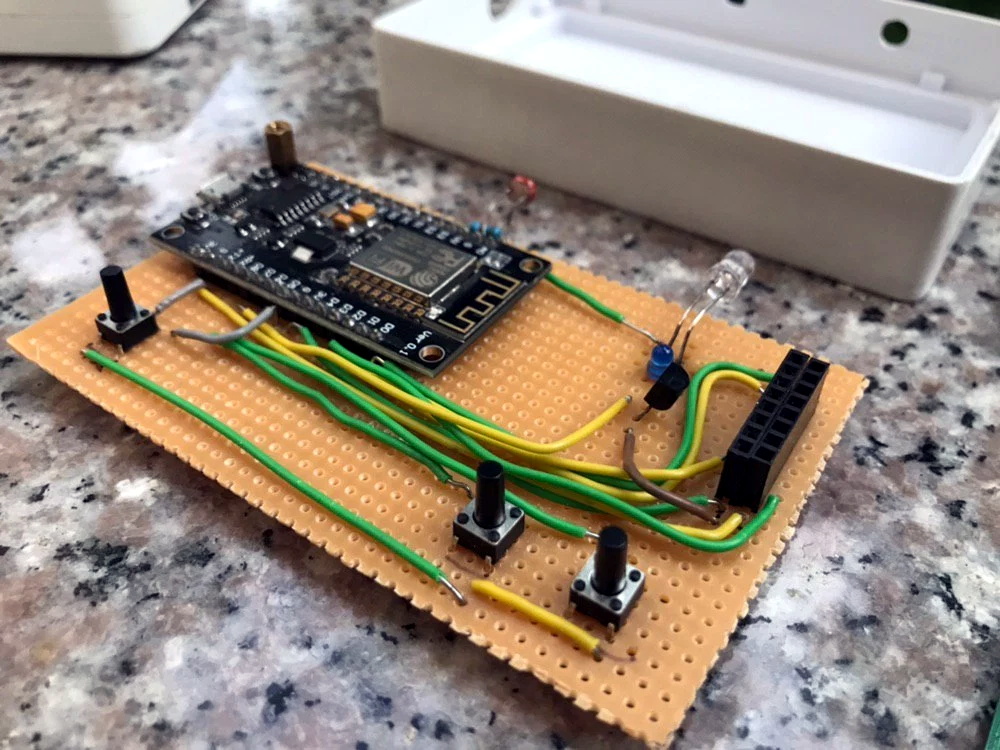
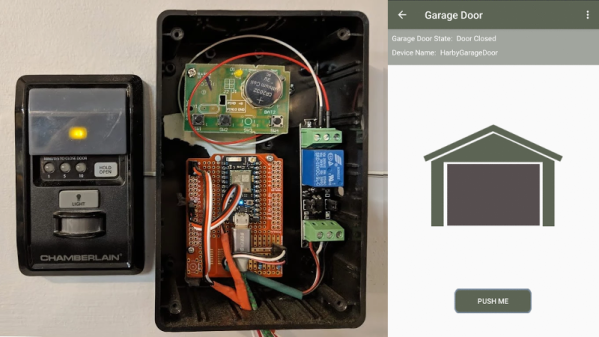
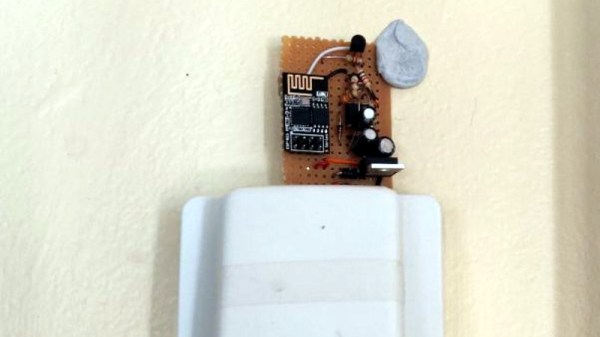
Maybe, maybe not, but short of a tinfoil helmet the only way to protect yourself is to build your own system. This IoT control for ceiling fans is a good example, with the added benefit that most wireless ceiling fan remotes are kind of lousy. [microentropie] didn’t like the idea of going the Sonoff route, so his custom controller is based on that IoT workhorse, the ESP8266. There are two versions, one switching the light and fan loads with relays, and one with triacs. The ESP serves up its own web page for control rather than using a cloud service, and is capable of setting up the fan to turn on and off automatically at preset times or temperatures. Everything sits in an unobtrusive box on the ceiling near the fan, but we bet this could be miniaturized enough to fit right inside the fan housing.

If some of [microentropie]’s code looks familiar, it might be because he borrowed it from his IoT rice cooker project.

Smart Plugs Don’t Save You Energy, But Don’t Consume Much Either

Amazon Alexa, Google Home, and just about every electronic device manufacturer are jumping on the bandwagon of connected devices. They promise us the ability to turn on our toaster from another room, unlock our doors just by shouting at them from outside, and change the channel on our TV through perfectly enunciating a sentence instead of mashing the buttons on our remotes like chumps. And yet, despite all this new-fangled finger-less control, there is an unanswered question: does this technology save us energy in the long run?

For years we’ve been hearing about vampire power and all the devices in our home that sit in standby, waiting for their masters to turn them on, quietly burning power to listen for that signal to wake. Fortunately the One Watt Initiative and general awareness and design for energy savings has cut out a lot of this phantom load. So how does the smart home, which essentially adds a bunch of connected vampires to our base load, end up saving money in the long run? And is it better than other alternatives or just good habits? I put these questions to the test with today’s smart power strips and controllable outlets.

Continue reading “Smart Plugs Don’t Save You Energy, But Don’t Consume Much Either”

Their Battery Is Full Of Air

Storing electrical energy is a huge problem. A lot of gear we use every day use some form of battery and despite a few false starts at fuel cells, that isn’t likely to change any time soon. However, batteries or other forms of storage are important in many alternate energy schemes. Solar cells don’t produce when it is dark. Windmills only produce when the wind blows. So you need a way to store excess energy to use for the periods when you aren’t creating electricity. [Kris De Decker] has an interesting proposal: store energy using compressed air.

Compressed air storage is not a new idea. On a large scale, there have been examples of air compressed in underground caverns and then released to run a turbine at a future date. However, the efficiency of this is poor — around 40 to 50 percent — mainly because the air heats up during compression and often needs to be prewarmed (using energy from another source) prior to decompression to prevent freezing. By comparison, batteries can be 70 to 90 percent efficient, although they have their own problems, too.

The idea explored in this paper is not to try to store a power plant’s worth of energy in a giant underground cavern, but rather use smaller compressed air setups like you would use batteries to store power at the point of consumption. The technology is called micro-CAES (an acronym for compressed air energy storage).

Continue reading “Their Battery Is Full Of Air”

MoAgriS: A Modular Agriculture System

Hackaday.io user [Prof. Fartsparkle] aims to impress us again with MoAgriS, a stripped-down rig for bringing crops indoors and providing them with all they need.

This project is an evolution of their submission to last year’s Hackaday Prize, MoRaLiS — a modular lighting system on rails — integrating modules for light, water, airflow, fertilizer and their appropriate sensors. With an emphasis on low-cost, a trio of metal bars serve as the structure, power and data transmission medium with SAM D11 chips shepherding each plant.

Reinforced, angled PCBs extend rails horizontally allowing the modules to be mounted at separate heights. Light module? Up top. Water sensor? Low on the rails above the pot’s rim. You get the idea. 3D printed clamps attach the rails to the plant’s pot with a touch of paint to keep it from sticking out like a sore thumb among the leaves.

Airflow modules replicate wind currents — the lack of which results in thin, fragile stems — and light modules include a soft white LED to accompany and mitigate the full-spectrum LEDs’ pink neon-like glow. To manage watering the plants, [Prof. Fartsparkle] initially wanted to use one pump to distribute water to every plant, but found some smaller pumps at a low enough price-point to make one per plant viable — and simpler to integrate as a module as well!

If you prefer your gardening to take place outdoors, consider a robot assistant to tackle your weeding.

Battery-Powered Watering Timer Converted To Solar On The Cheap

Watering the garden or the lawn is one of those springtime chores that is way more appealing early in the season than later. As the growing season grinds along, a chore that seemed life-giving and satisfying becomes, well, just another chore, and plants often suffer for it.

Automating the watering task can be as simple as buying a little electronic timer valve that turns on the flow at the appointed times. [A1ronzo] converted his water hose timer to solar power. Most such timers are very similar, with a solenoid-operated pilot valve in line with the water supply and an electronic timer of some sort. The whole thing is quite capable of running on a pair of AA batteries, but rather than wasting money on new batteries several times a season, he slipped a LiPo pack and a charge controller into the battery case slot and connected a small solar panel to the top of the controller.

The LiPo is a nominal 3.7-volt pack, so he did a little testing to make sure the timer would be OK with the higher voltage. The solar panel sits on top of the case, and the whole thing should last for years. And bonus points for never having to replace a timer that you put away at the end of the season with batteries still in it, only to have them leak. Ask us how we know.

Like the best of hacks, this one is quick, easy and cheap — $15 in parts, aside from the timer. There are more complicated irrigation solutions, of course, one of which even won the Hackaday Prize once upon a time. But this one has us ordering parts to build our own right now.