Giving A 6th Generation IPod A New Lease On Life

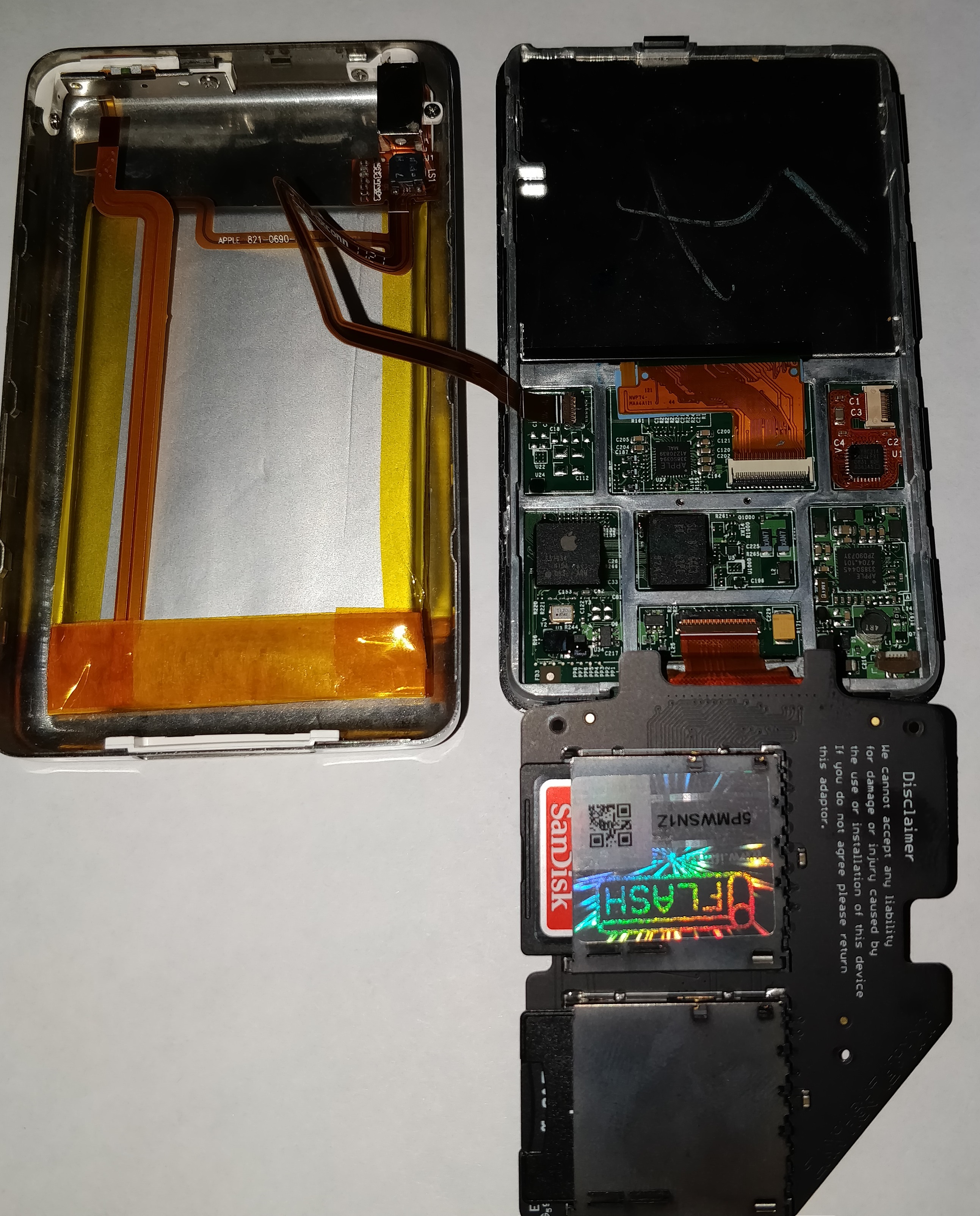
It can be disheartening when a favoured device begins to break-down. Afflicted by an all-but-dead battery and a fritzing-out hard drive, Redditor [cswimc] sensed the imminent doom creeping up on their 6th generation iPod, and responded by reviving and upgrading the decrepit device instead!

It’s no easy task to crack open one of these things, so they found themselves taking their time and carefully wedging the pry tool between the front and back covers, working their way around the exterior. Once separated, gingerly disconnecting the few ribbon cables allowed the iPod to be opened fully. From there, they turned to  swapping out the original hard drive for an iFlash dual SD card board — one of the cards turned out to be a dud, but 128GB is still a step up from 80GB — and a new 3000mAh battery. Combined with replacing the power-hungry HDD, the battery life has been overwhelmingly increased over the original’s 650mAh capacity!

Continue reading “Giving A 6th Generation IPod A New Lease On Life”

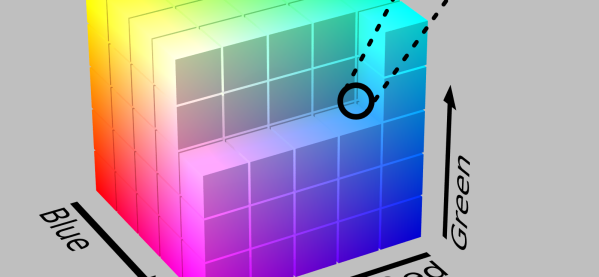
Color Spaces: The Model At The End Of The Rainbow

When I learned about colors in grade school everything started with red, yellow, and blue and getting fancier colors was easy. I mixed some blue into my yellow to get green, or into red to get purple, and so on. After painting enough terrifying “art” for my parents, this made intuitive sense. That is until my mind was blown by the revelation that this wasn’t always true! 

To make the same colors with light instead of paint I had to use red, green, and blue, not yellow. It was until much later when trying harness banks of RGB LEDs that this knowledge became useful. I was struggling to make my rogue diodes look quite the way I wanted when I stumbled into the realization that maybe there was another approach. What did the numbers representing R G and B actually mean? Why those parameters? Could there be others? [Elliot Williams] has written about the importance of gamma correction and adjustment for human perception of color, but we can ask a more fundamental question. Why do we represent color this way at all?

Continue reading “Color Spaces: The Model At The End Of The Rainbow”

Cutting Paper And Corners In Animation

Cutting every corner can lead to some shoddy projects, but [Terry Gilliam] shows us that cutting the right corners yields unforgettable animations when mixed with the right amount of quirky imagination. The signature animation style of Monty Python’s Flying Circus is a mixture of [Terry]’s artistic craft and doing it with as little work as possible. You can watch after the break.

For [Terry], cutout animation is the quickest and easiest way he knows to convey an idea, a joke, or a story. With his vocal repertoire, even the sound effects can be produced in a basement studio. Sometimes, he makes the artwork himself and sometimes he relies on found-media in magazines or print. Both of these resources have vast digital counterparts for the betterment or detriment of animators.

Cutout animations have limitations such as jerky movement and the signature paper-on-a-background look, but that didn’t stop South Park. Textures and gradients can be used, unlike traditional animation which leverages a simplified color palette so you can pick your poison.

If your story or idea is held back because it can’t be expressed, maybe it needs a cutout animation kick in the right direction, and it couldn’t hurt to illustrate your 2018 Hackaday Prize submissions. At the opposite end of the tech spectrum, we have an animation made with 3D printed objects.

Continue reading “Cutting Paper And Corners In Animation”

Storm Detector Modules: Dancing In The Rain

Earlier, we had covered setting up an AS3935 lightning detector module. This detector picks up radio emissions, then analyzes them to determine if they are a lightning strike or some other radio source. After collecting some data, it outputs the estimated distance to the incoming storm front.

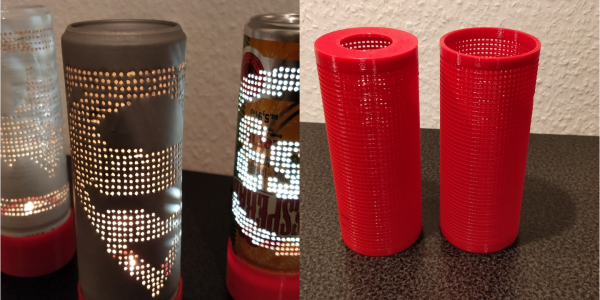
But that only gets you halfway there. The device detects many non-lightning events, and the bare circuit board is lacking in pizzazz. Today I fix that by digging into the detector’s datasheet, and taking a quick trip to the dollar store buy a suitable housing. The result? A plastic plant that dances when it’s going to rain!
Continue reading “Storm Detector Modules: Dancing In The Rain”

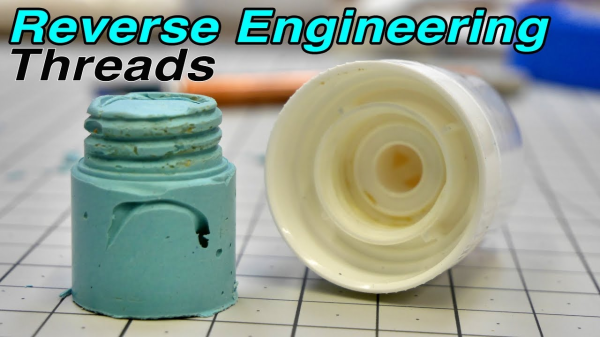
How To Reverse Engineer Mechanical Designs For 3D Modeling

If you’re interested in 3D printing or CNC milling — or really any kind of fabrication — then duplicating or interfacing with an existing part is probably on your to-do list. The ability to print replacement parts when something breaks is often one of the top selling points of 3D printing. Want some proof? Just take a look at what people made for our Repairs You Can Print contest.

Of course, to do that you need to be able to make an accurate 3D model of the replacement part. That’s fairly straightforward if the part has simple geometry made up of a primitive solid or two. But, what about the more complicated parts you’re likely to come across?

In this article, I’m going to teach you how to reverse engineer and model those parts. Years ago, I worked for a medical device company where the business model was to duplicate out-of-patent medical products. That meant that my entire job was reverse engineering complex precision-made devices as accurately as possible. The goal was to reproduce products that were indistinguishable from the original, and because they were used for things like trauma reconstruction, it was critical that I got it right.

Continue reading “How To Reverse Engineer Mechanical Designs For 3D Modeling”

DIY Perpetual Flip Calendar

Flip calendars are a neat little piece of history. Sold as tourist trinkets, they sit on your desk and show the current day of the month and, depending on the particular calendar, month and year. Each day, you rotate it and it shows you the current date. At the end of February, you rotate it a bunch of times to get from February 28th (or 29th) to March 1st. [measuredworkshop] always had fun flipping the dates on his parents’ flip calendar, so decided to build his own wooden one.

The calendars consist of a series of tiles with the dates on them inside an enclosure. Rotating the enclosure allows a new tile to slide down in front of the old one. Once you know how many tiles you are going to use, you put a different date on the back side of each tile. In [measuredworkshop]’s case, there were 15 tiles to hold 30 dates (he created one with 30/31 on it for the end of the month) so the 1 has a 16 on the back, the 2 a 17, and so on. Tiles of different colored wood were cut and sanded and then the numbers drawn on by hand.

The enclosure was cut using a Morso Guillotine, a machine which uses sharp blades to do precise mitre cuts in wood. One side of the enclosure was covered by wood, the other by clear acrylic, so that you can see how the mechanism works as it is rotated. Finally, a stand was cut from wood as well and the final product assembled.

As you can see in the video below this is a great showpiece, and because of the design gives a view into how flip-calendars work. At the end of his write-up, [measuredworkshop] shares a link he found to a 3d printed flip-calendar on Thingiverse. Check out some of the more techie calendars posted at Hackaday, like this e-ink calendar, or this Raspberry Pi wall calendar.

Continue reading “DIY Perpetual Flip Calendar”

An Introduction To Storm Detector Modules

Lightning storm detectors have been around for a surprisingly long time. The early designs consisted of a pair of metal bells and a pendulum. When there was a charge applied, for example by connecting one bell to the ground and the other to a lightning rod, the bells would ring when a lightning storm was close by. In the mid 18th century, these devices were only practical for demonstration and research purposes, but very likely represent the earliest devices that convert electrostatic charge to mechanical force. A bit over a hundred years later, the first lightning detector was considered by some as the first radio receiver as well.

As soon as I found out about storm detector chips, I knew I would have to get one working. For about $25, I ordered an AMS AS3935 module from China. This chip has been featured before in a number of excellent projects such as Twittering lightning detectors, and networks of Sub-Saharan weather stations. While there’s an Arduino library for interfacing with this IC, I’m going to be connecting it up to an ESP8266 running the NodeMCU firware, which means digging into the datasheet and writing some SPI code. If any of the above tickles your fancy, read on! Continue reading “An Introduction To Storm Detector Modules”