Practical Deep Learning

Deep Learning — the use of neural networks with modern techniques to tackle problems ranging from computer vision to speech recognition and synthesis — is certainly a current buzzword. However, at the core is a set of powerful methods for organizing self-learning systems. Multi-layer neural networks aren’t new, but there is a resurgence of interest primarily due to the availability of massively parallel computation platforms disguised as video cards.

The problem is getting started in something like this. There are plenty of scholarly papers that can be hard to wade through. Or you can grab some code from GitHub and try to puzzle it out.

A better idea would be to take a free class entitled: Practical Deep Learning for Coders, Part 1. The course is free unless you count your investment in time. They warn you to expect to commit about ten hours a week for seven weeks to complete the course. You can see the first installment in the video, below. Continue reading “Practical Deep Learning”

Extra Curricular Tour Of NASA’s Jet Propulsion Laboratory

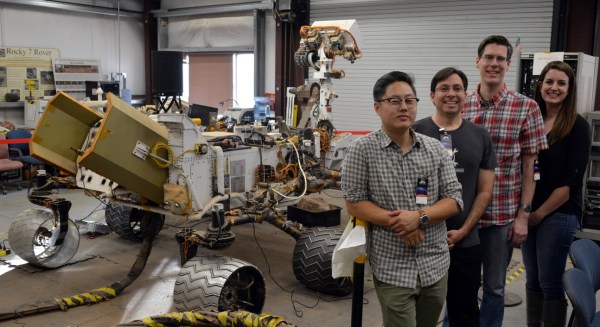
Last week, Hackaday had the chance to tour NASA’s Jet Propulsion Laboratory (JPL) in Pasadena, California. Tours are given all the time at JPL, but ours was special. Steve Collins invited us, and acted as our tour guide, and a new friendship with Michelle Easter got us a look inside the labs where equipment for the 2020 Mars mission is being built.

Continue reading “Extra Curricular Tour Of NASA’s Jet Propulsion Laboratory”

Tape-Head Robot Listens To The Floor

We were just starting to wonder exactly what we’re going to do with our old collection of cassette tapes, and then along comes art robotics to the rescue!

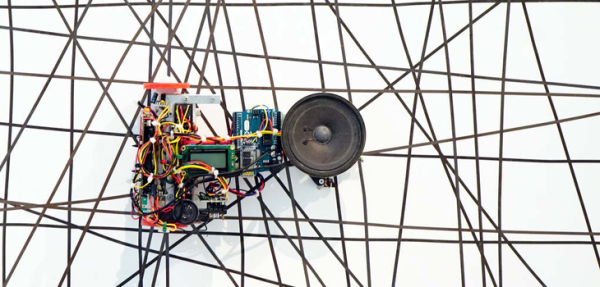
Russian tech artist [::vtol::] came up with another unique device to make us smile. This time, it’s a small remote-controlled, two-wheeled robot. It could almost be a line follower, but instead of detecting the cassette tapes that criss-cross over the floor, it plays whatever it passes by, using two spring-mounted tape heads. Check it out in action in the video below.

Some of the tapes are audiobooks by sci-fi author [Stanislaw Lem] (whom we recommend!), while others are just found tapes. Want to find out what’s on them? Just drive.

Continue reading “Tape-Head Robot Listens To The Floor”

Flexible, Sensitive Sensors From Silly Putty And Graphene

Everyone’s favorite viscoelastic non-Newtonian fluid has a new use, besides bouncing, stretching, and getting caught in your kid’s hair. Yes, it’s Silly Putty, and when mixed with graphene it turns out to make a dandy force sensor.

To be clear, [Jonathan Coleman] and his colleagues at Trinity College in Dublin aren’t buying the familiar plastic eggs from the local toy store for their experiments. They’re making they’re own silicone polymers, but their methods (listed in this paywalled article from the journal Science) are actually easy to replicate. They just mix silicone oil, or polydimethylsiloxane (PDMS), with boric acid, and apply a little heat. The boron compound cross-links the PDMS and makes a substance very similar to the bouncy putty. The lab also synthesizes its own graphene by sonicating graphite in a solvent and isolating the graphene with centrifugation and filtration; that might be a little hard for the home gamer to accomplish, but we’ve covered a DIY synthesis before, so it should be possible.

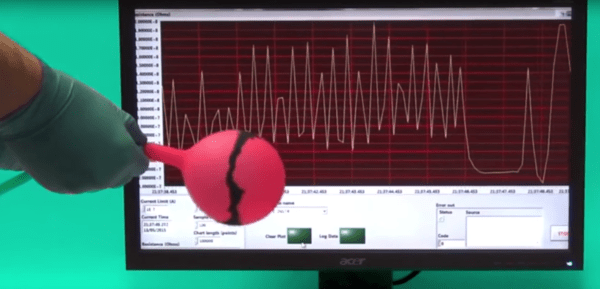
With the raw materials in hand, it’s a simple matter of mixing and kneading, and you’ve got a flexible, stretchable sensor. [Coleman] et al report using sensors fashioned from the mixture to detect the pulse in the carotid artery and even watch the footsteps of a spider. It looks like fun stuff to play with, and we can see tons of applications for flexible, inert strain sensors like these.

Continue reading “Flexible, Sensitive Sensors From Silly Putty And Graphene”

The Engines Of Ingenuity

Every once in a while, we stumble on an amazing resource that’s not exactly new, but it’s new to us. This is the case, in spades, with The Engines of Our Ingenuity, a radio show that’s been running since 1988!

Each episode covers an invention or engineering marvel, and tells the story of how it came to be, and puts each device into its historical and cultural context. Want to get the lowdown on how we safely bring fire into the kitchen? Or the largest land transport vehicle, NASA’s crawler? And what’s up with lobsters anyway?

Continue reading “The Engines Of Ingenuity”

Cheap Chainsaw Teardown Reveals Buried Treasures

People seem to have a love-hate relationship with Harbor Freight, and it mostly seems that they love to hate the purveyor of discount tools. This is not without cause — any number of HF tools have fallen apart in our hands. But there are some gems to be found amid the dregs and dross of your local branch of the 700-store US chain, as long as you match the tool to your needs and manage your expectations.

Now, we’d normally shy away from any electric chainsaw, especially a cordless saw, and doubly so a Harbor Freight special. But as [Professor Charles] demonstrates with his detailed and humorous teardown, the Lynxx 40-volt cordless 14″ chainsaw might be worth picking up just for harvesting parts. First there’s the battery pack, which is chock full of 18650 lithium cells. [Professor Charles] leads us on a detailed tour of the design compromises of the battery and charger and is none too impressed with either, but he clearly understands what it means to build to a price point. While [Charles] found the stock motor controller somewhat anemic, the real buried treasure in the tool is a huge brushless motor, powerful enough to “throw an 8-inch Vise Grip at you” during a (not so) locked rotor test.

The whole teardown is enlightening as to the engineering decisions that go into mass-market tools, so even if you can’t think of something to do with this motor, the article is worth a read. At $169 for the Lynxx (before the 20% coupon in your Sunday paper every week) it’s a little pricey to buy just to harvest parts, but it wouldn’t be the first HF tool to suffer that fate. We’ll bet these things will start showing up broken on the secondary market for a song, and if the [Professor]’s assessments are right, it likely won’t be the motors that fail.

Massive 20-oz. Copper PCB Enables Electric Racing

Is twenty times the copper twenty times as much fun to work with? Ask [limpkin] and follow along as he fabricates a DC/DC block for a Formula E race car on 20-oz copper PCBs.

The typical boards you order from OSH Park and the like usually come with 1-ounce copper – that’s one ounce of copper cladding per square foot of board. For those averse to Imperial units, that’s a copper layer 34 micrometers thick. [limpkin]’s Formula E control board needs to carry a lot of current, so he specified 700-micrometer thick cladding, or 20-oz per square foot. The board pictured cost $2250, so you’d figure soldering on the components would be an exotic process, but aside from preheating the board, [limpkin] took it in stride. Check out the image gallery of the session and you’ll see nothing but a couple of regular high-wattage soldering irons, with dirty tips to boot.

It’s pretty neat comparing what’s needed for power electronics versus the normal small signal stuff we usually see. We’d recommend looking at [Brian Benchoff]’s “Creating a PCB in Everything” series for design tips, but we’re not sure traditional tools will work for boards like these. And just for fun, check out the Formula E highlights video below the break to see what this build is part of.

Continue reading “Massive 20-oz. Copper PCB Enables Electric Racing”