Removing A Broken Tap From Something Really Really Expensive

What happens when you break a tap or a bolt in a component whose price tag sits in the tens of thousands. Just drilling it out and throwing in a nut insert stops being acceptable. Is there a way to remove the tap without damaging the master part at all?

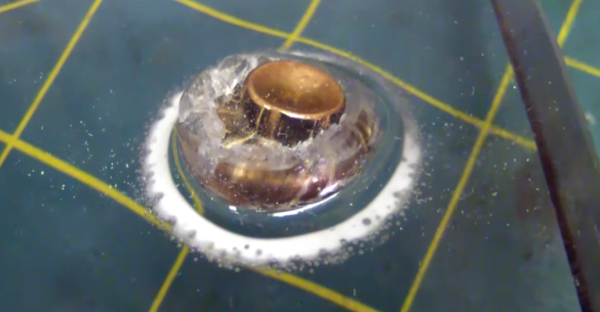
Broken tap stuck in the hole it was threading

Well, that’s where [Tom Grafton] of Jerry’s Broken Drill and Tap comes in. He’s here to remove taps and chew bubblegum, and he’s definitely chewing bubble gum loudly the whole time. His primary work horse is a Metal Disintegration Machine.

A MDM is basically half of a typical wire EDM set-up. In EDM you used an electrode to punch a hole through the material. Then you thread a wire through the hole, thread it through a sometimes startling array of pulleys, and get going.

[Tom] used the MDM with an appropriately sized electrode to precisely disintegrate the middle of the tap out. After that it’s some careful work with a specially machined magnetic chisel. A quick chase of the threads with a tap and it’s back to the customer.

As you can see in the video after the break, the end result is a threaded hole that’s so indistinguishable from the rest he has to mark which one it was; presumably so the customer doesn’t forget why they’re paying him.

Continue reading “Removing A Broken Tap From Something Really Really Expensive”

The Politest Patent Discussion, OSHW V. Patents

We’ve covered [Vijay] refreshable braille display before. Reader, [zakqwy] pointed us to an interesting event that occured in the discussion of its Hackaday.io project page.

[Vijay] was inspired by the work of [Paul D’souza], who he met at Makerfaire Bangalore. [Paul] came up with a way to make a refreshable braille display using small pager motors. [Vijay] saw the light, and also felt that he could make the vibrating motor display in such a way that anyone could make it for themselves at a low cost.

Of course, [Paul], had patented his work, and in this case rightly so. As jaded as we have become with insane patent trolls, our expectation on receiving the tip was that [Paul] had sued [Vijay] out of house and home and kicked his dog while he was at it. A short google search shows that [Paul] is no patent troll, and is a leader in his field. He has done a lot to help the visually impaired with his research and inventions.

Instead we were greeted by a completely different conversation. [Paul] politely mentioned that his lawyer informed him that in order to protect his IP he needed to let [Vijay] know exactly how the information could be used. No cease and desist, in fact he encouraged [Vijay] to continue his open research as long as he made it clear that the methods described could not be used to make a marketable product without infringing on [Paul]’s patents. They’d need to get in touch with [Paul] and work something out before doing such.

[Vijay] responded very well to this information. His original goal was to produce a cheap braille display that could be made and sold by anyone. However, he did use [Paul]’s work as a basis for his variation. Since [Paul]’s commercial interests relied on his patent, there was a clear conflict, and it became obvious to [Vijay] that if he wanted to meet his goal he’d have to pick a new direction. So, he released his old designs as Creative Commons, since the CERN license he was using was invalidated by [Paul]’s patent. He made it very clear that anyone basing their work off those designs would have to get in touch with [Paul]. Undaunted by this, and still passionate about the project, [Vijay] has decided to start from scratch and see if he can invent an entirely new, unprotected mechanism.

Yes, the patent system is actually encouraging innovation by documenting prior work while protecting commercial and time investments of beneficial inventors. Well. That’s unexpected.

Kudos to [Paul] for encouraging the exploration of home hackers rather than playing the part of the evil patent owner we’ve all come to expect from these stories. Also [Vijay], for acting maturely to [Paul]’s polite request and not ceasing his work.

“I Can Reflow” Merit Badge

[Nick Sayer] can reflow, and he can prove it. He designed a simple blinking-LED circuit that uses SMD parts to, well, blink LEDs. That’s not the point, though. It’s designed to be a test platform for reflow soldering, and to use a minimum number of valuable parts. Plus, it says “I can reflow!” in exposed copper. What else do you want?

OK, as far as “proving it” goes, the badge isn’t 100% reliable — we hand-solder 0805 components all day long. But still, if you want to try your hand at reflowing a circuit board, and you don’t want to ruin a lot of expensive parts if you fail, something like this is a good idea.

The design is open, and it’s really the idea that’s the point here anyway. How about something that would be really onerous to hand-solder, but still cheap? We’re thinking a matrix of tiny LEDs and a shift register or something.

We just ran an article on a hand-soldering challenge board, this seems the perfect complement. Display both proudly on your desk and confound and amaze your coworkers!

A Fountain Of Superhydrophobic Art

Superhydrophobic coating finds a new application in art through [Arthur Carabott] in the form of a bizarre fountain.

A Master’s student in the Global Innovation Design course at the London Royal College of Art, [Carabott] achieved the effect by leaving parts of the laser-cut acrylic untouched by Rust-oleum’s NeverWet Multisurface coating. A 3d printed spigot mounted high above the surface imparts greater velocity to the impacting water so as it hits the acrylic the liquid forms into channels giving the impression of something surreal. Indeed — his design is inspired by the optical illusions of Japanese mathematician Kokichi Sugihara which attempt to realize the impossible artwork of M.C. Escher. The effect is worthy of a double take.

Continue reading “A Fountain Of Superhydrophobic Art”

The Unity Of Dance And Architecture

In an ambitious and ingenious blend of mechanical construction and the art of dance, [Syuko Kato] and [Vincent Huyghe] from The Bartlett School of Architecture’s Interactive Architecture Lab have designed a robotic system that creates structures from a dancer’s movements that they have christened Fabricating Performance.

A camera records the dancer’s movements, which are then analyzed and used to direct an industrial robot arm and an industrial CNC pipe bending machine to construct spatial artifacts. This creates a feedback loop — dance movements create architecture that becomes part of the performance which in turn interacts with the dancer. [Huyghe] suggests an ideal wherein an array of metal manipulating robots would be able to keep up with the movements of the performer and create a unique, fluid, and dynamic experience. This opens up some seriously cool concepts for performance art.

Continue reading “The Unity Of Dance And Architecture”

Walnut Windfall Winds Up In Custom Keyboard

When a neighbor decided to cut down a walnut tree, [voluhar] decided to make something of the wood. The result was this custom keyboard that combines wood and metal in a lovely and functional package.

Walnut is a wood with a rich heritage in consumer electronics. Back in the early days of TV, huge console sets were built into solid walnut cabinets and proudly displayed along with the other fine furnishings in a home. [voluhar]’s keyboard captures a little of that spirit while retaining all the functionality you’d expect. From the custom PCB to the engraved aluminum key caps, it looks like every part was machined with a CNC router. The keyboard sports satisfyingly clicky Cherry MX switches, and a few cleverly positioned LEDs provide subtle feedback on the state of the locking keys. As for the imperfections in the walnut case, we think it just adds to the charm and warmth of the finished product, which would look great on any desktop.

Wood has appeared in a couple of custom keyboards that we’ve featured before, like this all-wood version. But if you want the retro look without the wood, you could always try a keyboard built out of a typewriter.

Continue reading “Walnut Windfall Winds Up In Custom Keyboard”

Brutal Water Cannon Defeats Summer Heat; Kills It On Documentation

There’s a war on, and while this over-the-top water blaster is certainly an escalation in the Water Wars arms race, that’s not the war we’re referring to. We’re talking about the Documentation War. Hackers, you’re on notice.

Gj3YAOLIf you want to see how a project should be documented, look no further than [Tim]’s forum posts over at WaterWar.net. From the insanely detailed BOM with catalog numbers and links to supplier websites, to scads of build photos with part number callouts, to the finely detailed build instructions, [Tim] has raised the stakes for anyone that documents any kind of build.

And that’s not even touching on the merits of the blaster itself, which has air and water tanks plumbed with every conceivable valve and fitting. There’s even an inline stream straightener made of bundled soda straws to keep the flow as laminar as possible. It looks like [Tim] and his colleagues are obsessed with launching streams of water as far as possible, and although bad weather has prevented an official measurement so far, from the video below it sure looks like he’s covering a huge distance with a stream that stays mostly intact to deliver the full blast to its intended target without losing a drop.

For as much fun as amped-up water guns appear to be, we haven’t seen too many grace these pages before. Going way back we covered a DIY super-soaker. For something much less involved than [Tim’s] masterpiece, you can pull together this pressurized water pistol in an afternoon.

Continue reading “Brutal Water Cannon Defeats Summer Heat; Kills It On Documentation”