Raspberry Pi Enters Microcontroller Game With $4 Pico

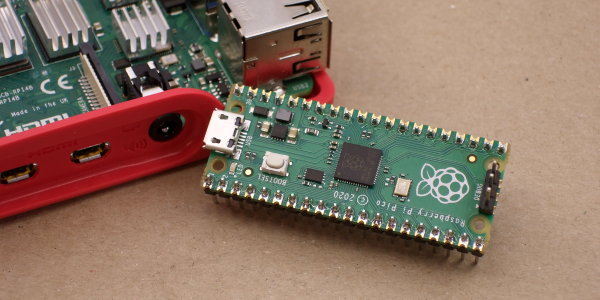
Raspberry Pi was synonymous with single-board Linux computers. No longer. The $4 Raspberry Pi Pico board is their attempt to break into the crowded microcontroller module market.

The microcontroller in question, the RP2040, is also Raspberry Pi’s first foray into custom silicon, and it’s got a dual-core Cortex M0+ with luxurious amounts of SRAM and some very interesting custom I/O peripheral hardware that will likely mean that you never have to bit-bang again. But a bare microcontroller is no fun without a dev board, and the Raspberry Pi Pico adds 2 MB of flash, USB connectivity, and nice power management.

As with the Raspberry Pi Linux machines, the emphasis is on getting you up and running quickly, and there is copious documentation: from “Getting Started” type guides for both the C/C++ and MicroPython SDKs with code examples, to serious datasheets for the Pico and the RP2040 itself, to hardware design notes and KiCAD breakout boards, and even the contents of the on-board Boot ROM. The Pico seems designed to make a friendly introduction to microcontrollers using MicroPython, but there’s enough guidance available for you to go as deep down the rabbit hole as you’d like.

Our quick take: the RP2040 is a very well thought-out microcontroller, with myriad nice design touches throughout, enough power to get most jobs done, and an innovative and very hacker-friendly software-defined hardware I/O peripheral. It’s backed by good documentation and many working examples, and at the end of the day it runs a pair of familiar ARM MO+ CPU cores. If this hits the shelves at the proposed $4 price, we can see it becoming the go-to board for many projects that don’t require wireless connectivity.

But you want more detail, right? Read on.

Continue reading “Raspberry Pi Enters Microcontroller Game With $4 Pico”

Pen Plotter Draws Maps Directly On The Wall

For map-lovers like [Christopher Getschmann], poring over a quality map can be as satisfying as reading a good book. Good maps can be hard to come by, though, especially at a scale worth looking at, or worth using as adornment on a dull, lifeless wall. The solution is obvious: build a wall-mount CNC plotter to draw maps directly on the wall.

[Christopher] began his map quest by scraping world map data from a number of sources, including OpenStreetMap, Natural Earth, and GEBCO. This gave him data for coastlines, terrain, and bathymetry — enough for a map of the world large enough to fill a wall. Since the scale of the map would preclude the use of even a large-format inkjet printer, [Christopher] set about building a wall-covering pen-plotter to render the map. The CoreXY-style plotter is large, but still light enough to hang on the wall while it works, and to be repositioned to cover a larger area.

The plotter runs on steppers driven by ultra-quiet Trinamic TMC5160 drivers, so the plotter wouldn’t be a nuisance while it worked. The map was plotted on eight pieces of cardboard mounted directly to the wall, filling the 2- x 3-meter space almost entirely. Landmasses and elevation contours were plotted as continuous lines in black ink, while bathymetric data was rendered in blue ink as cross-hatching with variable spacing, to make deeper oceans darker blue.

We find [Christopher]’s map breathtaking, all the more so considering the work that went into making it. It would be interesting to find alternate uses for the plotter, which reminds us a little of a cross between a draw-bot and a Maslow vertical CNC router, now that it’s done with its cartographic duties.

Empty Parking Lot

Pandemic Chip Shortages Are Shutting Down Automotive Production

Once upon a time, the automobile was a mostly mechanical beast, but no longer. Advanced electronics have weaved their way into the modern car, from engine to infotainment and climate control to the buttons now sprinkled throughout the passenger cabin. The gains in amenity and efficiency can’t be sniffed at, but it leaves manufacturers reliant on semiconductor suppliers to get cars out the door. Over the past year, it’s become much more complicated — with many automakers having to slow production in the face of integrated circuit shortages that can be traced back to Spring of 2020. Continue reading “Pandemic Chip Shortages Are Shutting Down Automotive Production”

Unknown Quantum Effect Makes Insulator Oscillate

If there are two classes of matter that electronics people can agree on, its conductors and insulators. Electrically, conductors and insulators don’t have much in common. The same has held true in the quantum physics world until some research at Princeton has suggested that quantum oscillation — a phenomenon associated with metals — is taking place in an insulator. Scientists aren’t sure what’s really happening yet, but it may suggest there is a new quantum particle yet to be discovered.

In metals, electrons are very mobile which allows a relatively easy flow of electrical current. However, at low temperatures, a magnetic field can shift electrons to a quantum state causing its resistance to change in an oscillating pattern. Insulators generally do not exhibit this effect.

Researchers made a monolayer of tungsten ditelluride using the same kind of adhesive tape process you see to create graphene. In bulk, the material is a conductor but in a monolayer, tungsten ditelluride is an insulator.

Continue reading “Unknown Quantum Effect Makes Insulator Oscillate”

This Week In Security: Ubiquiti, Nissan, Zyxel, And Dovecot

You may have been one of the many of us who received an email from Ubiquiti this week, recommending a password change. The email stated that there was an unauthorized access of Ubiquiti systems, and while there wasn’t evidence of user data being accessed, there was also not enough evidence to say emphatically that user data was not accessed. Ubiquiti has mentioned that the database that may have been accessed contains a user’s name, email address, hashed password, and optionally the mailing address and phone number.

Depending on how the Ubiquiti authentication system is designed, that hashed password may be enough to log in to someone’s account. In any case, updating your password would invalidate the potentially compromised hash. This event underscores a complaint voiced by Ubiquiti users: Ubiquiti has been making it difficult to administrate hardware without a cloud-enabled account. Continue reading “This Week In Security: Ubiquiti, Nissan, Zyxel, And Dovecot”

3D Printing In Five Axes Makes The World Flat

Just when you thought your 3D printer was hot stuff, along comes a 5D printer. Two doctoral students at Penn State want to add two more axes to get rid of overhangs. This means that instead of supports or breaking objects into pieces, the printer simply orients the print so each region of the part is printing as if it were flat. Of course, 5D printers aren’t really new, even though you don’t hear much about them. However, the paper details a new algorithm that eliminates manually defining print regions and rotations.

You do this all the time manually when you’re setting the print up. For example, if you want to print a letter T, you could print it with supports under the cross pieces or flip it upside down and print it with no support at all. The difference here is the printer can flip the workpiece itself to different angles and can change it on the fly during printing. The printer might print the shaft of the T, rotate it to draw half of the crossbar, then rotate it 180 degrees to print the other half. In all three zones, the print head is depositing materials flat with no overhang. In a simple case like a T that doesn’t really require a special machine or an algorithm, but in the general case, you often can’t just rotate a model to avoid using supports.

Continue reading “3D Printing In Five Axes Makes The World Flat”

South Korea Blankets Country With Free WiFi On All Public Transit

Wrapping up a multi-year project to provide free WiFi on all public transportation, South Korea’s Ministry of Science and Information and Communications Technology (MSIT) announced that a total of 35,006 buses had been equipped nationwide.

Previously, subscriber-based WiFi had been installed on subways and in subway stations. It was provided privately by two phone carriers and free only for their subscribers. The coverage was spotty and slow, and in 2017 the government took over and implemented a better system. With this announcement, the whole public transportation system is now covered with stable and free WiFi.

We also noticed that the government has released the details of the 220,000 WiFi access points to the public. This includes the location, IP address, and RSSI data for use by people and companies wanting to develop location-based services. What is the state of free WiFi access points in your region, and does it extend to public transportation? Do you find it reliable, or do you use your data plan when out and about?